Website Claim Consistency Scanner
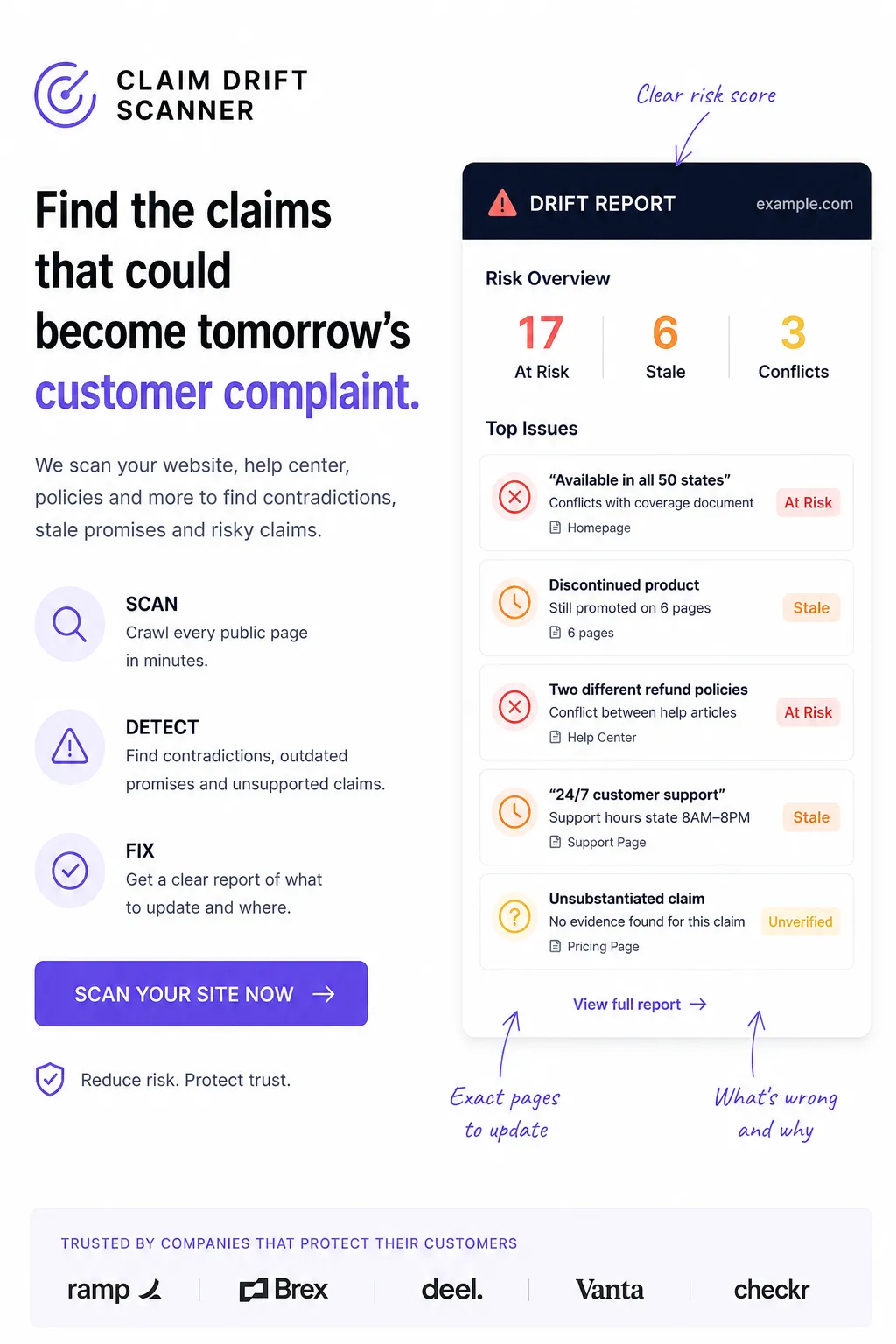
Companies make hundreds of public claims across websites, help centers and policy pages, then forget to update them when the business changes. Claim Drift Scanner crawls those surfaces, extracts factual claims and flags contradictions, stale promises and claims that may no longer be true. Why now: AI makes it cheap to understand and compare thousands of pages continuously, while companies are publishing more content across more surfaces than their teams can manually reconcile. Example: enter a fintech’s URL and the scanner finds that “available in all 50 states” conflicts with its own coverage documentation, a discontinued product is still promoted on six pages, and two help articles describe different policies.
Description
No additional description provided.
The Pitch
Public statements have quietly become operational debt. A company’s website is no longer a brochure; it is a sprawling, semi-legal interface with customers, regulators, partners, support teams, and sales prospects. Every stale sentence is a tiny liability because it can be quoted back to the company by someone with leverage. Most firms already understand code debt and security debt, but claim debt is newer, softer, and often invisible until it creates a refund demand, regulatory headache, lost deal, or customer support escalation.
This is especially interesting because the source of truth inside a company is usually fragmented, while the outside world experiences the company as if it were coherent. Product knows one version of reality, legal another, support another, marketing another. The public site becomes the accidental place where all those versions collide. A tool that reads the company from the outside can reveal contradictions that internal systems miss precisely because it has the same view as a customer, journalist, regulator, or plaintiff.
The business works because the value is not in producing more content, but in creating institutional memory. Companies are good at launching new pages and bad at retiring old promises. The more regulated, complex, or fast-changing the business is, the more likely its public language becomes an archaeological record of past strategies. A scanner that says, “you still promise this thing you stopped doing nine months ago” is not just checking copy; it is recovering forgotten obligations.
There is also a subtle accountability gap this product could own. No single team is clearly responsible for the truthfulness of every public claim, yet many teams suffer when those claims are wrong. That makes the problem persistent: marketing edits pages, legal reviews high-risk language, support patches help articles, product changes functionality, and nobody has a live map of what the company is still saying. The best version of this business becomes the neutral audit layer across all of them.
The most durable insight is that trust often erodes through small inconsistencies rather than major scandals. A customer who sees two policies, two availability claims, or two descriptions of the same product does not need proof of bad faith; confusion is enough to reduce confidence. A company that continuously reconciles its own public truth would feel unusually well-run, and in markets where credibility matters, that discipline itself becomes a competitive advantage.