Wearable Posture Correction Reminder Device
You already know your posture is terrible. The problem is that you forget approximately 14 seconds after remembering. Build a tiny wearable that detects when you've been slouching and gives you a gentle buzz until you straighten up. Track how long you spend in good posture, learn which positions cause problems, and gradually train you to correct yourself without thinking about it. And for the people who have ignored every gentle reminder technology has ever invented, offer an optional setting that makes the reminder considerably harder to ignore.
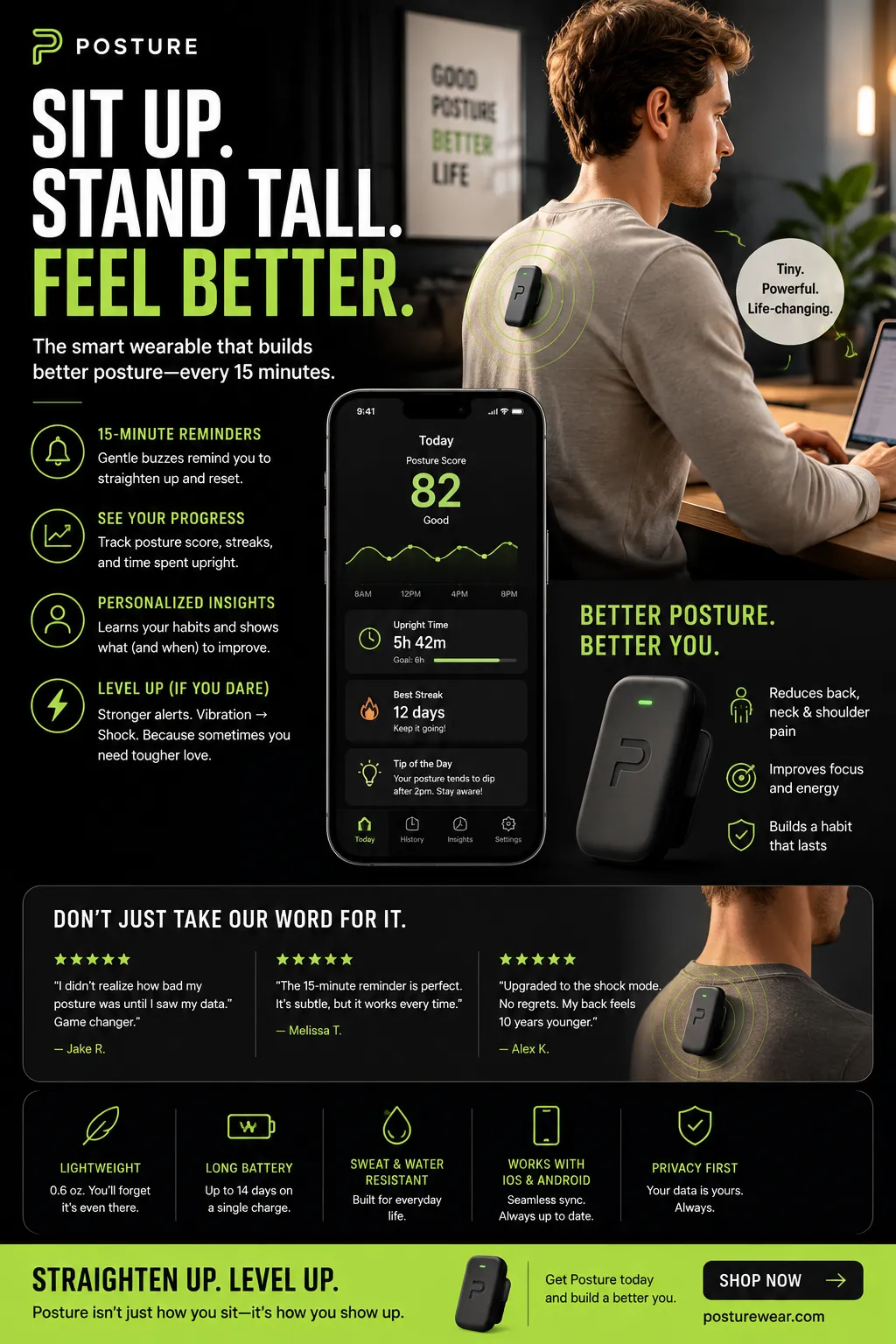
Description
No additional description provided.
The Pitch
A posture wearable is compelling because it sells behavior change at the exact moment behavior is happening. Most wellness products ask people to review yesterday’s data and somehow become different tomorrow. Posture is different: the correction window is measured in seconds. A device that notices the lapse and interrupts it gently turns posture from an abstract health intention into a reflex loop. That immediacy is the product.
The surprisingly large opportunity is that bad posture is not perceived as a medical condition by most people, but it is felt constantly as a low-grade annoyance: neck tension, back stiffness, fatigue, self-consciousness on video calls. It sits in the valuable middle ground between vanity and pain. People may not book physical therapy for it, but they will buy a small device if it promises to make them feel less hunched, look more composed, and end the day with less discomfort.
What makes the product interesting is that it does not need to “solve posture” in a grand clinical sense. It only needs to create awareness often enough that the user begins self-correcting before the buzz arrives. The best version of the business is selling the disappearance of its own intervention: a device that becomes less necessary as it works. That is rare in consumer hardware, where products usually demand more attention over time. Here, success feels like forgetting the product because your body has learned the lesson.
There is also a useful emotional asymmetry in the market. People dislike being scolded by apps, but they tolerate being nudged by objects if the feedback feels private and physical. A quiet buzz under a shirt is more acceptable than a notification that says “sit up straight.” It avoids the shame of public correction while keeping the accountability impossible to rationalize away. The optional harsher mode adds another insight: some customers do not want more kindness from technology; they want a credible external force that defeats their own laziness.
The business works if it becomes the simplest physical reminder for a modern body that spends too much time folded around screens. Chairs, desks, apps, and exercises all require the user to remember. A wearable that remembers for them occupies a small but powerful category: not health tracking, but habit interception.