Voice AI Fraud Detection for Banks
Banks are getting better at detecting suspicious transactions, but they still have almost no way to know when the person authorizing one may be unusually vulnerable. Imagine a fraud system that learns a customer’s normal speech patterns and adds another layer of protection when something meaningfully changes. If an 80-year-old customer suddenly calls to wire $40,000 to a new recipient and their speech has also shifted significantly from their baseline, the bank could require additional verification, contact a trusted person, or slow the transaction down. Voice AI is becoming good enough to detect subtle changes associated with cognitive aging, creating a new signal banks could use alongside transaction data. That’s a product that needs to exist
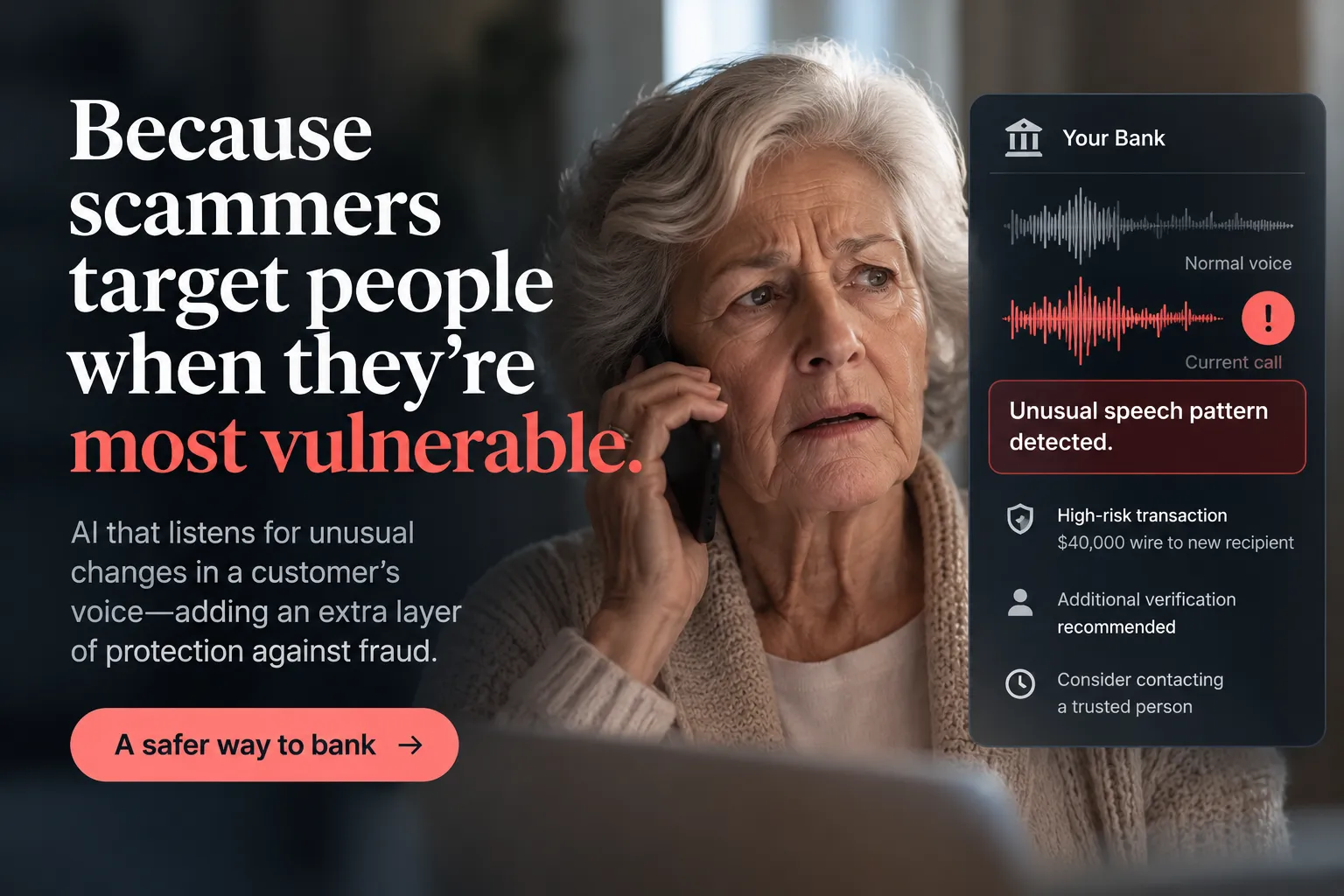
Description
No additional description provided.
The Pitch
Banks sit at the exact point where cognitive vulnerability turns into irreversible financial loss. Families may notice decline too late, doctors may see it episodically, and fraud tools may only see transaction anomalies. A bank, by contrast, sees the moment when impaired judgment is about to move money. That makes it one of the few institutions where detection is not merely informative but immediately actionable.
The important shift is that vulnerability is not the same as fraud. Many damaging transactions are genuinely authorized, which makes them hard for existing systems to stop. A customer may pass security questions, recognize the recipient, and sound confident while still being manipulated or cognitively impaired. A voice-based baseline gives the bank a way to notice risk without needing to prove criminal intent. It turns protection from a binary question of “is this transaction fraudulent?” into a more humane question: “is this customer acting like themselves?”
The business works because the cost of being wrong is already high in both directions. If a bank lets a vulnerable customer lose life savings, the reputational damage is severe even when the bank followed procedure. But if it blocks ordinary transactions too aggressively, it alienates customers and creates operational friction. A customer-specific speech signal is valuable precisely because it can be narrow: not a general diagnosis, not a surveillance tool, but an additional reason to slow down only the transactions that already look consequential.
There is also an unusual trust advantage. People often resist health monitoring when it feels abstract or invasive, but they understand extra caution around large transfers. The product is not asking the customer to become a patient; it is offering a financial seatbelt. That distinction matters, especially for older customers who may fear losing independence. The best version would protect autonomy by making intervention rare, contextual, and tied to money movement rather than constant assessment.
The deeper opportunity is that aging customers are becoming a larger share of bank deposits at the same time that scams are becoming more personalized and psychologically sophisticated. Financial institutions will need tools that understand not just accounts, but moments of impaired consent. A company that can help banks recognize those moments without turning every older customer into a problem would occupy a rare and valuable position: protecting money by detecting changes in the person, not just changes in the transaction.