Verified Scout Network for Emerging Trends
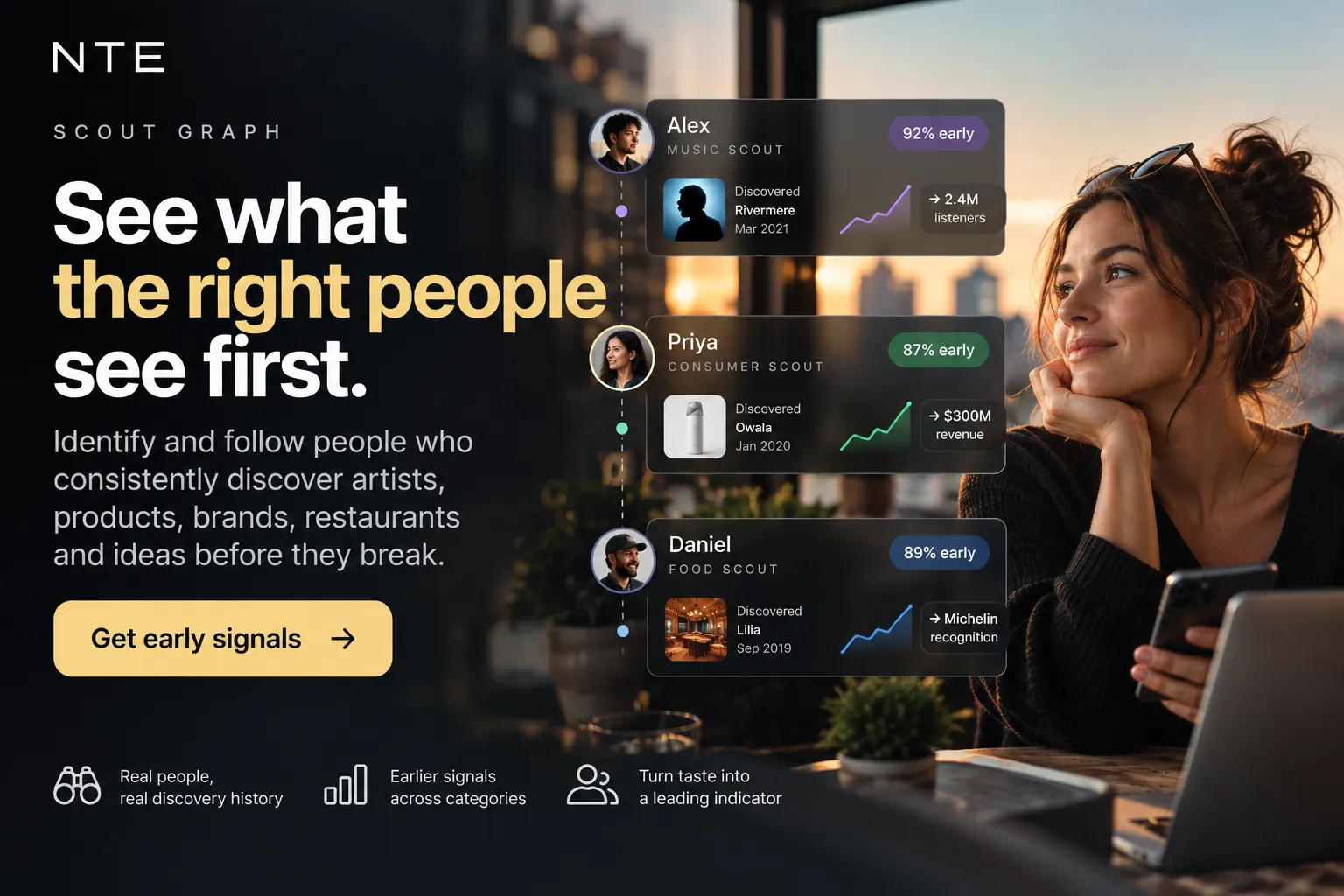
The internet is very good at telling you what is trending once everyone has started paying attention, but surprisingly bad at identifying the people who repeatedly know what will matter before everyone else does. Someone should build a provenance graph that records when people discover artists, products, startups, restaurants, writers, brands, or ideas and measures whose early discoveries consistently become important later. Those people effectively become verified scouts, and their collective activity could become a leading signal for labels, investors, brands, publishers, retailers, or anyone trying to see what is coming next. AI makes it newly practical to track and evaluate millions of historical picks rather than relying on self-proclaimed tastemakers. Imagine 60 people with unusually strong histories of finding consumer brands early independently becoming interested in the same unknown skincare company before search or social-volume data shows anything unusual.
Description
No additional description provided.
The Pitch
Taste is one of the few forms of intelligence that is valuable before it is legible. By the time something is measurable through follower growth, search traffic, sales velocity, or press mentions, the cheapest and most interesting opportunity has often passed. The valuable signal is not popularity itself, but the pattern of attention just before popularity becomes obvious.
The internet flattened access to discovery, but it also made authority noisier. Many people claim to be early; very few have a recoverable record proving it. The compelling shift is turning taste from a personality trait into an auditable history. Once discovery has memory, the person who found ten important things early is no longer merely “cool” or “well connected.” They become a measurable instrument, like a sensor placed closer to the future than conventional data sources.
The deepest value would come from separating influence from foresight. Today, the market often confuses people who make things popular with people who notice them early. Those are different talents. A celebrity posting about a brand may move demand, but that does not mean they understood the underlying shift. A quiet buyer, curator, engineer, stylist, bookstore owner, or niche forum participant who repeatedly spots things before amplification begins may be far more predictive. The business works if it reveals these hidden forecasters before the market knows to listen to them.
It would also change how organizations look for novelty. Most companies do not lack data; they lack trustworthy early filters. Their research teams are often trapped between anecdote and lagging metrics, making decisions either from vibes or dashboards that describe the past. A network of verified scouts could become a new kind of institutional peripheral vision, especially in categories where cultural adoption moves faster than corporate sensing mechanisms.
The most interesting part is that the graph becomes more valuable as time passes. Every prediction ages into evidence. Every miss matters too. Over years, the system could develop a compounding archive of who was early, in what domains, under what conditions, and with which kinds of blind spots. That is hard to copy because the asset is not just data about what became important; it is timestamped context about who recognized importance before it was safe to say so.