Verified Real-World Presence Graph Infrastructure
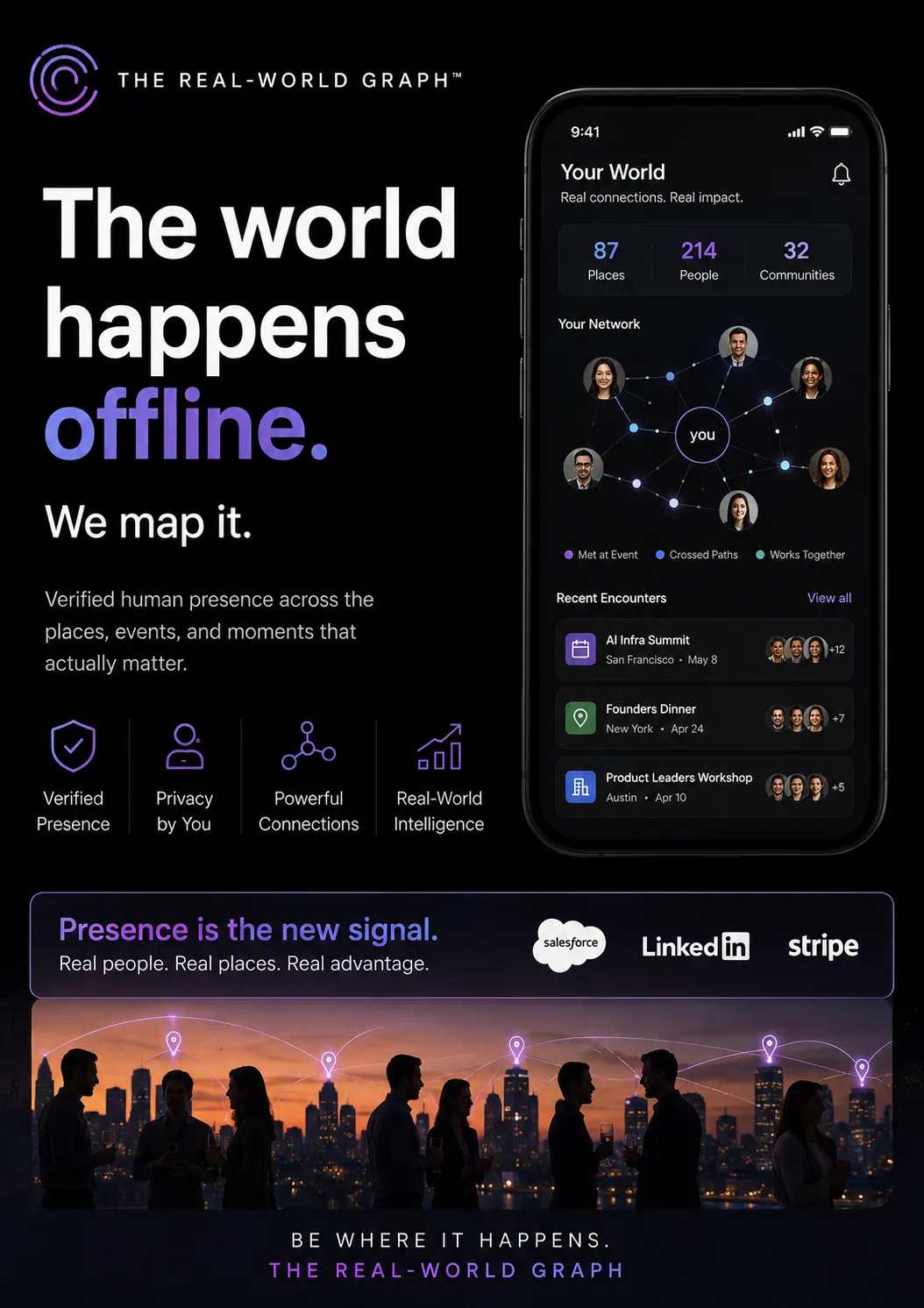
The internet knows who you follow, what you buy, what you click, and where you post, but almost nothing about one of the strongest human signals: who actually spends time together in the real world. The Real-World Graph would be infrastructure for verified physical presence, capturing privacy-controlled encounters across conferences, offices, universities, restaurants, stadiums, clubs, and private gatherings. Apps could build on it: Salesforce could identify accounts engaging offline, LinkedIn could surface people you repeatedly cross paths with, conferences could measure which introductions actually happened, and investors could spot communities forming before they appear online. Phones, NFC, digital wallets, tickets, and identity credentials increasingly make presence verifiable, while AI is making online activity infinitely easier to manufacture. Google mapped places. LinkedIn mapped connections. The Real-World Graph would map where humans actually come together.
Description
No additional description provided.
The Pitch
A business built around verified physical presence would matter because the offline world still produces the highest-signal relationships, while the digital systems of record mostly see shadows. A person liking a post is cheap. A person repeatedly showing up in the same room, at the same table, or at the same small gathering is expensive in time, attention, and intent. The more online behavior becomes automated, optimized, and synthetic, the more valuable the scarce signal becomes: two humans were actually near each other, by choice, in a specific context.
The surprising power of this idea is that presence is not just another data point; it is a missing layer beneath many existing products. CRM systems know emails were sent, calendars know meetings were scheduled, and social networks know connections were declared, but none of them reliably know which relationships are gaining real-world density. The difference between “connected” and “spending time together” is enormous. Many important things happen before they become legible as transactions: a buyer quietly attending three industry dinners, a founder repeatedly appearing around a new technical community, two teams overlapping at the same venues before a partnership is announced.
This could become compelling because real-world co-presence has network effects that are difficult to fake and hard for incumbents to reconstruct retroactively. The value of the graph increases not merely with more users, but with more verified venues, events, credentials, and contexts. A conference organizer’s data becomes more useful when attendees carry persistent presence histories; a professional profile becomes richer when it includes trusted physical overlap; a venue becomes more valuable when it can prove not just foot traffic, but the composition and intersections of that traffic.
The business also sits at an important cultural fault line: people want proof, but not surveillance. That tension is exactly why a neutral presence layer could be valuable if designed around consent, selective disclosure, and contextual permissions. The winning version would not be a panopticon of human movement. It would be closer to a wallet for social proof: letting people and organizations reveal that certain encounters happened without exposing every place they have been.
The deeper thesis is that the internet has over-indexed on declared identity and performative activity, while under-measuring proximity, recurrence, and shared context. Yet human trust has always been built through repeated presence. A company that makes that signal usable without making it creepy would own a primitive the digital economy is strangely missing: evidence that people are not just connected, but actually converging.