Verified Professional Event Attendance Network
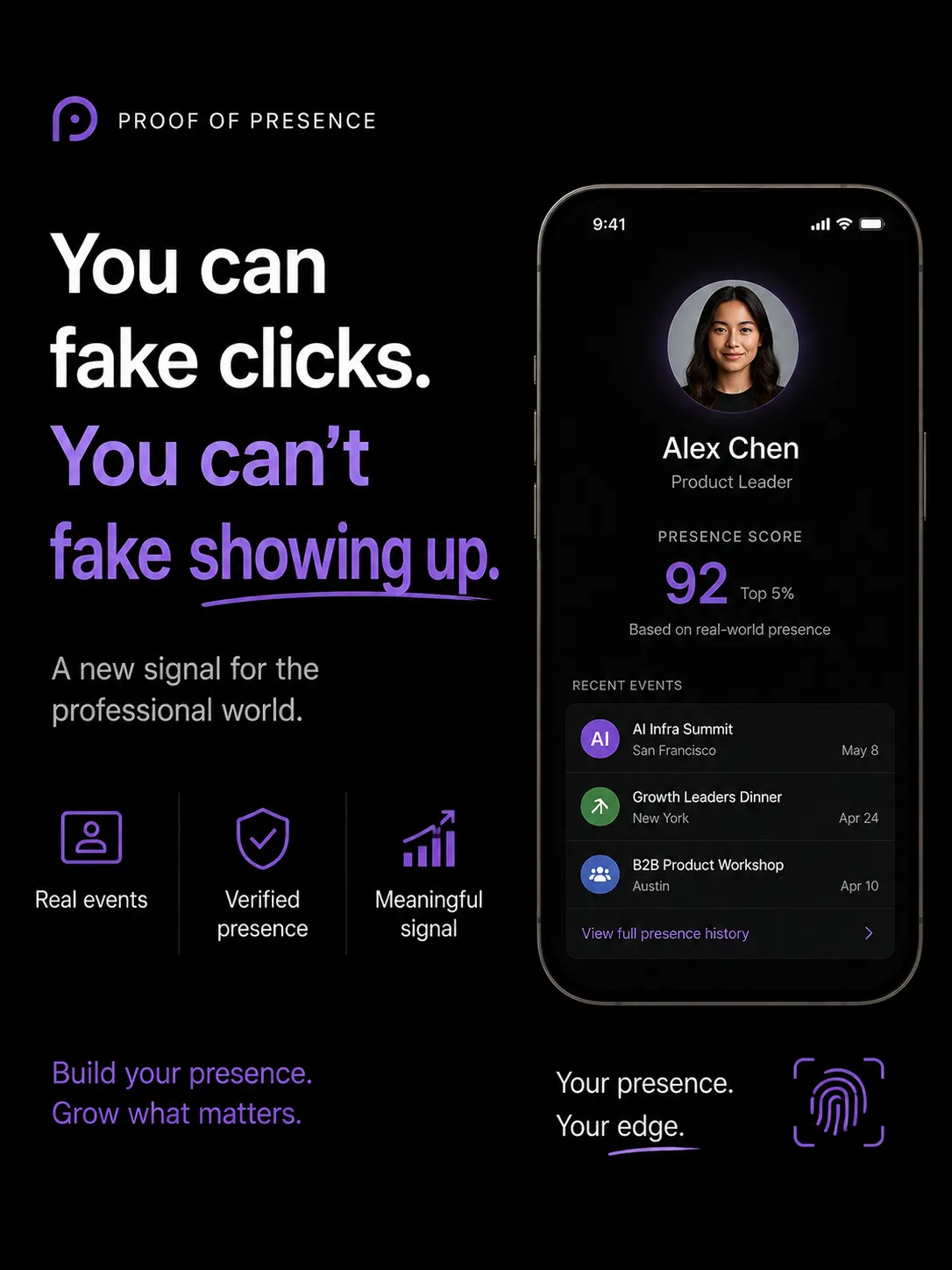
The internet is rapidly making professional signals less trustworthy. AI can write your posts, send your emails, comment on LinkedIn, attend webinars, and eventually interact online almost entirely on your behalf. What remains expensive is actually showing up. Proof of Presence would create a professional identity layer based on the rooms someone has physically chosen to enter — industry dinners, workshops, conferences, customer councils, founder gatherings, and private communities — creating a verified history of interests and participation. Someone who repeatedly attends AI infrastructure gatherings tells you something far more meaningful than someone who follows 50 AI accounts. LinkedIn built the professional graph around who you know. The next one could be built around where you showed up.
Description
No additional description provided.
The Pitch
Physical presence is becoming one of the few professional signals that is still costly in the right way. Online expression used to carry effort: writing a thoughtful post, maintaining a network, joining a niche conversation. AI compresses that effort toward zero. But travel, time, awkward conversations, and repeated attendance still reveal preference. The valuable signal is not that someone claims to care about a field; it is that they keep spending scarce evenings, calendar space, and social energy inside it.
The interesting shift is that presence is a more honest graph than connection. Professional networks are polluted by politeness, growth tactics, and dormant relationships. Event history is harder to fake and more temporally precise. Two people who both attended the same three specialized workshops in six months may have more in common than two people who have been connected online for a decade. A record of rooms entered creates a map of professional intent, not just professional affiliation.
It also turns fragmented offline activity into durable reputation. Today, much of the most important professional discovery happens in rooms that disappear when the name badges are thrown away. The dinner organizer knows who came. The conference app knows who checked in. The community host knows who keeps returning. But that information usually remains trapped, temporary, and invisible to the broader market. A shared identity layer could make offline participation compound, so that showing up once is an event, but showing up repeatedly becomes a credential.
The business works because the most valuable professional contexts are already gated by trust, but their trust systems are primitive. Hosts want better ways to know who belongs in a room. Attendees want credit for being serious before they are famous. Recruiters, founders, sellers, investors, and community builders all care less about a person’s polished profile than about whether they are genuinely embedded in a domain. Verified presence becomes useful precisely because it is not a résumé line someone wrote about themselves.
The larger idea is that professional identity may move from self-description to behavioral evidence. The last era rewarded people who were good at broadcasting. The next may reward people whose movements reveal taste, commitment, and proximity to important conversations. If the internet fills with synthetic activity, the scarce asset will not be another place to post. It will be a trustworthy memory of where real people actually were.