Verified B2B Vendor Performance Records
Become the verification layer for B2B outcomes. Vendors publish verified performance records generated from standardized measurement rather than self-authored case studies. Buyers can ask, “What has this product actually achieved for companies like mine?” and get comparable evidence across vendors. Why now: customer proof is already central to B2B purchasing, but it remains fragmented across testimonials, references, ROI studies and analyst validation, with no standard data layer underneath it. Example: instead of Vendor A saying it reduces processing time 40% and Vendor B saying it improves productivity 60%, a buyer sees verified distributions across hundreds of deployments using the same definitions.
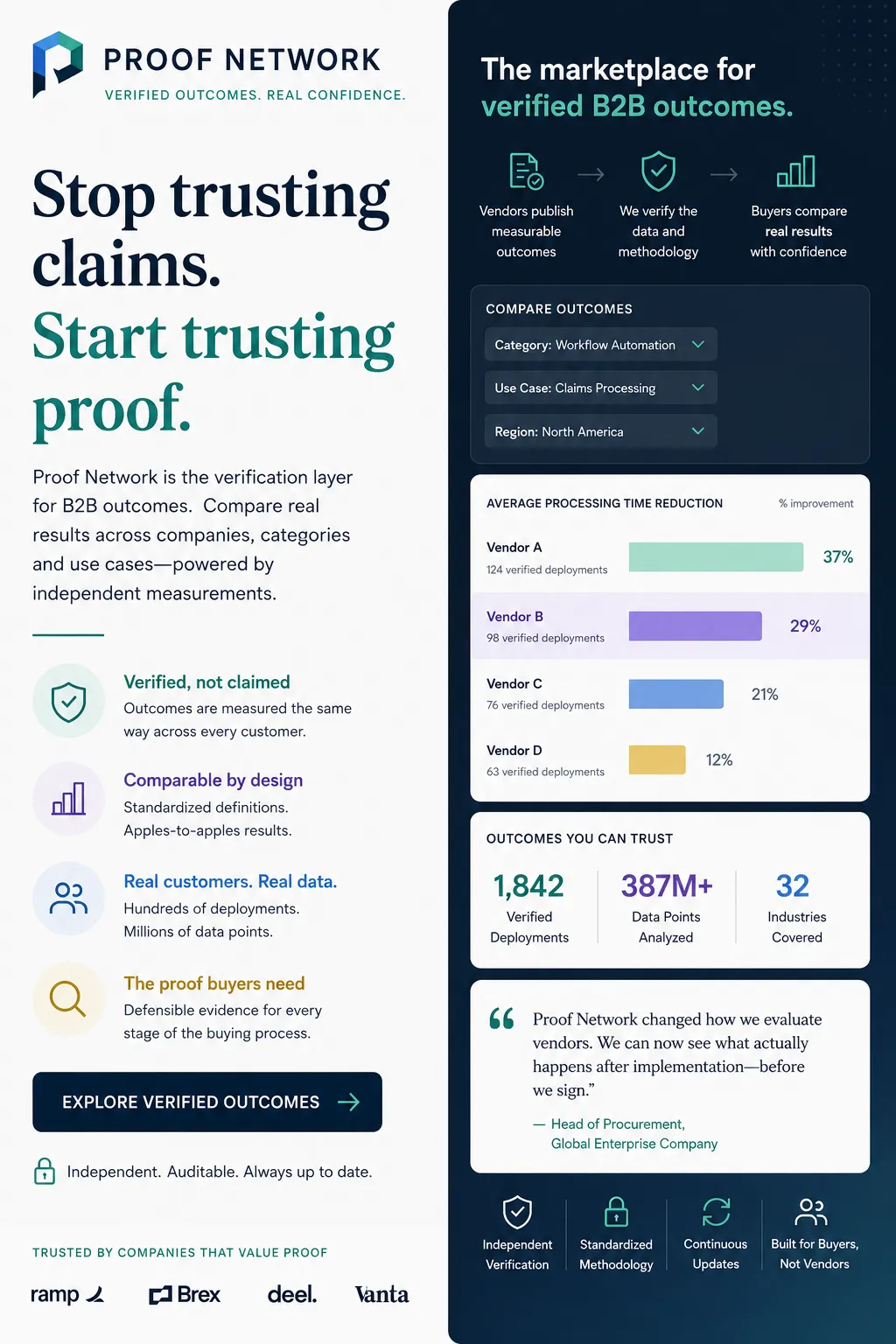
Description
No additional description provided.
The Pitch
B2B software has quietly become a market of unverifiable claims. Buyers do not lack information; they lack information they can trust across options. Every vendor can produce a glowing customer quote, a selective ROI study, or a reference from an unusually successful deployment. The result is that proof, the most valuable asset in the sales process, is still packaged as marketing. A company that turns outcomes into comparable records would not be adding more content to the buying journey; it would change what counts as evidence.
The deeper opportunity is that performance data has more value when it is standardized than when it is private. A single customer result helps close one deal. A normalized corpus of results across industries, company sizes, use cases, implementation models, and time periods becomes market infrastructure. Once enough vendors and buyers rely on the same definitions, the business starts to resemble a credit bureau for software performance: not because it judges every product with a single score, but because it makes previously anecdotal risk legible.
This also shifts power in a subtle way. Today, the best buyers run their own informal diligence networks: backchannels, peer calls, consultants, spreadsheet models, and long reference processes. Smaller or less sophisticated buyers often cannot do that, so they overpay for brand, analyst placement, or confident storytelling. Verified outcome records would compress a kind of institutional knowledge that is currently available only to companies with the time and leverage to extract it. That makes the product valuable not because it replaces judgment, but because it gives more buyers the raw material for better judgment.
For vendors, the strongest pull is not compliance or reputation; it is differentiation in crowded categories where feature lists have converged. If every competitor can claim automation, AI, workflow efficiency, or revenue impact, then the vendor with believable outcome distributions has a different kind of advantage. The best companies would want the market to become more empirical because empirical markets reward actual performance over narrative skill. Over time, refusing verification could become its own negative signal.
The most interesting version of this business would become more useful as more parties scrutinize it. Buyers would demand cleaner evidence, vendors would compete on measured results, and the verification layer would accumulate the context needed to interpret outcomes rather than merely display them. In a world where software is easier to buy but harder to trust, the scarce asset is not another recommendation engine. It is a shared memory of what actually happened after purchase.