Verification Layer for AI-Generated Code Changes
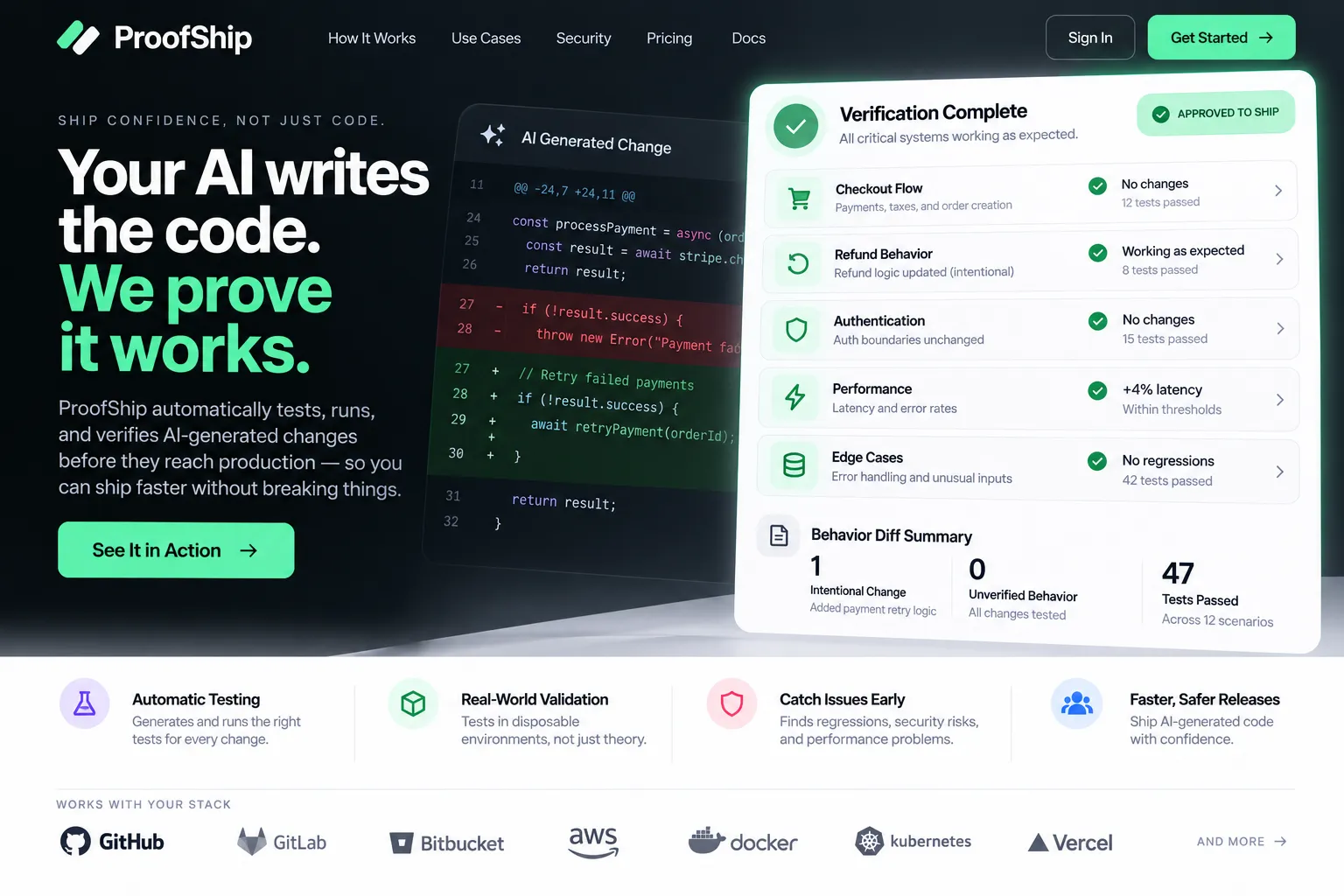
AI can now generate software faster than humans can realistically review it, which means traditional code review is becoming the bottleneck and eventually stops being a reliable safety mechanism. Build a verification layer that evaluates every AI-generated change by proving what behavior changed, automatically generating tests, running the software in disposable environments, comparing before-and-after outcomes, and producing a compact evidence package humans can approve instead of reading thousands of lines of code. This matters now because software teams are moving toward a world where agents write most of the implementation while people increasingly supervise outcomes rather than source code. Imagine an AI agent rewriting checkout and the system proving that payments, refunds, authentication, latency, and edge cases still behave correctly before the change is allowed to ship.
Description
No additional description provided.
The Pitch
The unit of trust in software is shifting. For decades, teams trusted code because a human had read it, understood it, and signed off. That model breaks when code becomes abundant and attention becomes scarce. The valuable layer is no longer another tool that writes more software; it is the system that can say, with evidence, what the new software actually does differently.
The non-obvious opportunity is that AI-generated code makes verification more valuable precisely because generation is becoming cheap. When implementation costs fall, the cost of mistakes becomes the dominant constraint. A team may be willing to let agents produce enormous amounts of code, but only if there is a dependable way to bound the risk of each change. In that world, the scarce asset is not engineering throughput but confidence. The company that owns confidence sits in the approval path for every meaningful change.
This also reframes code review from a craft activity into an evidence problem. Humans are often poor judges of large diffs, especially in unfamiliar systems, but they are good at evaluating claims: this endpoint still returns the same contract, this permission boundary was not widened, this refund path still reconciles correctly. A verification layer that translates code changes into behavioral evidence would make reviewers more powerful instead of merely faster. It would preserve human judgment while removing the parts of review that humans were never especially good at.
The strongest version of this business becomes more defensible as it sees more systems. Every codebase has its own hidden assumptions, brittle integrations, and business-critical invariants that are not fully written down. A product that repeatedly observes changes, tests, failures, approvals, and production outcomes can learn what each organization actually cares about. Over time, it becomes less like a generic testing tool and more like an institutional memory of software behavior.
The timing is compelling because AI coding adoption creates a new kind of asymmetry: companies can create changes at machine speed but still absorb incidents at human speed. That gap will force organizations to install a gate between generation and production. If agents become the factory, verification becomes the quality-control system. And in software, the quality-control system may become more important than the factory, because anyone can generate code, but not everyone can know whether it is safe.