Verifiable Experience Credential Platform
The internet can increasingly prove you're human, but it still can't prove you've actually experienced the thing you're talking about. Experience Passport would create a private, portable record of verifiable experiences that people can selectively reveal without exposing their identity: owned three Teslas, stayed at 14 Marriott properties, used Fidelity for 11 years, completed 200 Peloton rides. As AI makes generating convincing reviews, recommendations and opinions nearly free, firsthand experience becomes scarce. A Reddit comment could suddenly carry something far more useful than a blue check: Verified: Fidelity customer since 2015. The next trust layer of the internet may be proof not of who you are, but of what you've actually done.
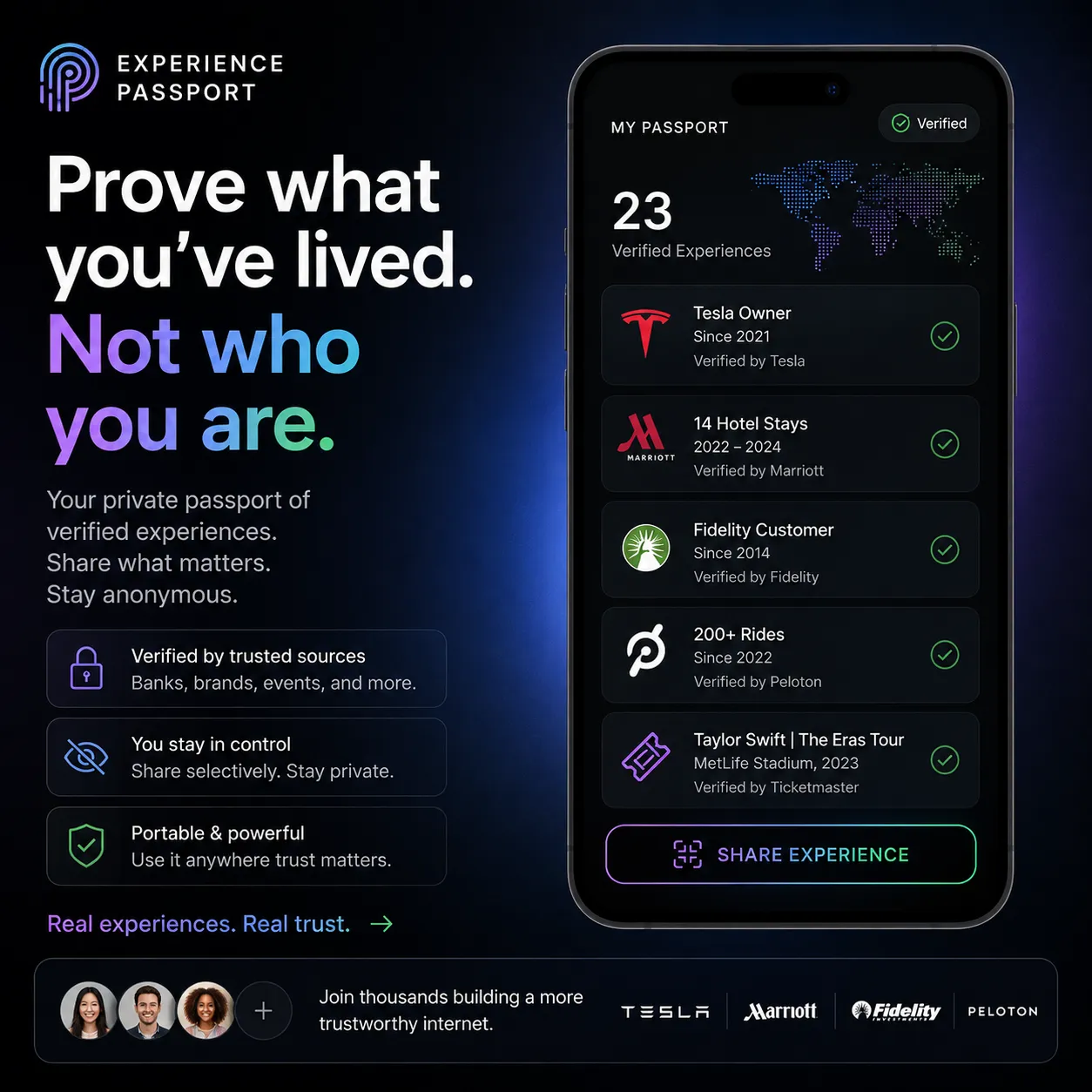
Description
No additional description provided.
The Pitch
The internet’s trust problem is moving from identity to provenance. Knowing that a real person wrote something is becoming less useful than knowing whether that person has standing to say it. A verified human who has never used a product can still produce a persuasive opinion; an anonymous person who can prove ten years of usage may be far more valuable. The status marker changes from “I am someone” to “I have been there.”
The most interesting part is that the data already exists, but it is trapped in corporate silos where it mostly serves the company, not the customer. Airlines, banks, gyms, hotels, retailers, brokerages, automakers, and apps all know what a person has actually done. But the user cannot easily carry that history into public discourse, marketplaces, communities, or decision-making contexts. Turning experience into a user-controlled credential makes accumulated life with services portable, the way a résumé made work history portable.
This could also change the economics of reviews and recommendations. Today, platforms treat all text as the primary asset and then fight endlessly over whether that text is fake, paid, biased, or automated. But if experience becomes attestable, the valuable layer is no longer the review itself; it is the verified context around the reviewer. “Three-year owner,” “visited twice,” “cancelled after six months,” or “used across two recessions” may matter more than the paragraph attached to it.
The privacy angle is not a side benefit; it is what makes the category possible. Many of the most useful proofs are things people would never want to disclose under their real names: medical history, financial relationships, purchases, travel patterns, employment tools, fertility apps, political donations, dating platforms. A system that can prove relevance without revealing identity lets people contribute hard-won knowledge in places where full disclosure would be socially or professionally costly.
The deeper business is not verification for bragging rights, but a market for credibility in a world flooded with fluent imitation. As synthetic content gets cheaper, the premium shifts to evidence of contact with reality. The internet has spent decades rewarding people who sound knowledgeable. The next version may reward people who can prove they were actually in the room.