User-Owned AI Context Vault
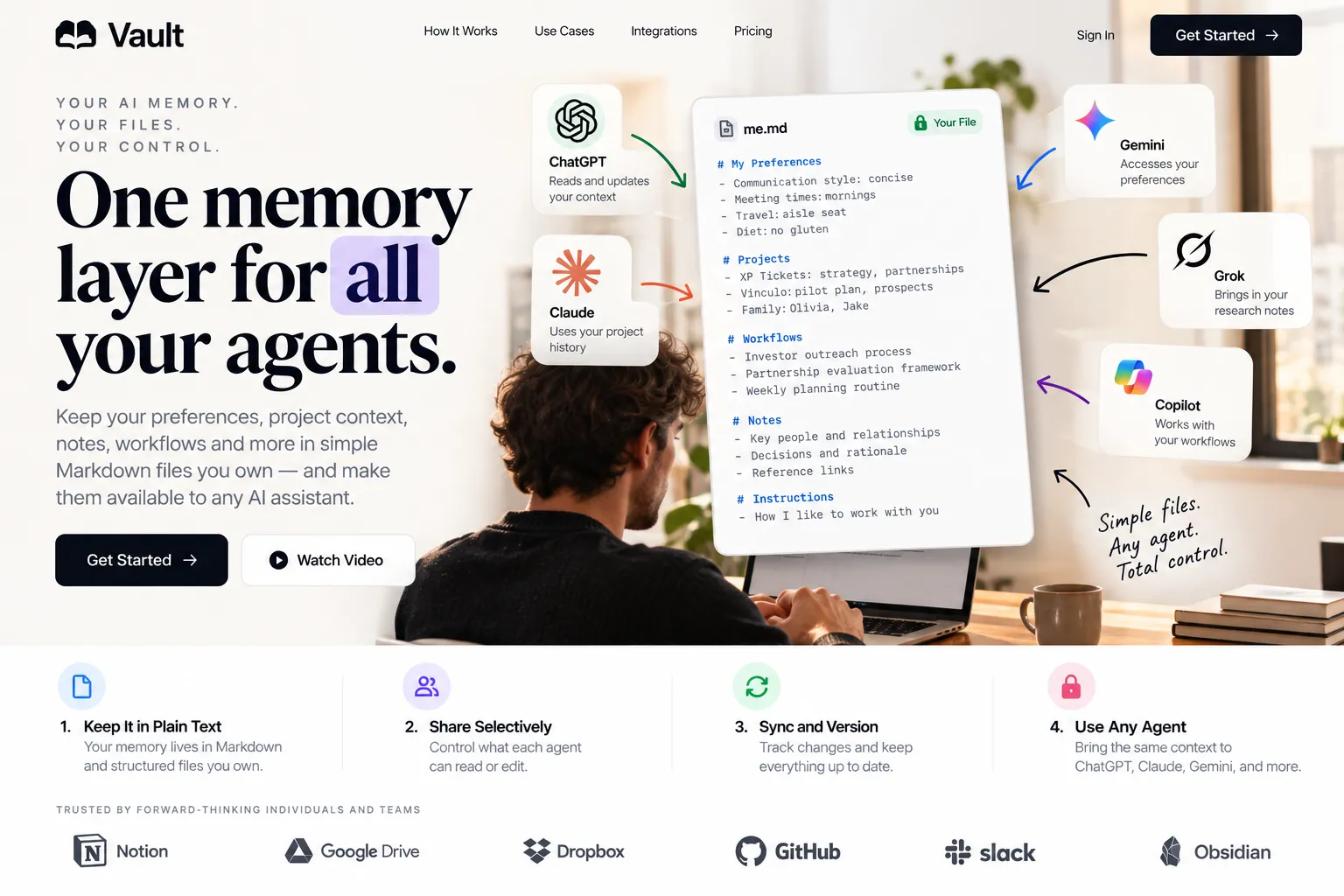
Your AI agents are beginning to accumulate preferences, memories, project context, relationship notes, and instructions, but most of that knowledge is trapped inside whichever product collected it. Build a user-owned AI context vault where the canonical version of everything your agents know about you lives in simple Markdown and structured text files that any authorized assistant can read or update. The platform handles permissions, version history, conflict resolution, and selective sharing while keeping the underlying data portable and inspectable. This matters now because Markdown is becoming a first-class format across productivity tools while more people use multiple AI assistants that need access to the same persistent context. Imagine switching from one agent to another and instantly bringing years of preferences, decisions, project history, and workflows with you because the memory was never owned by the agent in the first place.
Description
No additional description provided.
The Pitch
AI memory is likely to become more valuable than any single AI interface. Today, people treat chat history as exhaust, but over time it becomes a map of how they think, work, decide, write, buy, delegate, and relate to others. The assistant that holds this context gets better, but the user becomes dependent on it in a way that feels less like software loyalty and more like being unable to leave a doctor because they are the only one with your medical records.
A business built around user-owned context benefits from a rare inversion: the more fragmented the AI market becomes, the more valuable the neutral layer becomes. If one assistant won everything, memory could remain vertically integrated. But the world is moving the other way. People already use different models and agents for writing, coding, research, scheduling, customer support, and internal work. In that environment, the durable asset is not the agent; it is the continuity between agents. The company that stores and governs that continuity could become the quiet infrastructure beneath many visible AI products.
The choice of plain, inspectable files matters because trust is not just about security; it is about legibility. People may not want to understand a database schema or proprietary memory graph, but they can open a folder and read “writing-preferences.md” or “family-context.md.” That changes the emotional contract. The product is not asking users to believe that their digital self is safely hidden somewhere. It lets them see, edit, delete, copy, and reason about it. In a category defined by uncanny personalization, boring transparency becomes a premium feature.
The strongest business pressure may come from the enterprise side, where AI context will collide with compliance, turnover, and institutional memory. Companies will not want critical operating knowledge scattered across employee-specific assistants or trapped inside vendor-specific memory systems. A portable context layer could make AI useful without making every department dependent on an opaque archive owned by a model provider. The same logic that made identity, document storage, and password management separate categories could apply to AI memory: the more sensitive and reusable the asset, the less sense it makes for it to live inside the application using it.
What makes this especially interesting is that it is both deeply personal and highly infrastructural. For individuals, it preserves continuity of self across tools. For organizations, it preserves continuity of work across people and vendors. The company would not be selling another assistant. It would be selling the right to have assistants without surrendering the accumulated knowledge that makes them useful.