Used Car Inventory Routing Software
Used cars don’t have one true price anymore—the same vehicle can be worth hundreds or even thousands more depending on the ZIP code, local demand, competition, and how quickly it is likely to sell. Build software that scans every VIN across a dealer group, predicts its retail value and days-to-sale in surrounding markets, subtracts transport and reconditioning costs, and recommends where that car should physically sit to maximize profit. This matters now because dealerships increasingly have enough pricing, inventory, and logistics data to treat cars like dynamically routed assets instead of fixed inventory. Imagine a dealer discovering that a truck sitting in Pittsburgh would earn $1,300 more and sell 12 days faster in Columbus, then moving it there with one click.
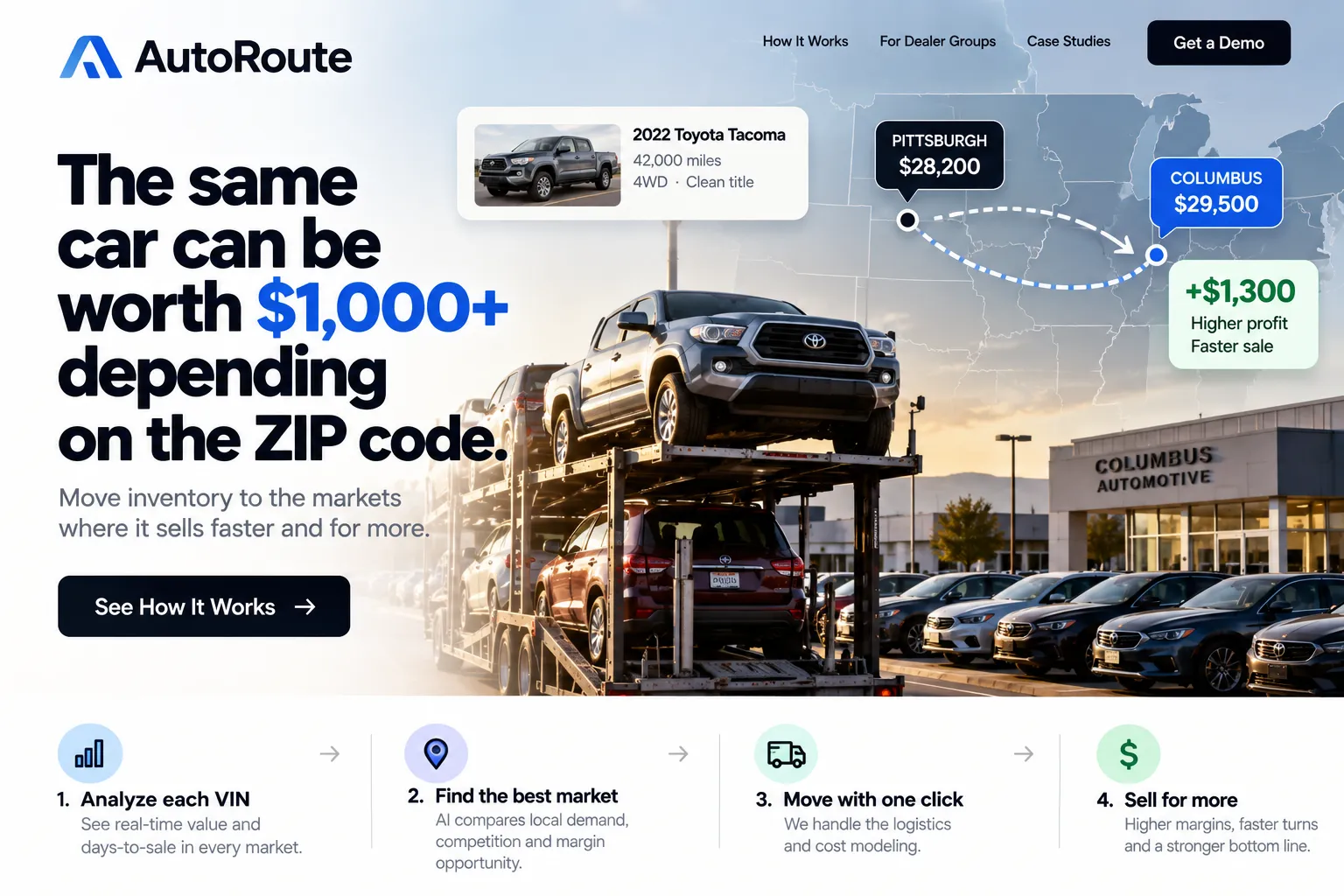
Description
No additional description provided.
The Pitch
A dealer group’s profit is often trapped in geography, not negotiation. Two stores under the same ownership can look like separate businesses to customers, but economically they are nodes in one inventory network. A car that is stale, discounted, and tying up floorplan expense in one city may be fresh inventory in another. The business exists in the gap between how dealers are organized operationally and how demand actually moves across regions.
Used cars are unusually suited to this kind of optimization because every unit is both standardized and idiosyncratic. A VIN carries enough structured information to compare it across markets, but condition, mileage, trim, color, and local taste make its value highly situational. That combination creates persistent mispricing. Unlike new cars, supply cannot be ordered cleanly from a factory to match demand; the inventory is whatever the trade-in lane, auction, and acquisition teams happen to produce. Better allocation therefore becomes a direct substitute for better sourcing.
The hidden cost this attacks is time. Dealers tend to see gross profit per vehicle, but the better metric is profit per day of ownership. A car that sells for slightly more after sitting 70 days may be worse than one that sells quickly at a lower headline margin, because aging inventory consumes capital, attention, lot space, and eventually forces markdowns. The strongest version of this business would not merely say where a car is worth more; it would understand when moving the car changes the entire economic life of that unit.
It is also compelling because the decision is small enough to be frequent and large enough to matter. Moving one vehicle for an extra few hundred dollars may not sound transformative, but a dealer group turns thousands of units a year, and the same mistake repeats constantly. The software would sit at the intersection of many low-drama decisions that currently rely on instinct, local habit, or whoever complains loudest about inventory shortages.
Most importantly, this turns multi-location ownership into a structural advantage. A single rooftop can only price to its immediate market. A group with many stores can arbitrage differences in demand, but only if it can see inventory as fluid rather than local. If the industry keeps consolidating, the winners will not simply be the groups with the most cars; they will be the groups that know the best place for each car to live.