Trust Measurement Platform for AI Advertising
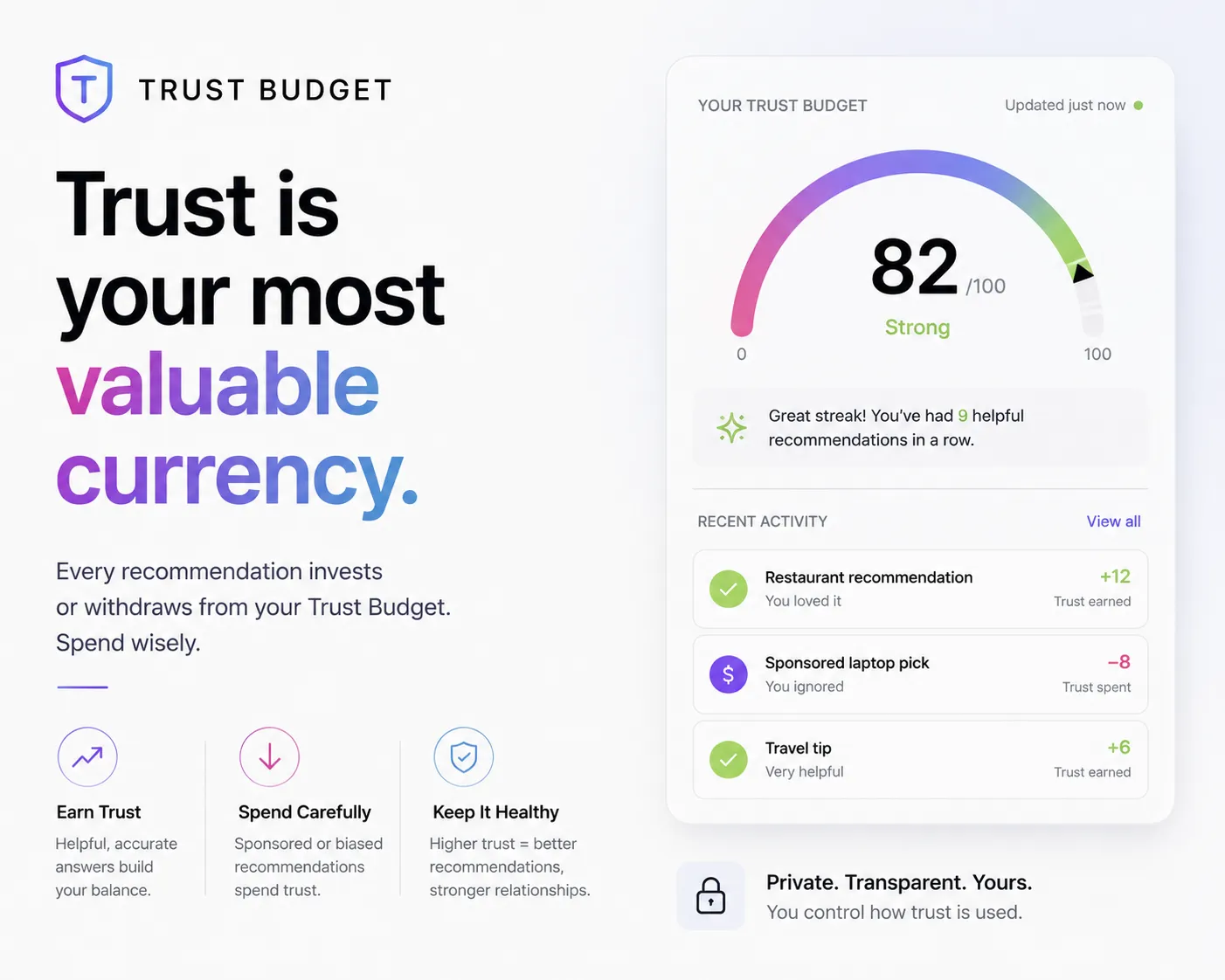
AI companies may eventually discover that trust behaves more like capital than sentiment. Every useful recommendation deposits a little trust; every sponsored or commercially influenced recommendation risks withdrawing some. Trust Budget would quantify that balance by measuring how commercial interventions change acceptance, verification, abandonment and future reliance on an assistant. Before inserting a sponsored recommendation, an AI platform could estimate not only the revenue it might generate but the trust it is likely to consume. Advertising would finally have a cost that doesn't appear on today's income statement.
Description
No additional description provided.
The Pitch
A business like this becomes compelling because AI assistants are not web pages with ad slots; they are delegated decision systems. Once a user asks an assistant to choose, compare, book, buy, summarize, diagnose, or recommend, the commercial layer is no longer adjacent to the experience. It sits inside the act of judgment. That makes trust depletion harder to detect and more expensive to repair than in search or social, where users already expect a certain amount of persuasion. The more useful assistants become, the more valuable and fragile their neutrality becomes.
The deepest opportunity is that platforms will need a new internal accounting system for something they previously treated as brand residue. Today, a commercial team can measure revenue from an insertion with precision, while the cost to user confidence appears later as lower retention, extra verification, reduced automation, or a subtle unwillingness to delegate consequential tasks. A company that makes those effects legible would change the argument inside AI companies. It would let product, revenue, and safety teams discuss the same tradeoff in the same units, instead of fighting through anecdotes.
This also creates a rare measurement problem where the buyer cannot easily build a neutral answer alone. If an assistant marks its own homework, commercial pressure will bias the interpretation. The market will likely reward an independent system that can become a shared reference point across platforms, advertisers, regulators, and enterprise customers. In the same way credit ratings, app measurement, and security audits became useful because trust required an outside vocabulary, AI commerce may need a third-party grammar for when persuasion crosses into degradation.
The timing matters because monetization will arrive before the norms are settled. The first generation of AI ad products will be shaped by whoever can answer a deceptively simple question: not “did the ad convert?” but “what did the recommendation teach the user about the assistant?” If users learn that the assistant is occasionally steering them, they may not leave immediately; they may do something worse for the platform and advertisers alike, which is to keep using it while trusting it less.
The striking possibility is that the best advertising infrastructure for AI may be one that limits advertising. That sounds commercially awkward, but it is precisely why it could be valuable. A system that knows when not to monetize preserves the surface area where monetization can endure. In AI, restraint may become a revenue technology.