Travel Pickup Network for Regional Products
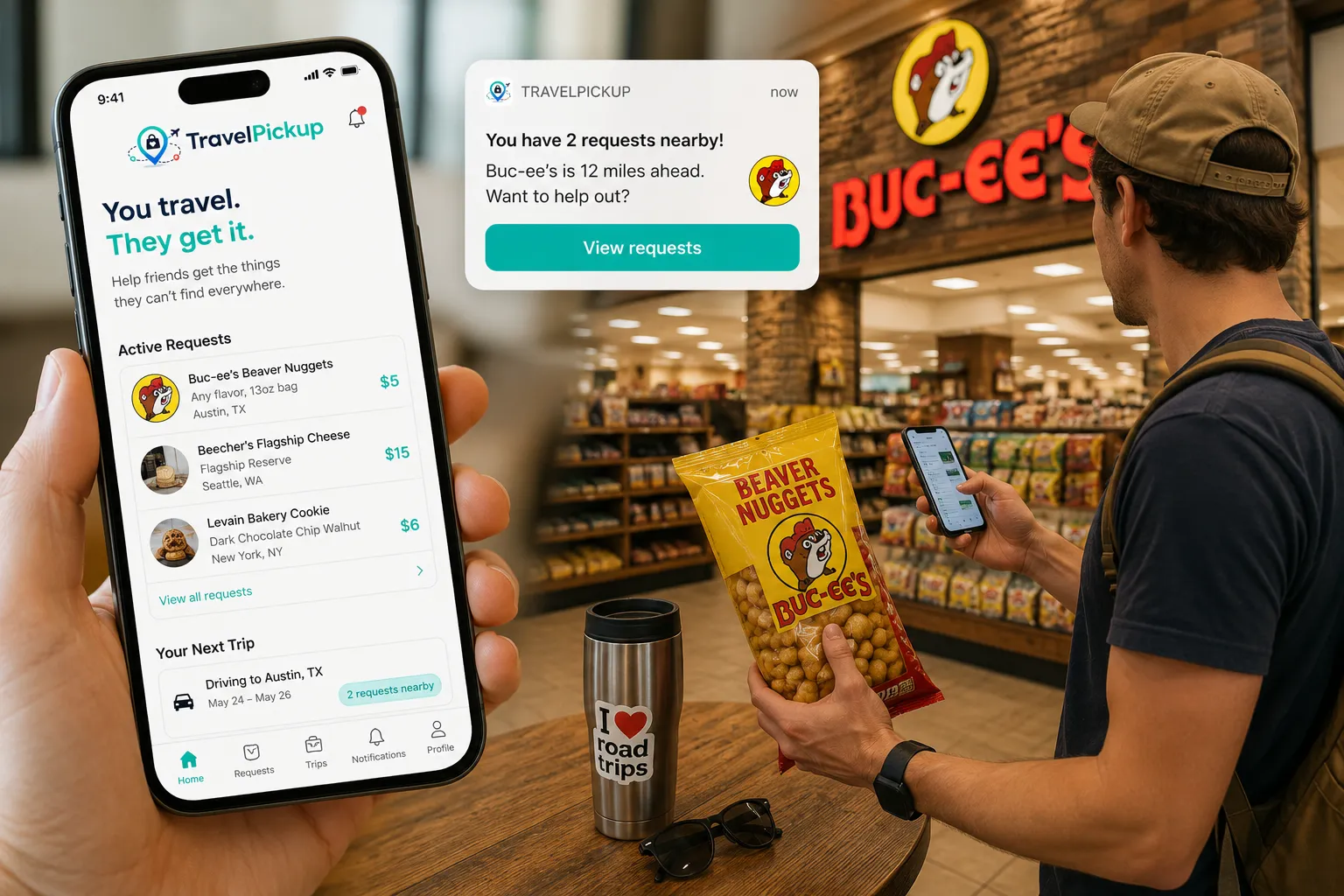
Regional stores, local specialties, and destination-only products create constant missed opportunities because friends rarely know when someone they know is traveling nearby. Whether it's Buc-ee's snacks, Costco items, a favorite cheese shop, or a local bakery, coordinating these pickups usually depends on remembering to text the right people at the right time. A Travel Pickup Network automates that process by letting users create standing requests tied to specific stores, cities, or regions. Whenever someone in their network is traveling nearby, they receive a notification asking if they'd like to pick up the requested item, with payment and optional tipping handled automatically. As location sharing, travel planning apps, and digital payments have become commonplace, the infrastructure now exists to make these passive matches happen without requiring any extra planning. For example, you create a standing request for cheese from a small shop in Quebec, and six months later a friend driving through the area receives a notification asking if they'd like to grab your usual order while they're already there.
Description
No additional description provided.
The Pitch
This turns travel into a latent distribution network without asking anyone to become a courier. Most delivery businesses fail when they try to manufacture supply: drivers, routes, warehouses, cold chains, and utilization problems. Here, the “route” already exists. The marginal cost is a small detour inside a trip that was happening anyway, and the social relationship makes the errand feel more like thoughtfulness than labor.
The strongest demand is not for generic convenience but for items whose value is tied to place. A snack from a road-trip stop, a bakery item from a hometown, a regional grocery brand, or a shop that refuses to ship are all worth more because they are not universally available. Scarcity here is not artificial; it is geographic. The business would not be competing with Amazon on speed or selection, but capturing the long tail of things that become emotionally or culturally valuable precisely because they are hard to get.
The non-obvious behavior is that people already do this, but only when memory and coincidence align. The real product is not delivery; it is remembering on everyone’s behalf. A standing request changes the burden from “I need to know who is going where” to “the system will notice when the right person is nearby.” That shift matters because most missed pickups are not caused by unwillingness. They are caused by the awkwardness and timing friction of asking at the right moment.
Trust also works differently here than in anonymous marketplaces. People are often uncomfortable paying strangers to buy personal or perishable goods, but comfortable asking a friend to bring back something specific. The social graph narrows supply, but increases reliability, generosity, and acceptance of informal exceptions. It also makes small transactions viable: a $14 pastry box or a $9 jar of sauce is too trivial for a logistics company, but perfectly natural as a favor with reimbursement.
If it worked, the company would reveal a new category between commerce and social utility: not shopping, not shipping, but opportunistic access. The world is full of desirable products trapped in local pockets, while millions of people constantly move through those pockets with unused carrying capacity. A business that quietly connects those two facts could make the physical world feel searchable in a way it currently does not.