Transaction Asset Measurement Platform
Every company knows what it made on the last transaction. Almost nobody measures what that transaction made possible next. That matters because low-margin businesses can work incredibly well when each sale leaves behind something valuable, like a recurring customer, supplier relationship, data, balance or distribution advantage. Carryforward plugs into a company’s payments, CRM and product data to identify what survives each transaction, measure its future value and show where growth is creating volume without creating an asset. As AI makes it easier to launch new products, marketplaces and transaction layers, companies will generate more revenue streams without knowing which ones actually strengthen the business. A travel marketplace might discover customers rarely repeat, but the same 400 advisors drive thousands of bookings, so Carryforward tells it to build around the advisor relationship instead of optimizing consumer retention.
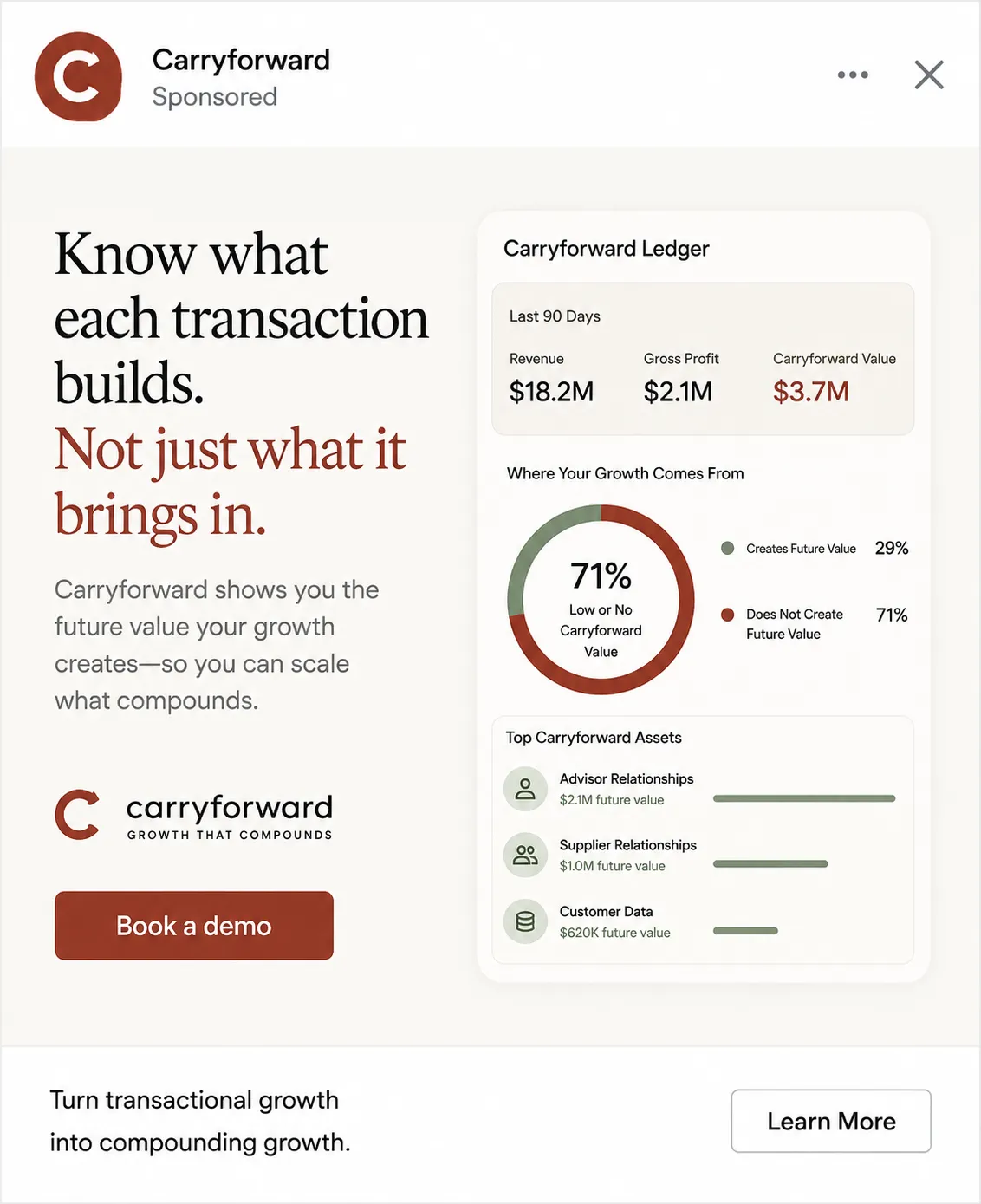
Description
No additional description provided.
The Pitch
A quiet accounting failure: companies treat revenue as an endpoint when it is often a byproduct of asset creation. Two transactions with identical margins can be radically different businesses if one produces a repeat buyer, better underwriting data, cheaper supply, or embedded distribution, while the other merely consumes attention and leaves nothing behind. The valuable insight is that “quality of revenue” is not a finance concept; it is an operating system for deciding what the company should become.
This would matter most in businesses where the surface economics are misleading. Marketplaces, vertical software, fintech products, agencies, commerce businesses, and AI-generated service layers often look messy because value accumulates somewhere other than the invoice. A transaction may appear unattractive until you realize it reliably recruits supply, teaches a model, lowers future acquisition costs, or creates proprietary workflow position. Conversely, a fast-growing line may be quietly hollow if every sale has to be re-earned from scratch. The company that can distinguish compounding revenue from disposable revenue gets to see the business beneath the business.
The most interesting wedge is that the answer cannot be found in any one existing system. Payments know money moved. CRM knows who touched whom. Product analytics knows what happened. None of them know what endured. That missing layer is becoming more valuable because modern companies increasingly operate as bundles of micro-businesses: subscriptions mixed with usage, services mixed with software, marketplaces mixed with managed operations. The old question, “Which segment is profitable?” is too crude. The sharper question is, “Which activity leaves us with something we can use again?”
If this existed, it could change managerial taste. Teams would stop worshiping gross revenue and start favoring transactions that improve the next transaction. That is a subtle but powerful shift: it rewards durability over velocity, learning over volume, and relationship density over one-off conversion. In a world where AI lowers the cost of creating new offers, the scarce skill will not be launching more things. It will be knowing which things make the company more structurally advantaged each time they happen.
The business is compelling because it names and measures a form of value that operators already sense but rarely quantify. Every good business has residue: trust, data, habit, liquidity, access, preference, leverage. The companies that learn to see that residue clearly will make better decisions than competitors who only see the sale.