Token Compression Software for AI Inference
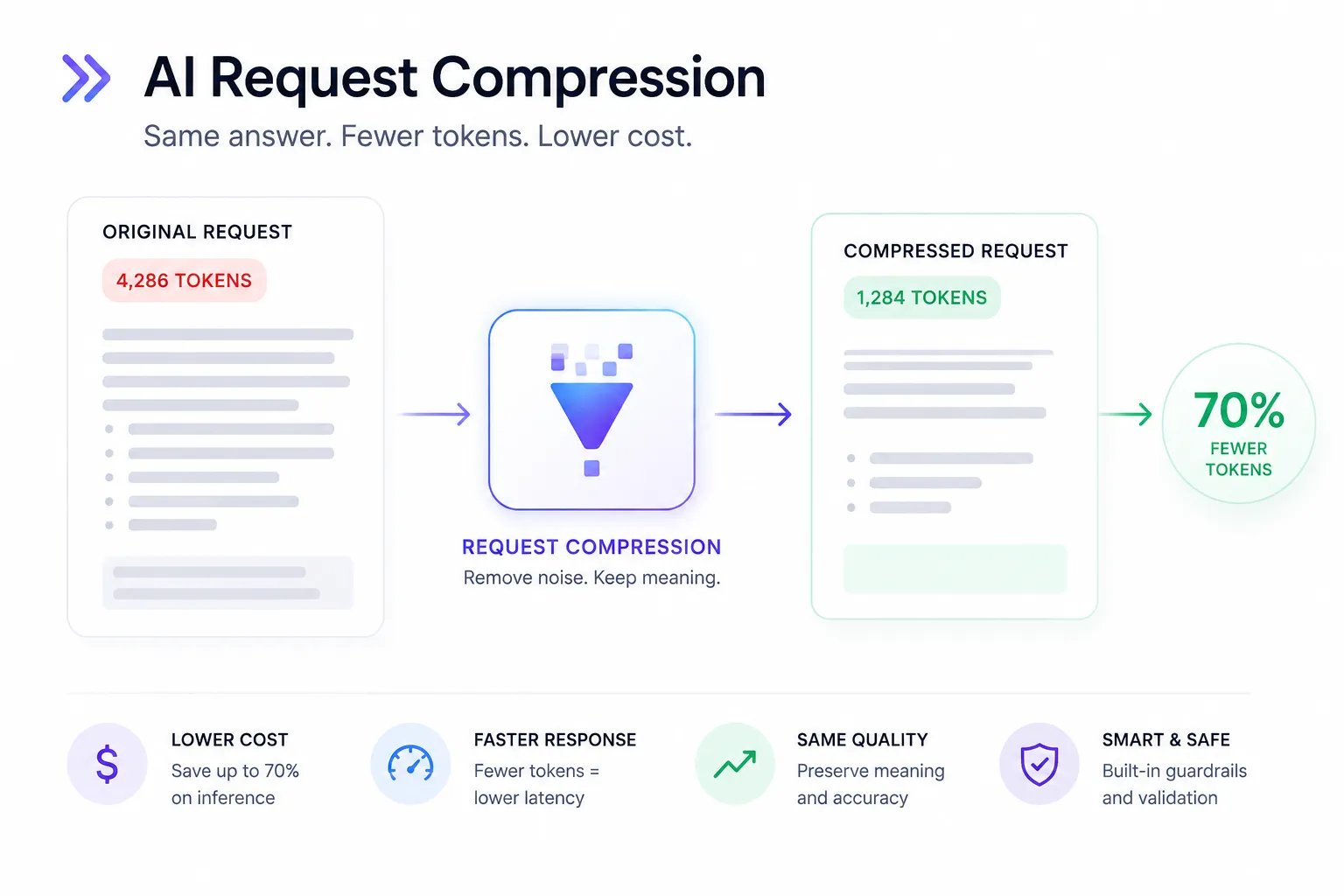
Everyone focuses on making chips faster. Very few are focused on making inference requests smaller. This company invents a new software layer that automatically rewrites prompts, compresses context, removes redundant reasoning, and minimizes tokens before every inference call. If successful, customers spend dramatically less without changing models. A legal AI platform could reduce every document review request by 60% while producing nearly identical results, cutting millions from its annual compute bill.
Description
No additional description provided.
The Pitch
As AI gets embedded into ordinary software, inference stops being an occasional expense and becomes a margin line inside every search, support ticket, contract review, coding session, and analyst workflow. The companies that win with AI may not be the ones with the most powerful models, but the ones that can afford to invoke them constantly. A layer that makes every call smaller becomes a kind of invisible tax reduction on the entire AI economy.
The non-obvious insight is that much of what gets sent to models is not actually signal. Prompts accumulate boilerplate, duplicated instructions, irrelevant history, overly long context windows, and defensive wording added by engineers who do not fully know what the model needs. As systems mature, they often become more wasteful, not less, because every edge case adds more text and nobody wants to remove anything that might be important. This creates a strange new software problem: language systems generate linguistic technical debt.
That makes the opportunity unusually attractive because the buyer does not need to believe in a new model, a new workflow, or a new interface. The value comes from sitting between existing applications and existing model providers, quietly reducing waste in something the customer already pays for. If the output quality holds steady, the product has one of the cleanest value propositions in software: the same answer, lower bill. In a world where model choice changes constantly, a model-agnostic efficiency layer could become more durable than many applications built on top of any single model.
There is also a compounding data advantage. The more requests the system sees, the better it can learn which tokens matter for which tasks, which instructions are dead weight, and how far context can be compressed before accuracy breaks. That knowledge is not generic prompt advice; it is an empirical map of how different models consume information in real production settings. Over time, the company is not merely shortening text. It is learning the hidden economics of reasoning.
The deeper thesis is that AI cost will not be solved only by cheaper hardware or cheaper models. It will also be solved by demand-side efficiency: using less intelligence per task without users noticing. If AI becomes a basic input to software, then inference compression becomes analogous to caching, bandwidth optimization, or database indexing—unsexy infrastructure that matters precisely because it is everywhere.