Temporary Financial Verification for Credit Applications
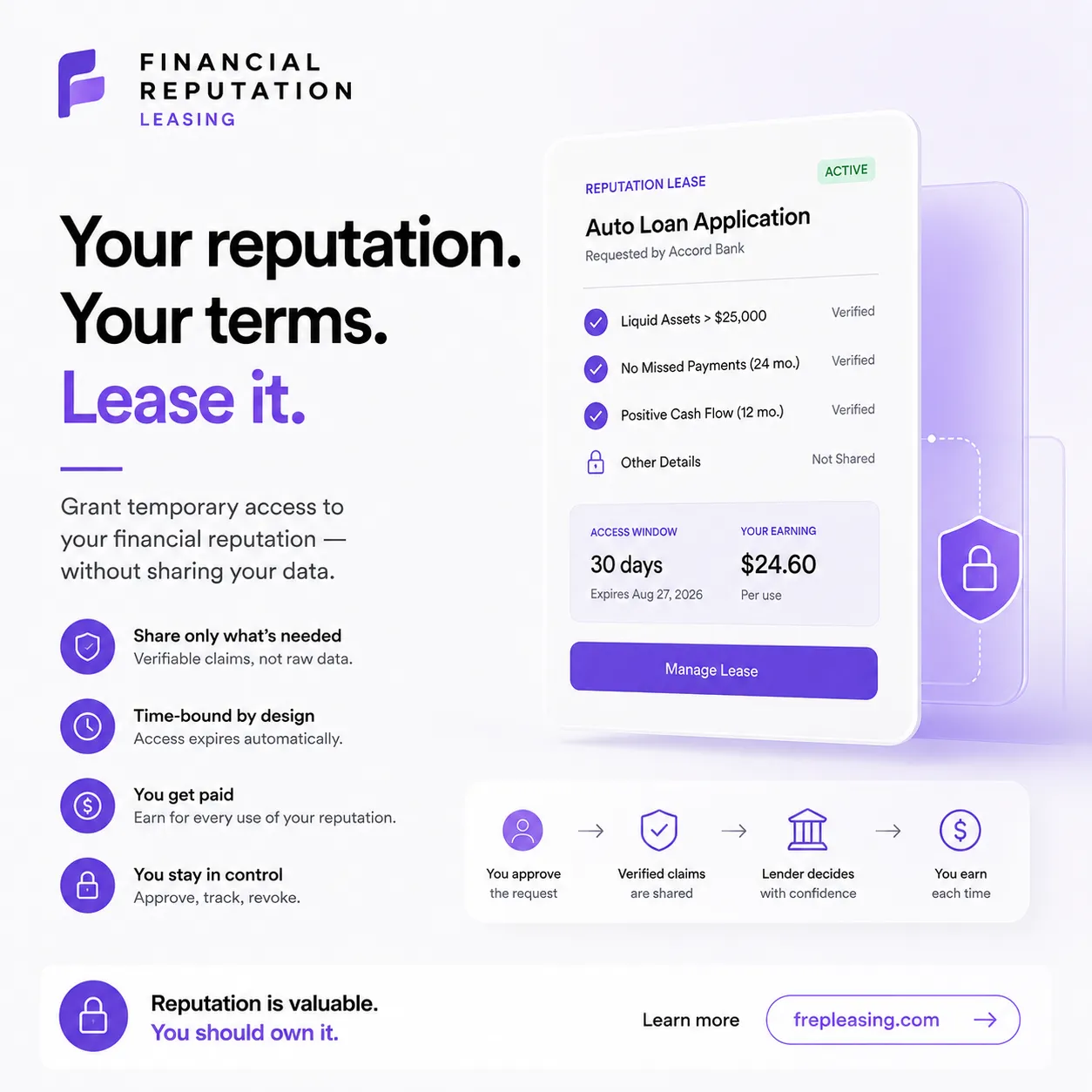
Applying for credit still means repeatedly handing institutions permanent copies of sensitive financial information. Financial Reputation Leasing would let consumers grant temporary access to specific financial claims instead: prove you've maintained $25,000 in liquidity, positive cash flow, and no missed payments for two years without revealing the underlying accounts or transactions. The proof expires when the underwriting window closes, and lenders could pay consumers for permission to use stronger proofs. As financial data becomes portable and zero-knowledge verification improves, reputation could become something consumers selectively rent rather than permanently surrender.
Description
No additional description provided.
The Pitch
The strange flaw in credit underwriting is that it confuses evidence with possession. A lender does not actually need a borrower’s bank statements, payroll history, account balances, or transaction feed forever. It needs confidence about a few facts at a specific moment. A business built around temporary financial proofs would turn today’s overexposure into a cleaner market: the borrower keeps the data, the lender gets the assurance, and the valuable object becomes the verified claim rather than the raw file.
This would be compelling because financial reputation is already monetized, but almost entirely by intermediaries that package people’s histories without giving them much control or upside. Credit bureaus, data aggregators, and lenders all extract value from reputation as a durable asset. The missing piece is a consumer-controlled instrument that can be used briefly, precisely, and repeatedly. If someone’s strong financial behavior helps a lender make a better decision or lower its risk, it is odd that the consumer’s only reward is a slightly improved chance of approval.
The most interesting shift is that privacy could become economically productive rather than merely protective. Most privacy products ask institutions to accept less information as a matter of principle. This model offers them better information in a narrower form: mathematically or institutionally verified answers to underwriting questions, stripped of irrelevant noise. That could make the private option the higher-quality option, not the compromise option. A lender may prefer “this person has met the required liquidity and payment conditions” over thousands of messy transactions that create compliance burden, bias risk, storage liability, and analytical ambiguity.
The business also sits at a rare point where consumer incentives and lender incentives can align. Consumers want fewer permanent trails of sensitive data. Lenders want fresher, more reliable signals and less responsibility for securing information they never truly needed. Regulators increasingly dislike unnecessary data retention. A company that reduces data exhaust while improving decision quality is not just selling convenience; it is removing a hidden cost embedded in every financial application.
If this existed at scale, it could change the meaning of creditworthiness from a static score assigned to a person into a set of portable, expiring credentials assembled for a particular decision. That is a more natural shape for modern finance. People are not one number, and institutions do not need the whole person. They need permissioned confidence, for a limited purpose, at the moment it matters.