Telecom Edge AI App Store
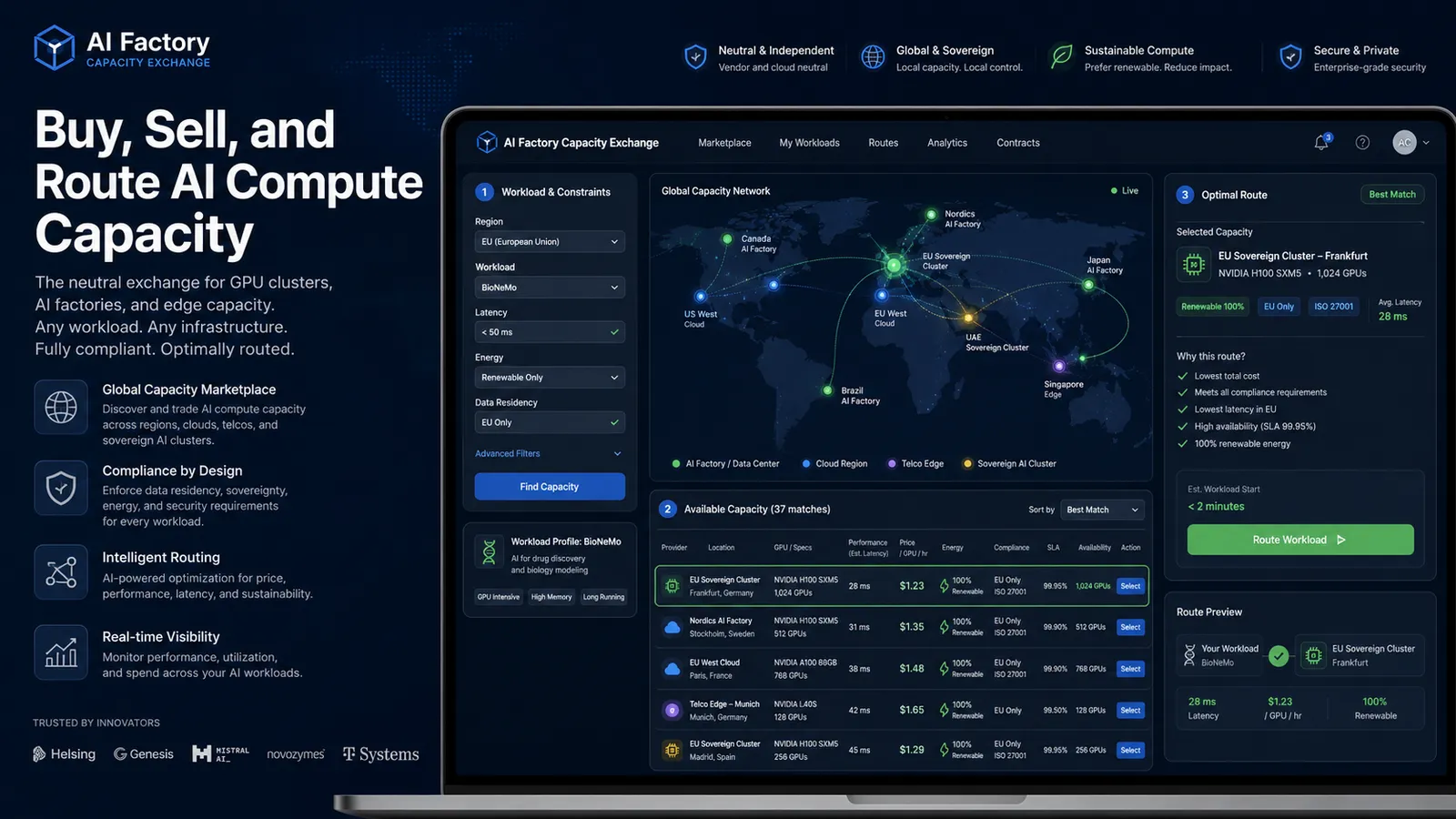
Telcos are being encouraged to turn cellular infrastructure into distributed AI-compute networks, but there is no obvious application ecosystem for that capacity. Build an app store and deployment platform for workloads that benefit from being physically close to users: video analytics, robotics coordination, retail intelligence, gaming inference, autonomous-vehicle support and real-time translation. Developers would deploy an edge workload once, and the platform would package it for participating telecom networks, handle billing and enforce latency, privacy and geography requirements. A stadium, for example, could activate crowd-flow analysis and live multilingual commentary only during events without installing its own permanent compute cluster. This is interesting because AI-RAN only becomes economically meaningful when someone creates demand beyond telecom workloads.
Description
No additional description provided.
The Pitch
Telecoms may end up owning one of the scarcest physical assets in AI without knowing how to monetize it: proximity. Cloud computing won by centralizing capacity, but many emerging AI tasks lose value when they travel too far. A model that detects a safety hazard, guides a robot, renders a game action, or translates speech in a live venue is not just buying compute; it is buying milliseconds, jurisdiction, and physical context. Those are not easily replicated by hyperscale data centers.
The missing layer is not more infrastructure, but legibility. Developers do not want to negotiate with dozens of carriers, understand regional network topology, or rewrite software for each edge environment. Venues, cities, retailers, automakers, and game studios do not want to become distributed-systems operators. A marketplace that turns messy, fragmented telecom capacity into something developers can actually target would create a new abstraction: not “run this in the cloud,” but “run this near the people, devices, or event that matters.”
This business would also benefit from a strange asymmetry: demand for edge AI is likely to be intermittent, local, and spiky, which makes it unattractive for customers to own dedicated hardware but attractive for a shared network. A stadium needs intense compute for four hours, not all week. A retailer may need computer vision during peak shopping periods. A city may need extra inference during emergencies or festivals. The more irregular the demand, the more valuable it becomes to have rentable intelligence already embedded in the network.
There is also a trust angle that could matter as much as latency. Many real-world AI workloads involve sensitive video, location, speech, or operational data. Processing close to the source can reduce what gets transmitted, stored, or exposed across borders. The platform could make “where the computation happened” a first-class property, not an implementation detail. In regulated or reputation-sensitive environments, that may be the difference between an AI use case being theoretical and actually deployable.
The deeper business is not an app store in the consumer sense; it is demand formation for a dormant asset class. If telecom edge capacity remains something carriers sell one bespoke enterprise deal at a time, it will stay niche. If it becomes something software can discover, reserve, and trust, then cellular infrastructure stops being just a connectivity layer and starts behaving like programmable real estate for machine intelligence.