Support Ticket Analysis and Recovery Playbooks
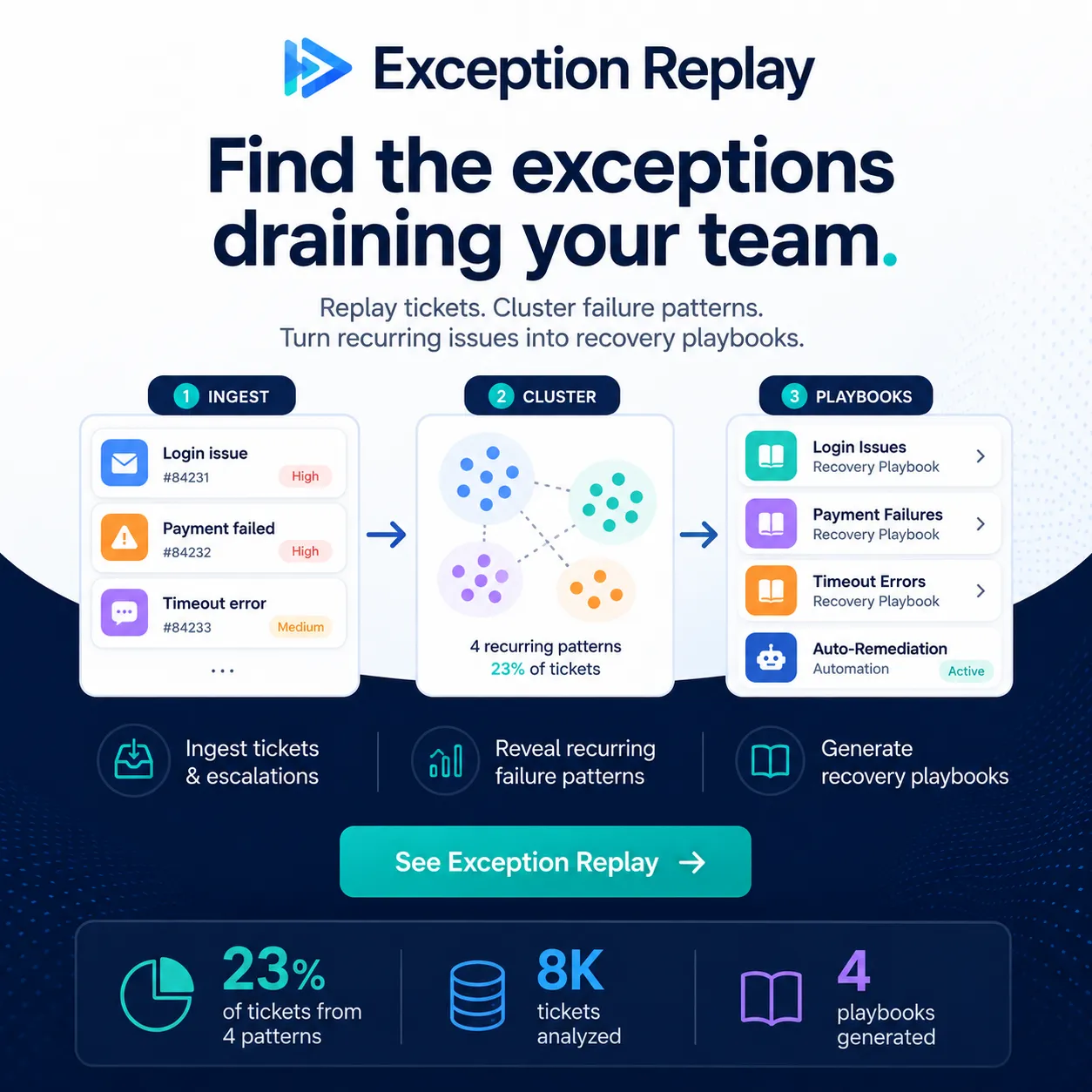
Companies know they have support problems but rarely know which recurring exceptions are consuming the team. Exception Replay ingests support tickets, complaints or escalation logs, clusters the underlying failure patterns and generates executable recovery playbooks for the highest-volume cases. Why now: LLMs can reconstruct operational sequences from messy support histories that previously required weeks of manual process analysis. Example: 8,000 tickets reveal that 23% come from four account-closure scenarios; the product turns each into a structured detection rule, resolution sequence and automation spec that can be deployed immediately.
Description
No additional description provided.
The Pitch
Support tickets are one of the richest operational datasets inside a company, but they are usually treated as exhaust. They describe, in plain language, where the business actually breaks: the policy exception that agents work around, the edge case the product team never modeled, the manual reconciliation step everyone has normalized. A company that can turn this messy record into a map of repeatable failures is not just improving support; it is discovering the hidden operating system of the business.
The reason this can matter economically is that many support costs are not caused by volume alone, but by ambiguity. A simple question can be deflected with documentation or a chatbot, but an exception requires judgment, context, and cross-system action. Those are the cases that absorb senior agents, create escalations, frustrate customers, and resist ordinary automation. If the product identifies the few recurring exception types hiding inside thousands of unique-seeming complaints, it attacks the expensive part of support rather than the visible part.
The most interesting wedge is that the output is not an analytics dashboard. Companies already have dashboards telling them ticket counts went up. What they lack is the translation layer between “this keeps happening” and “here is the operational routine that should run when it happens.” A business that produces detection rules and recovery sequences creates something closer to institutional memory: the undocumented know-how of the best agent, extracted from past cases and made repeatable.
This would also improve over time in a way that ordinary workflow software does not. Every resolved exception becomes evidence about what worked, what failed, which systems were touched, and where humans still had to intervene. The product’s value compounds as it learns the company’s specific failure patterns, vocabulary, policies, and edge cases. The moat is not generic language understanding; it is the accumulation of operational precedent.
The deeper thesis is that many companies do not need more automation in the abstract. They need a way to find the right automations, because the highest-return workflows are buried in the messiest parts of the business. Exception Replay would be compelling because it starts where reality is noisiest and converts that noise into precise, repeatable action.