Submission Tracking and Acceptance Guarantee Service
Agents are getting good at submitting things. Permit applications. Insurance reimbursements. Invoices into accounting systems. The harder problem is that submitting something is not the same as getting it accepted. A permit can sit for weeks before anyone tells you a field was wrong. An insurance claim can disappear into a queue. An invoice can fail because it landed in the wrong system. By the time anyone notices, the deadline may have passed and the person who told the agent to handle it is still responsible. So there is probably a company whose job starts after the agent clicks submit. It tracks every submission until there is an actual outcome, follows up when something stalls, catches rejections, and fixes problems before they become expensive. The simple version is a dashboard that tells you what is stuck. The more interesting version guarantees the outcome. If the agent submits something incorrectly, the company fixes it or pays for the mistake. That turns agent reliability from a software feature into something closer to insurance. And that feels like a much bigger business.
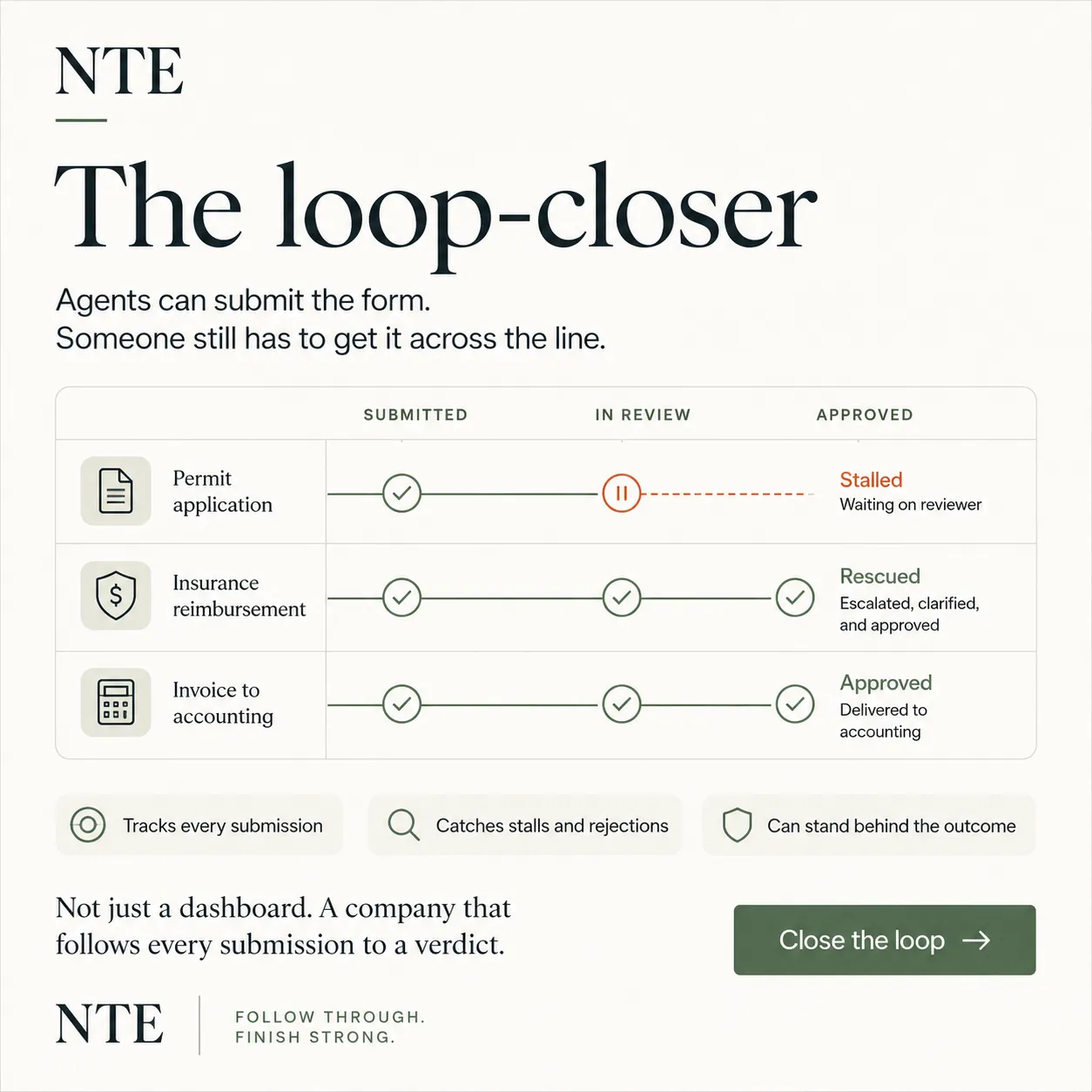
Description
No additional description provided.
The Pitch
The moment of submission is a false finish line. Most systems are built around the sender’s perspective: the form was completed, the upload succeeded, the email was sent. But the economic value lives on the receiver’s side, where acceptance, payment, approval, or denial actually happens. A business that owns the liminal space between “sent” and “resolved” would be selling something far more valuable than workflow automation: it would be selling closure.
This becomes especially important as agents create more volume. Human workers have always carried a hidden layer of institutional paranoia: they know which office loses paperwork, which portal silently rejects attachments, which payer needs to be called twice, which invoice system marks things received but not approved. Agents can perform the visible task, but they do not naturally inherit this anxious memory of how organizations fail. A company that accumulates this operational scar tissue across many customers could become the missing reliability layer for automated work.
The business also benefits from a useful asymmetry: the cost of a failed submission is often far larger than the cost of monitoring it. A delayed permit can idle a crew. A rejected reimbursement can erase margin. A missed vendor invoice can damage a relationship or trigger penalties. Because the loss is tied to time, not just clerical effort, customers will care less about saving minutes and more about avoiding silent failure. That makes the product feel less like a productivity tool and more like a risk control.
There is also a trust gap in agent adoption that cannot be solved by better demos. Companies may believe agents can do work, but they still need someone accountable when the work crosses into brittle external systems they do not control. The party willing to stand behind the outcome becomes unusually important. In practice, that accountability could be more defensible than the automation itself, because it depends on monitoring infrastructure, exception handling, historical data, and financial confidence.
If this company existed, it would be compelling because it would recognize that the next bottleneck in automation is not task execution but task finality. As more work is delegated to machines, the scarce commodity becomes proof that the world on the other end actually agreed.