Startup Valuation Debt Analysis Platform
A startup raises $500 million at a $10 billion valuation, but the valuation isn't just a reward. It creates an enormous amount of future performance the company now has to deliver. Valuation Debt calculates that obligation: the revenue, margins, growth and market position required for a company to justify its latest valuation within a defined period. Every new financing can increase or reduce the balance. Instead of saying a startup is “overvalued,” investors could see that it carries $6.4 billion of valuation debt and exactly what must happen to repay it. Private valuations would stop being snapshots and become measurable promises about the future.
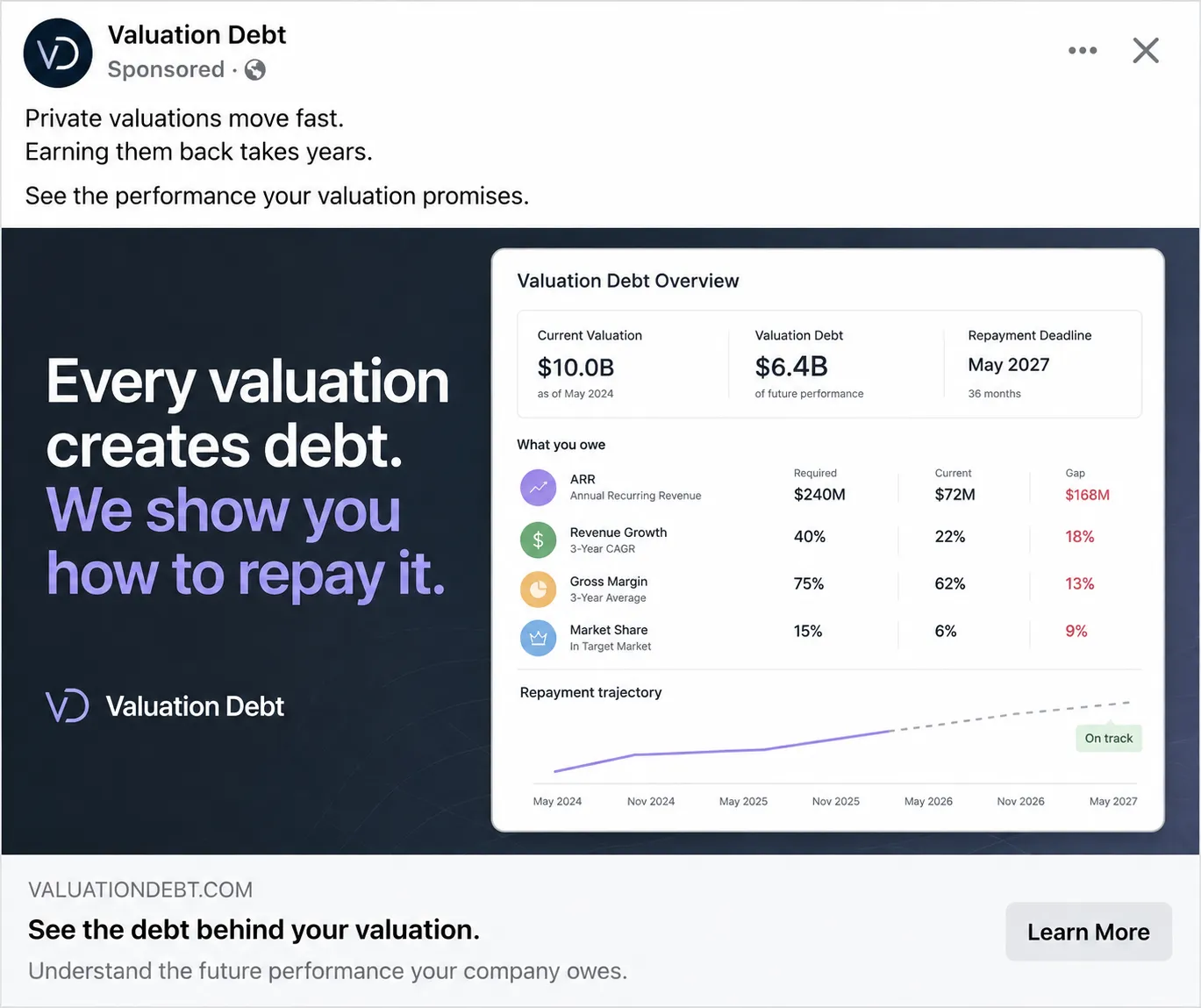
Description
No additional description provided.
The Pitch
Private markets are full of numbers that look precise but behave like stories. A valuation is treated as a single data point, when in practice it is a claim about years of future execution compressed into one figure. Translating that figure into an operating burden makes the hidden contract visible. The interesting shift is not from subjective to objective valuation, but from admiration to accountability: what must the company become for this price to have been reasonable?
The strongest insight is that valuation is not only a market signal; it changes the company’s physics. A high mark affects employee expectations, acquisition discipline, investor behavior, press perception, and the board’s tolerance for ordinary outcomes. Once a company is priced for perfection, perfectly good performance can still become failure. A tool that quantifies this pressure would name something founders and investors already feel but rarely measure: the difference between building a great company and building one large enough to escape its last valuation.
It would also create a more useful language for disagreement. Today, calling a company overvalued often sounds ideological, jealous, or backward-looking. But saying that a company needs to reach a certain revenue scale, margin profile, or category position within a given timeframe moves the debate to assumptions rather than vibes. That matters because private-company pricing is increasingly negotiated in rooms where optimism has few units of measurement. The business works if it becomes the shared grammar for converting belief into testable consequences.
There is also a durable wedge in the fact that every participant benefits from ambiguity until ambiguity becomes expensive. Founders like high prices, employees like paper gains, funds like marks, and later investors like momentum. But the bill comes due during down rounds, exits, secondary sales, compensation resets, and LP reporting. A system of valuation debt would be most valuable precisely because it is uncomfortable before it is necessary. It gives sophisticated actors a way to be honest without being bearish.
The deeper opportunity is that private markets are becoming more continuous, while their analytical tools still belong to an era of episodic financing. As startups stay private longer and secondary markets broaden, valuation needs to behave less like a headline and more like a balance sheet item. If this company existed, its category would not be “valuation software.” It would be a credit bureau for ambition: a way to track how much future greatness has already been spent.