Startup Pivot Strategy Platform
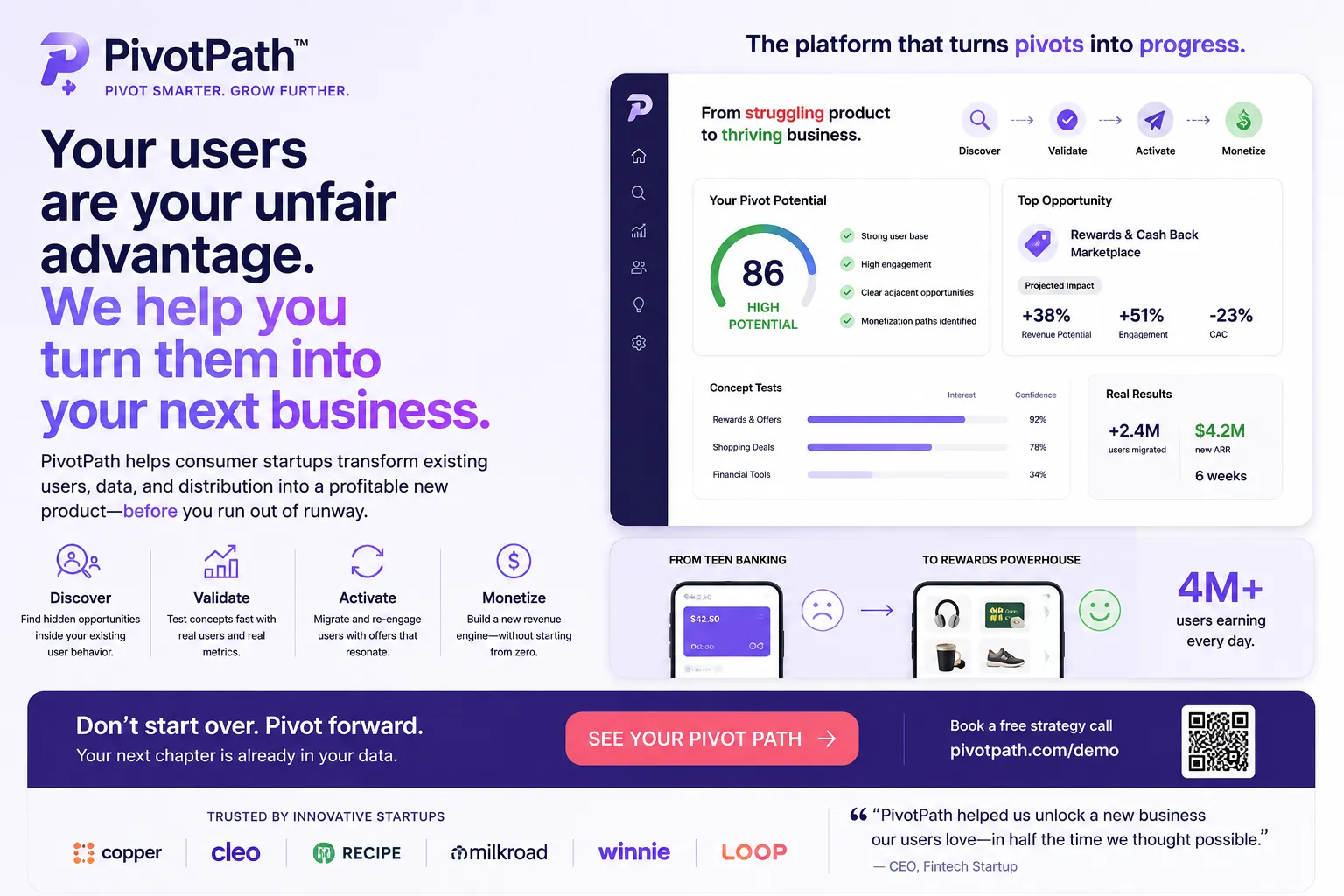
A platform that helps struggling consumer startups turn an existing audience into a new business before they run out of money. It would analyze how users already behave, identify adjacent products or revenue models, test new offers, connect the company with advertisers or commerce partners, and migrate customers into the strongest concept. A failed banking app, for example, might discover that its most valuable asset is not the financial product but millions of users who respond to rewards and shopping offers. The platform would turn startup pivots from a last-minute founder instinct into a repeatable operating process.
Description
No additional description provided.
The Pitch
Many consumer startups die while still owning something valuable: attention with context. A generic audience is cheap, but an audience whose behavior, intent, trust, and habits are already legible can be extraordinarily specific. The failure is often that the original product monetized the wrong part of that relationship. A budgeting app, fitness tracker, social tool, or learning app may lose as a standalone business while still revealing what its users want, avoid, buy, compare, or obsess over.
This would be especially powerful because pivots are usually treated as acts of imagination, when they are often acts of translation. The question is not “what else could we build?” but “what business is this user base already trying to become?” Usage data contains clues founders are too close to see: the features people abuse, the notifications they actually open, the segments that behave unlike everyone else, the moments when users show commercial intent. A company that can read those patterns across many struggling startups would build an unusual kind of institutional memory about which audiences can be profitably reinterpreted.
The business also works because the alternative is wasteful for everyone involved. Startups with shrinking cash balances typically sell for scraps, shut down, or force a desperate pivot with too little evidence. Meanwhile advertisers, commerce companies, lenders, insurers, education providers, and marketplaces are constantly paying to reach the exact kinds of niche audiences these startups already gathered. The missing layer is not more ad inventory; it is a credible way to match dormant demand with an audience that was assembled for a different purpose but is economically useful in a neighboring one.
There is a strong timing advantage because consumer companies have become cheaper to start but harder to sustain. That creates a growing graveyard of products that achieved distribution without finding a durable business model. Each one looks like a failure in isolation, but together they form a supply of underpriced audiences, behavioral data, and brand permission. A platform that repeatedly converts those stranded assets into operating businesses would be less like a turnaround consultant and more like a salvage market for consumer demand.
The deepest insight is that product-market fit may not be binary; it may be misfiled. A company can fail at the product it chose while succeeding at revealing a market it did not understand. The business that can systematically recover that hidden market would profit from a common startup error: mistaking the first product for the real asset.