Soft Swarmbots Revolutionize Indoor Farm Pollination
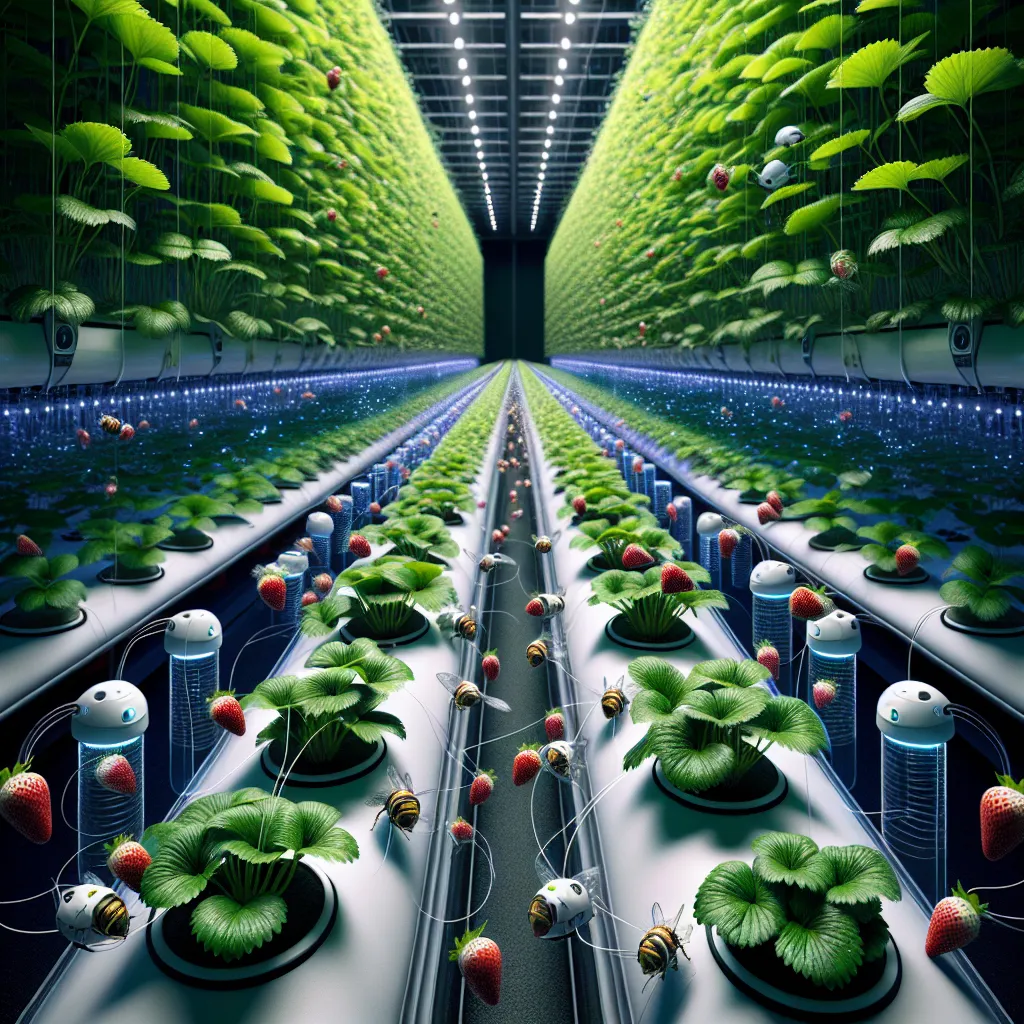
Indoor farms and greenhouses are rapidly expanding, but they face a hidden bottleneck: pollination. Without bees or wind, pollination becomes manual, costly, and unreliable — especially in vertical farms where human access is limited. Enter the era of “soft swarmbots.” These tiny, magnetically controlled soft robots can navigate narrow crop rows without harming delicate plants, using embedded sensors to identify flowers and mimic pollination through targeted vibrations or puffs of air. Unlike rigid drones, they can crawl or hover through dense vegetation and operate quietly, autonomously, and safely. This wasn’t possible before — now it is, thanks to advances in flexible electronics and magnetic locomotion. These bots could be the missing link in scaling high-yield, climate-resilient urban farming. Imagine a swarm of gentle pollinators buzzing through an enclosed strawberry farm in Tokyo — no bees, no humans, just precision agriculture powered by programmable nature.
Description
No additional description provided.
The Pitch
As urban environments continue to grow, traditional farming methods face mounting challenges. Indoor farms and greenhouses offer a promising solution, providing the means to grow fresh produce in controlled environments close to city centers. However, these systems contend with a critical issue: pollination. In the absence of natural pollinators like bees or the wind, indoor farms often resort to manual pollination methods. This approach can be both labor-intensive and unreliable, particularly in vertical farm settings with limited human accessibility.
This is where the innovation of soft swarmbots comes into play. These small, magnetically controlled soft robots are designed to navigate the tight spaces of indoor farms. They feature advanced embedded sensors to detect flowers and execute pollination through precise vibrations or puffs of air. Unlike traditional, rigid drones, these soft swarmbots boast the ability to crawl or hover seamlessly through dense foliage, operating with minimal noise and maximum safety.
The technological leap facilitating this innovation stems from advances in flexible electronics and magnetic locomotion. Before these technological advances, creating such delicate yet sophisticated robots was unattainable. Today, they present a revolutionary solution capable of addressing the pollination bottleneck for high-yield, climate-resilient urban agriculture.
For those interested in launching this technology as a Minimum Viable Product (MVP), several steps can be followed. First, leveraging open-source platforms for flexible electronics design and prototyping, both hardware and software, can accelerate development. Tools like Arduino or Raspberry Pi can serve as the foundation for building and testing prototypes. Additionally, collaboration with experts in robotics and agriculture for iterative testing and refinement will ensure practical application and efficacy.
The Go-To-Market (GTM) strategy should focus on partnerships with urban farms, technology demonstrations, and pilot programs to showcase the benefits and reliability of soft swarmbots. A strong emphasis on sustainability and precision agriculture will appeal to environmentally conscious consumers and businesses.
From a business model perspective, offering a subscription-based service could provide continuous software updates, maintenance, and support for these robotic fleets. This model allows for recurring revenue and long-term partnerships with clients who benefit from always having state-of-the-art technology.
Imagine a scenario where urban farms, freed from the constraints of traditional pollination, flourish with healthy crops thanks to this next-generation pollination solution. With soft swarmbots, the future of food production in urban landscapes becomes not just feasible, but sustainable and efficient.