Smart Dust for Terraforming and Climate Regulation
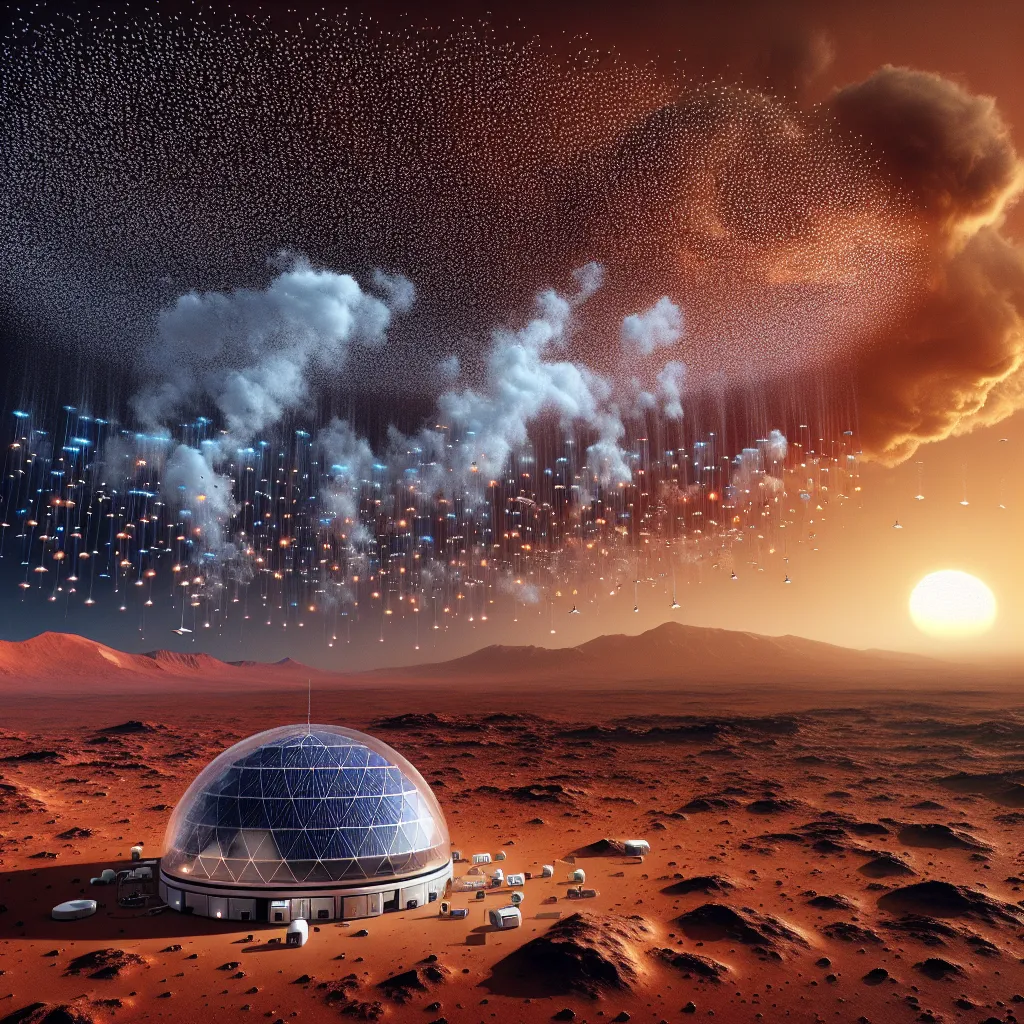
Terraforming Mars or regulating Earth’s climate has long been in the realm of sci-fi — limited by how much hardware we can launch, power, and maintain. But with 2D-CMOS logic, imagine deploying trillions of ultra-lightweight, solar-powered smart dust particles into the atmosphere of another planet. Each particle acts as a tiny weather modulator: redirecting light, influencing cloud formation, or seeding elements. These could be programmed with swarm logic to adapt based on real-time conditions, self-organize, and optimize planet-scale environmental changes. Why now? These devices couldn’t be built with silicon. But atom-thin materials enable such scale, and the breakthrough from Penn State shows we can embed logic in them. A future Mars colony could deploy this dust to warm a crater, regulate light, or protect habitats — all autonomously.
Description
No additional description provided.
The Pitch
For decades, the concepts of terraforming Mars or controlling Earth's climate have captivated scientists and science fiction enthusiasts alike. These grand visions have been constrained by the significant challenges associated with launching, powering, and maintaining the necessary hardware. Traditional technologies are simply too bulky, energy-intensive, and resource-heavy for the task.
With the advent of 2D-CMOS logic, these dreams are moving closer to reality. Recent breakthroughs, such as those from the research team at Penn State, have demonstrated the potential to embed logical operations within atom-thin materials, offering an unprecedented opportunity to revolutionize climate management on both planetary and extraterrestrial scales.
The Challenge
The core problem has always been one of scalability and efficiency. Existing technologies are not capable of deploying the quantities required for meaningful climate intervention, whether on Earth or in space. The sheer number and energy requirements of traditional hardware make such endeavors impractical and prohibitively expensive.
The Solution
Enter the concept of deploying trillions of ultra-lightweight, solar-powered smart dust particles. These particles are equipped with 2D-CMOS logic, enabling each to function as a tiny weather modulator. By implementing swarm logic algorithms, these particles can adapt in real-time, self-organizing to optimize environmental conditions autonomously. They can redirect sunlight, influence cloud formation, or seed various elements to effect weather changes.
This innovative approach could transform terraforming as we know it. For instance, a future Mars colony could utilize smart dust to warm craters, regulate sunlight exposure, or shield habitats, thereby creating a more hospitable environment for human settlement.
Product Details
1. Smart Dust Particles: Comprised of ultra-thin materials embedded with 2D-CMOS logic, each particle is powered by solar energy and functions autonomously.
2. Swarm Logic: Algorithms allowing collective operation and adaptation based on real-time environmental data, ensuring efficient modulation and distribution.
3. Deployment Mechanism: Strategies for delivering and dispersing the smart dust particles accurately across targeted areas.
4. Monitoring and Control Systems: Interfaces for oversight and minor adjustments, although the primary function is autonomous.
Tools for MVP Development
1. Nanofabrication Facilities: To develop and refine the 2D-CMOS particles.
2. Simulation Software: To model the potential interactions and effects of the smart dust deployment at scale.
3. Swarm Algorithm Development Platforms: For programming the autonomous behavior of the particles.
4. Prototyping Labs: To test small-scale deployments in controlled environments.
Go-To-Market Strategy
1. Partnerships: Collaborate with space agencies, climate research institutions, and private aerospace companies for initial testing and deployment.
2. Pilot Programs: Conduct pilot tests in controlled environments or specific planetary regions to demonstrate efficacy and safety.
3. Awareness Campaigns: Educate potential stakeholders and partners on the technology's capabilities and advantages.
4. Regulatory Engagement: Work closely with relevant authorities to ensure compliance and address ethical concerns related to climate intervention.
Business Model
1. Licensing: Offer the technology under license to space and climate organizations interested in utilizing the tech for specific applications.
2. Collaboration: Form joint ventures with established aerospace and environmental companies to co-develop and market tailored solutions.
3. Service Model: Provide ongoing support, maintenance, and updates for deployed systems, ensuring optimal performance and adaptation to environmental changes.
4. Research and Development: Invest in continuous innovation to expand the capabilities and potential applications of smart dust technology.
By harnessing the potential of 2D-CMOS logic in ultra-thin materials, this innovative approach promises to unlock new horizons in climate control and terraforming, transforming speculative science fiction into a feasible reality.