Smart Dog Collar Behavior Translator
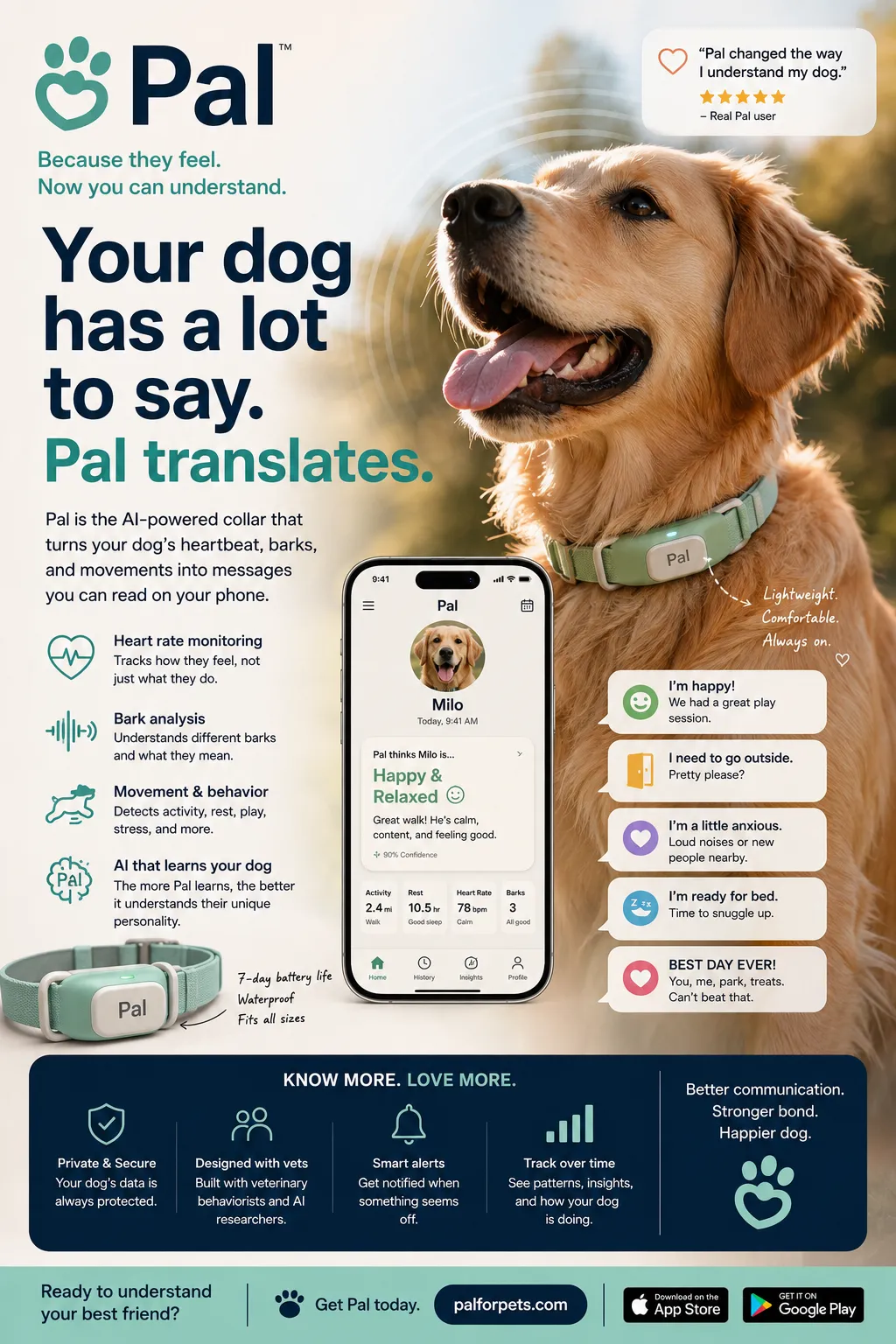
Your dog is already communicating with you all day. You just don't speak dog. Build a smart collar that combines heart rate, movement, location, sounds, sleep, eating patterns, and everything it learns about your specific dog, then translates that into simple messages on your phone. “I'm anxious.” “I really need to go outside.” “Something feels different today.” “BEST DAY EVER.” It wouldn't literally translate barking into English. It would do something more useful: learn what your dog's behavior means well enough to help you understand them.
Description
No additional description provided.
The Pitch
A compelling version of this company would not be a gadget business so much as a relationship business. People already treat dogs as family, but the relationship is strangely asymmetrical: owners spend thousands on food, toys, walkers, grooming, daycare, insurance, and veterinary care while still guessing at the animal’s most basic state. The valuable wedge is not more data about a pet; it is reducing the emotional uncertainty of caring for a creature that cannot explain itself.
The strongest business truth is that dogs are repetitive in ways humans are not. A single dog’s routines, stress signals, bathroom patterns, appetite changes, recovery rhythms, and excitement loops can become legible over time because the baseline is so personal and stable. Generic “dog behavior” advice is often weak because it averages across breeds, ages, homes, and temperaments. But a system that knows one specific dog well can notice deviations that even loving owners miss, especially when those deviations are subtle, gradual, or happen while nobody is watching.
This would also sit at the intersection of affection and prevention, which is a rare commercial position. Most pet spending is either delight-driven or crisis-driven: a new toy on one end, an emergency vet visit on the other. A product that helps owners catch discomfort, anxiety, aging, pain, or routine disruption earlier turns care into a daily habit rather than an occasional intervention. That matters because many expensive pet problems begin as ambiguous behavior: restlessness, hiding, licking, eating slightly less, sleeping oddly, moving differently. The business becomes compelling if it can make those weak signals understandable before they become obvious.
The emotional design matters as much as the sensing. A dashboard full of biometrics would make owners feel like technicians; a good translation layer would make them feel more fluent. The magic is not pretending the dog has human thoughts, but giving owners language for patterns they already half-suspect. “She is unusually unsettled after being alone today” is more powerful than a chart, because it changes what the owner does next. The product wins if it makes people say, “That is exactly what I felt, but I didn’t know how to interpret it.”
If it worked, it would become hard to remove. The collar would accumulate a history of the dog’s life that no replacement product could instantly reproduce: what normal looks like, what stress looks like, what aging looks like, what recovery looks like. Over time, the company would not merely monitor pets; it would become the memory layer for the relationship between a person and an animal they love.