Smart Checkout for Locked Retail Merchandise
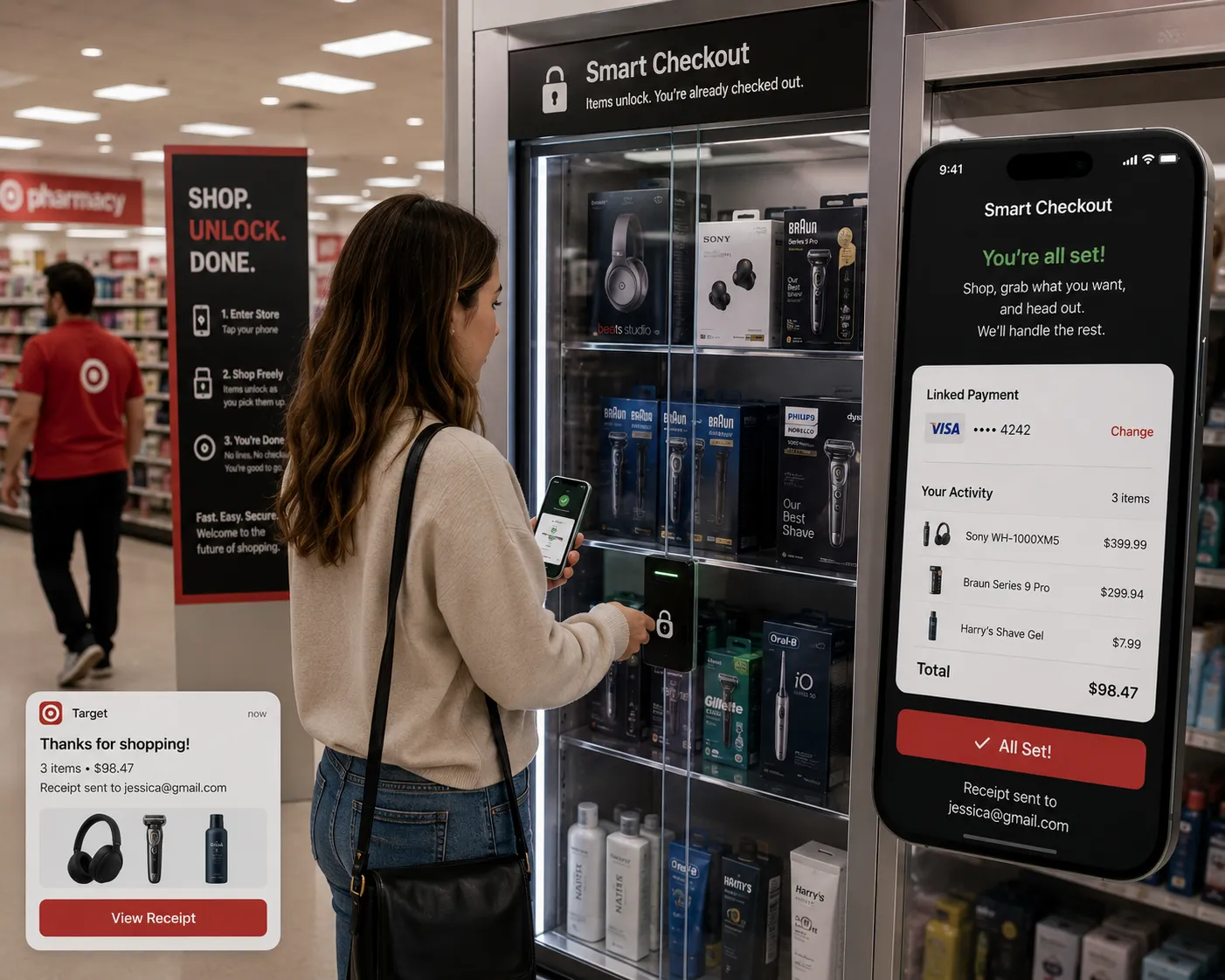
Retailers increasingly lock everyday products behind glass because of theft, creating frustrating shopping experiences where customers must repeatedly wait for employees to unlock simple items like shampoo, razors, or headphones. A Locked Merchandise Smart Checkout replaces manual unlocking with automated purchasing, allowing shoppers to identify themselves when entering the store and instantly unlock products as they select them. Every item is immediately associated with their payment method, eliminating traditional checkout while preserving theft protection. Employees shift from acting as human key holders to assisting customers with higher-value interactions. As retailers continue investing in cashierless technology, RFID, computer vision, and digital identity systems, there's an opportunity to modernize one of the most frustrating aspects of in-store shopping. Imagine walking through Target, tapping your phone once at the entrance, and every locked product automatically unlocking as you pick it up, with your receipt already complete before you leave the store.
Description
No additional description provided.
The Pitch
The interesting thing about locked merchandise is that it turns theft prevention into a tax on the best customers. The person most harmed by the locked case is not the thief, but the shopper willing to pay, standing in an aisle wondering whether deodorant is worth finding an employee. A business that removes that friction without asking retailers to loosen security would be valuable because it converts loss prevention from a blunt barrier into a permission system.
This would work because locked products are not random; they tend to be small, high-velocity, high-shrink items where the margin for bad experience is unusually low. Nobody wants a ceremonial interaction to buy toothpaste. When low-consideration purchases require high-effort service, stores accidentally train customers to buy those items online. The prize is not just faster checkout, but keeping routine replenishment inside physical retail before it quietly migrates to subscription carts and next-day delivery.
It also changes the economics of labor in a subtle but powerful way. Today, employees are often used as moving keys, summoned for five-second interventions that interrupt everything else they might be doing. That is a uniquely wasteful form of service: too important to eliminate, too trivial to make satisfying. Automating access lets stores preserve control over inventory while reclaiming employee attention for moments where human help actually affects basket size, loyalty, or problem resolution.
The deeper opportunity is that identity can become a store-level convenience layer, not just a payment credential. Once a shopper has opted into being recognized, locked cases stop being dead zones in the store and become interactive purchase points. The case knows who is asking, what item was taken, and whether payment is attached. That makes the physical shelf behave more like a digital cart, but only in the parts of the store where that intelligence has immediate value.
What makes the business especially compelling is that it does not require retailers to choose between trust and control. Most retail technology asks stores to believe shoppers will behave better if the experience improves. This idea is more pragmatic: assume shrink remains a problem, but stop punishing everyone equally for it. The company that solves this would own a strange but important seam in modern retail, where the locked cabinet, the checkout lane, and the customer account collapse into one action.