Small Modular Reactor Market Intelligence Platform
The next nuclear boom won’t just create reactors—it will create thousands of companies trying to sell into them. Governments, utilities, hyperscalers, engineering firms, equipment manufacturers, investors, and suppliers will all need to know the same thing: which reactor projects are moving forward, who’s involved, and when buying decisions are being made. Today, that information is scattered across regulatory filings, government announcements, local news, and company press releases. This startup becomes the definitive intelligence platform for the global small modular reactor industry, tracking every project from announcement through operation with real-time updates on permitting, funding, contractors, procurement timelines, and key decision makers. As nuclear deployment accelerates, it becomes the first place companies go to find customers, partners, and opportunities. A turbine manufacturer could receive an alert the moment a newly approved reactor enters procurement, allowing its sales team to engage months before competitors even know the project exists.
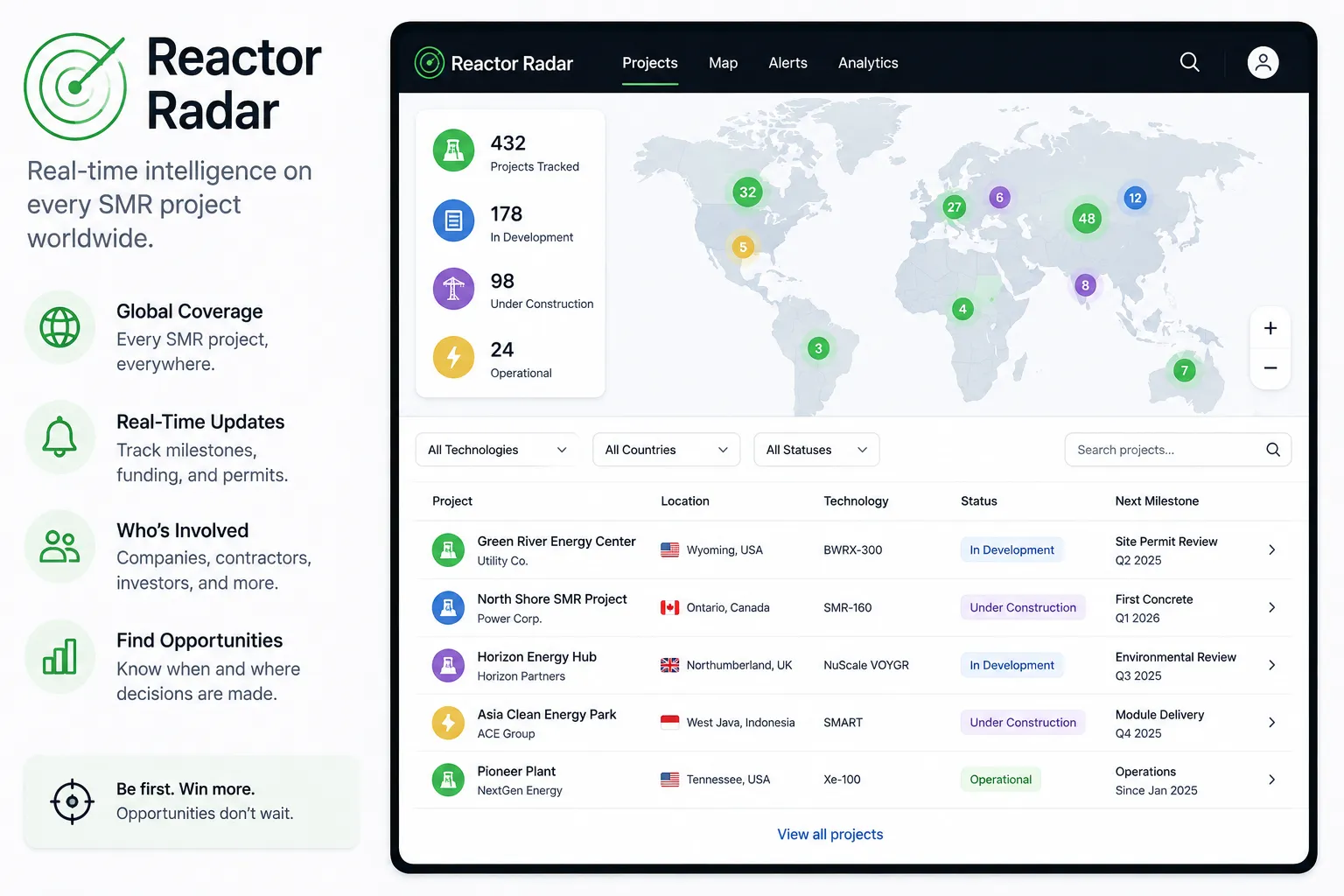
Description
No additional description provided.
The Pitch
A market becomes unusually valuable to map when it is both slow-moving and high-stakes. Small modular reactors will not be bought impulsively, and the number of real projects may remain modest for years. But each one concentrates enormous commercial value: site work, turbines, heat exchangers, fuel handling, control systems, security, construction, insurance, legal work, grid interconnection, and long-term maintenance. In markets like this, being early to one real deal matters more than discovering a thousand weak leads.
The hard part is that the nuclear industry is transparent in the wrong way. Much of the relevant information is technically public, but buried in formats and institutions that punish casual observers: licensing dockets, environmental reviews, provincial development agencies, utility board filings, parliamentary testimony, procurement notices, and small local updates that never reach mainstream industry coverage. The opportunity is not merely aggregating news; it is turning procedural noise into commercial signal. A company that understands which filing actually indicates momentum can become more valuable than a database with more entries.
The timing is especially interesting because SMRs are creating a new selling environment before they create a large operating fleet. For decades, nuclear procurement was dominated by a small set of utilities, national champions, and mega-projects. SMRs broaden the cast: industrial sites, remote mining operations, data centers, military facilities, municipal utilities, shipyards, and new project developers may all participate in ways that do not fit the old nuclear sales map. The companies that can interpret this emerging buyer universe will have an advantage over incumbents whose relationships were built around yesterday’s reactors.
There is also a trust premium in this category. Bad information in nuclear is not just inconvenient; it can waste years of business development effort or cause a supplier to miss a narrow qualification window. A trusted record of project status, counterparties, and procurement timing becomes part of how the industry coordinates itself. Once enough serious participants rely on the same source, it stops being just a research tool and becomes a shared commercial calendar for the sector.
The most compelling version of this business is not a media company covering nuclear enthusiasm. It is closer to a Bloomberg terminal for a narrowly defined industrial transition: expensive enough to warrant expert data, complex enough to resist shallow scraping, and consequential enough that knowing six months earlier who is serious can change the outcome of a sale.