Slack Duplicate Question Prevention Tool
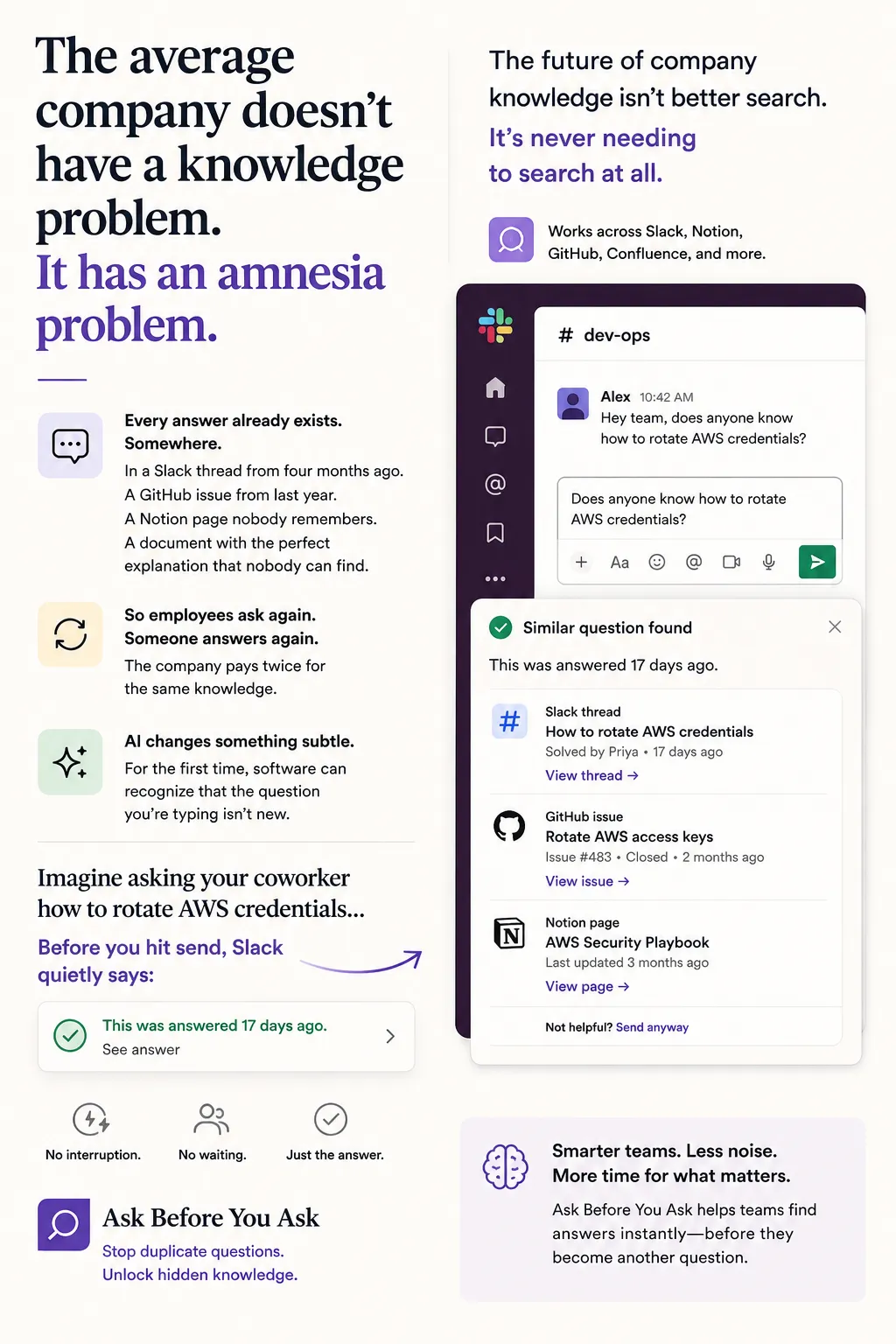
Employees ask the same questions over and over because they have no idea the answer already exists. The solution isn’t another knowledge base. It’s stopping duplicate questions before they’re asked. This startup lives inside Slack. As someone types a question, it instantly searches past conversations, documents, GitHub issues, and internal wikis, surfacing the most relevant answers before they hit send. Instead of interrupting coworkers or waiting for replies, employees get the context immediately, with links to the original discussion if they need more detail. The timing is right because AI can now understand intent instead of matching keywords, making it possible to recognize that today’s question is really the same one someone answered months ago.
Description
No additional description provided.
The Pitch
Most organizations already paid once to produce the answer, then keep paying again every time someone has to rediscover, restate, or re-litigate it. The waste is deceptively invisible because it arrives in polite fragments: a quick Slack question, a short clarification, a “does anyone remember?” thread. But at scale, these fragments become a tax on the people with the most context.
The strongest insight is that the moment before a question is asked is more valuable than the moment after. Search requires an employee to stop, decide where to look, choose the right words, judge the results, and admit that the burden is on them. But typing a question is already the most natural expression of what they need. If software can intercept that intent at the point of articulation, it turns knowledge retrieval from a separate chore into a near-automatic reflex. That changes behavior without asking employees to become better librarians.
This also turns messy internal communication from a liability into an asset. Companies often treat old Slack threads as ephemeral clutter, while official documentation is treated as the “real” knowledge. In practice, the opposite is often true: the most useful context lives in the informal explanation, the debated tradeoff, the exception someone mentioned once, or the decision buried in a thread. A business that can mine that ambient memory makes the organization smarter without requiring everyone to document perfectly.
The product becomes more valuable as the company becomes more complex. In small teams, people can rely on memory and proximity. In larger organizations, the same question has different owners, historical reasons, and hidden dependencies. The pain compounds especially when teams are distributed, onboarding is constant, or institutional knowledge walks out the door. Preventing repeated questions is not just about saving minutes; it preserves scarce expert attention and reduces the drag that makes large companies feel slower than they are.
Its defensibility would come from becoming the layer that understands a company’s internal language better than any generic tool. Every organization has its own acronyms, half-deprecated systems, recurring debates, and tribal shortcuts. The more questions it sees and deflects, the better it understands which answers are trusted, current, and actually useful. Over time, it would not merely retrieve knowledge; it would map where an organization’s memory is reliable, stale, duplicated, or missing.