Shared Software Exception Resolution Network
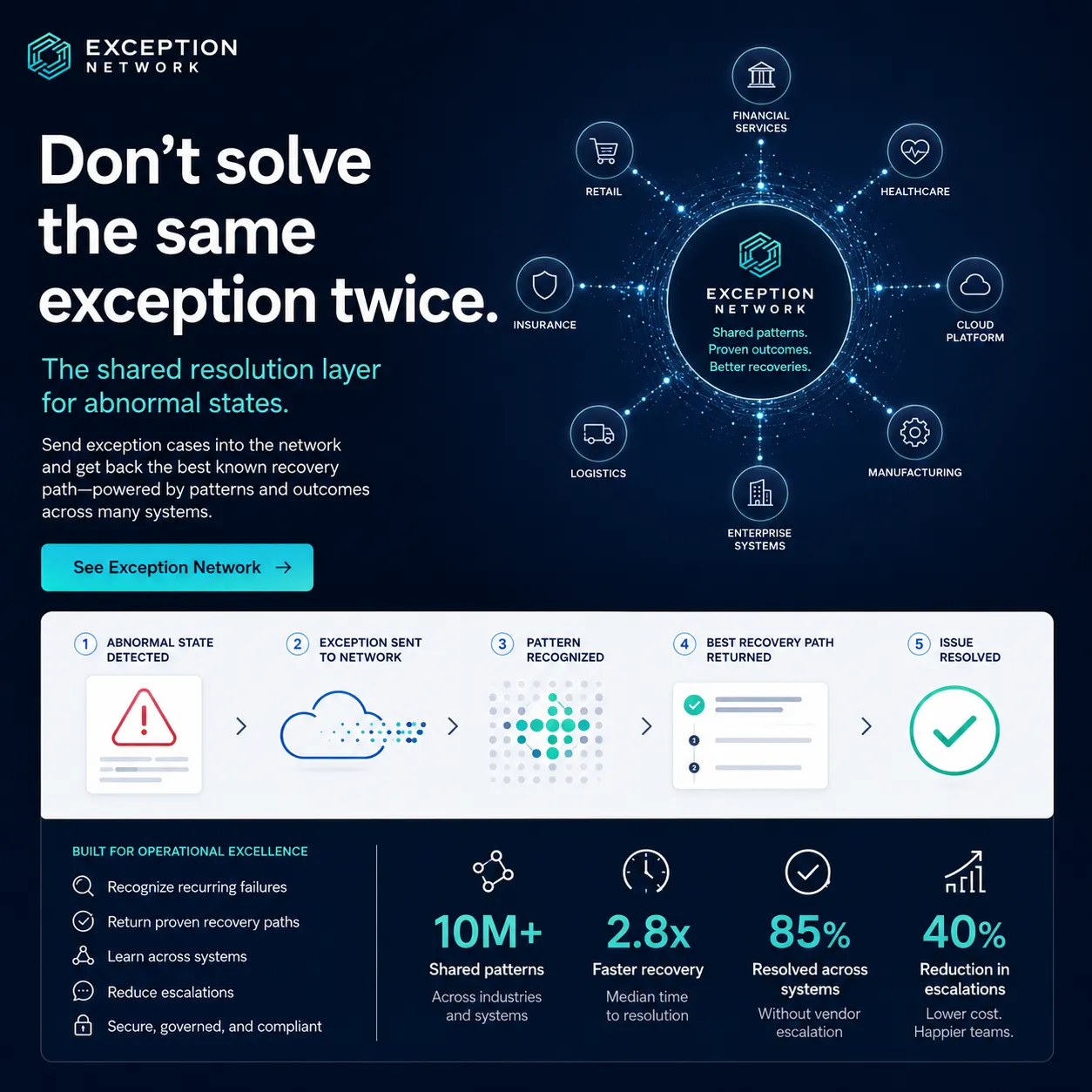
Every company independently encounters versions of the same failure patterns: payment reversals, identity mismatches, inventory conflicts, eligibility edge cases, account closures and regulatory holds. Exception Network would become a shared resolution layer where software submits an abnormal state and receives the best known recovery path based on outcomes across thousands of systems and companies. Why now: AI makes exception states understandable across heterogeneous software, while increasing automation means the remaining failures are becoming more consequential and more valuable to solve. Example: a payroll platform encounters an unfamiliar tax-registration failure, the network recognizes a pattern previously resolved across hundreds of similar cases, executes the proven recovery sequence and returns the customer to the normal workflow.
Description
No additional description provided.
The Pitch
The interesting thing about exceptions is that they are not really exceptional. They only appear rare inside one company’s database. Across the economy, the same ugly edge cases recur constantly, but the learning is trapped in support tickets, operations playbooks, compliance emails, and senior employees’ heads. A business that turns those scattered recoveries into reusable infrastructure would be valuable because it converts operational scar tissue into a compounding asset.
Most software is built around the happy path, yet customer trust is often won or lost in the unhappy path. A failed onboarding, frozen payment, misclassified user, or unresolved compliance hold can undo months of product polish. Companies spend heavily to acquire customers and automate workflows, then leak value precisely where their systems become least confident. A shared resolution layer would sit at the point where automation currently hands the problem back to humans, making it possible for software to recover gracefully instead of merely detecting that something has gone wrong.
The compounding advantage would come from outcome data, not from rules alone. A single company can document what it tried; a network can learn what actually worked across institutions, geographies, vendors, and regulatory contexts. That distinction matters because many exception problems are not solved by knowing the official rule. They are solved by knowing the sequence, timing, evidence, escalation path, and fallback that tends to clear the blockage. The product becomes more useful as it sees more failures, because each resolved case improves the odds that the next company does not need to rediscover the answer.
There is also a subtle shift in software economics happening here: as normal workflows become cheaper to automate, abnormal workflows become the new cost center. The last 5% of cases can consume a disproportionate share of support labor, engineering attention, compliance review, and customer goodwill. If exceptions are the residue left behind by every wave of automation, then the company that specializes in that residue occupies a durable position. It is not competing to own the primary system of record; it is becoming the connective tissue between systems when reality refuses to fit their schemas.
The broader thesis is that business software has over-indexed on standardization while the real world remains stubbornly irregular. A shared exception network would recognize irregularity as its own category of infrastructure. The prize is not just fewer support tickets, but a world where companies become collectively better at handling the messy cases that no one wants to own but everyone eventually faces.