Shared Safety Network for AI Agents
AI agents are beginning to run the same kinds of workflows across thousands of companies, but when one agent discovers a dangerous failure mode, every other company usually has to learn the same lesson independently. Build a shared failure-intelligence network that collects verified agent mistakes, turns successful harness fixes into reusable behavioral patches and regression tests, and identifies other agents exposed to the same problem before they encounter it themselves. This matters now because agents are moving into long-running, high-stakes work while harness improvements can increasingly generalize across related tasks without retraining the underlying model. Imagine one commerce agent nearly double-charging a customer after an ambiguous payment timeout, a fix being validated once, and thousands of similar agents receiving the tested safeguard before making the same mistake.
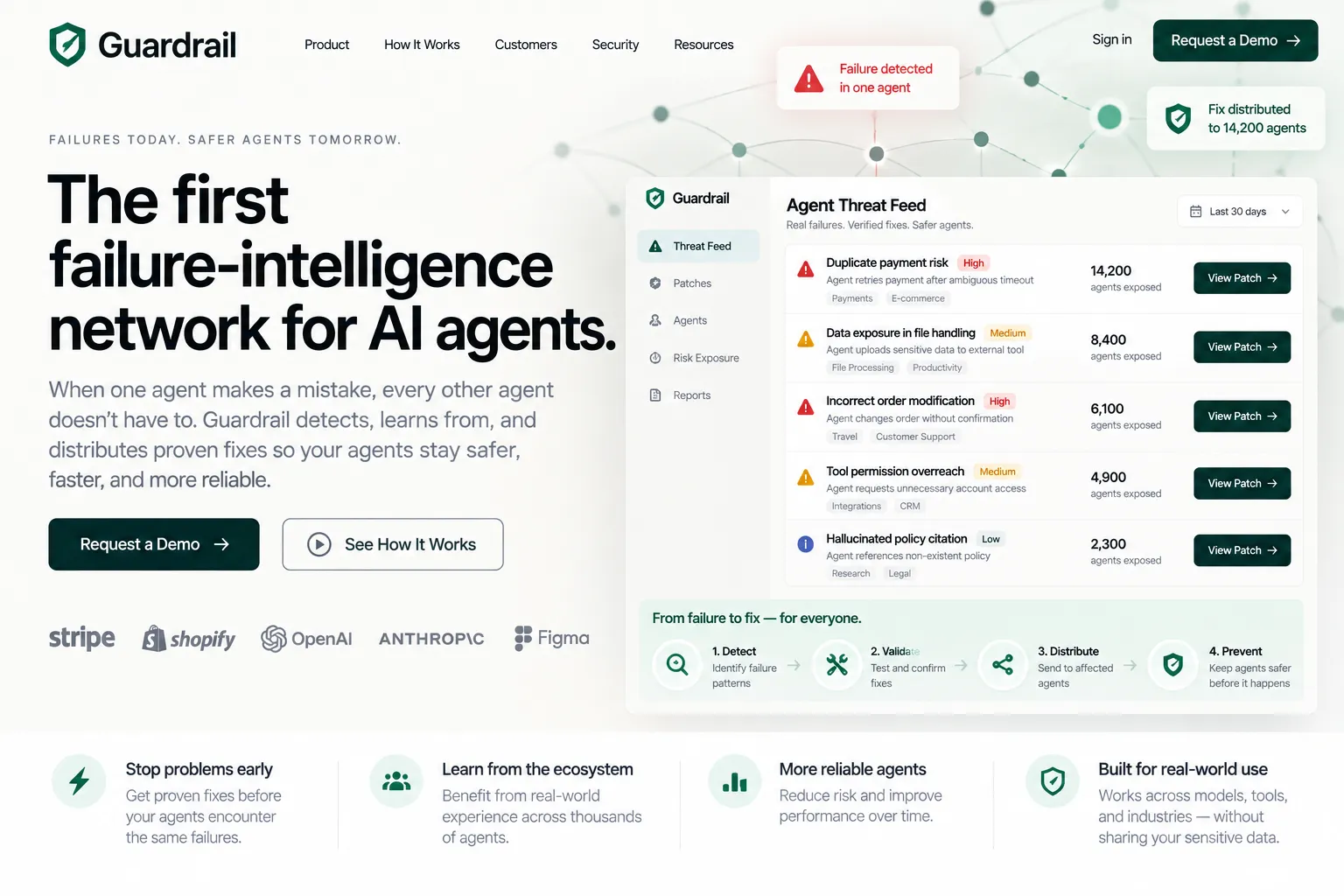
Description
No additional description provided.
The Pitch
AI agent failures are not as unique as they appear from inside any one company. Many organizations will believe their incident was caused by their particular data, prompts, tools, users, or edge cases. In reality, a large share of failures will come from repeated patterns: ambiguous confirmations, stale state, tool misuse, missing escalation thresholds, overconfident retries, or bad assumptions after partial success. A company that can recognize these patterns across customers would see the shape of the risk before any individual customer sees enough examples to understand it.
This creates a rare kind of network effect rooted in error, not usage. Most software gets better for a customer because that customer uses it more. Here, the product gets better because other customers’ agents fail first. The value of the network is not that it has more data in the generic sense, but that it accumulates scar tissue. Each verified failure becomes a small piece of institutional memory that can be applied elsewhere, turning someone else’s near-miss into your prevention layer.
The business also sits at a useful distance from the model providers. Foundation models will improve, but companies will still need to decide what an agent is allowed to do in a specific workflow, when it should stop, what counts as evidence, and how to recover from uncertain outcomes. Those rules are too operational and context-dependent to live entirely inside the model, yet too common to be reinvented by every company. The durable layer may be the harness around the model: the behavioral immune system that notices when intelligence is about to become action.
The economic pull is strongest because the worst failures are both rare and expensive. A company may not see enough catastrophic examples in its own environment to justify deep investment before something goes wrong, but it also cannot afford to wait until internal evidence accumulates. Shared failure intelligence changes the math: prevention no longer depends on suffering the failure yourself. That is especially powerful in regulated, financial, medical, legal, and commerce workflows, where a single mistake can create operational, reputational, or compliance damage far beyond the cost of the software involved.
If agents become a standard operating layer for companies, then their failures will become a new category of business risk: partly cybersecurity, partly quality assurance, partly insurance, and partly operational safety. The company that catalogs, validates, and distributes defenses against those failures could become a quiet piece of infrastructure for the agent economy. Its importance would come from a simple asymmetry: mistakes spread silently until they are named, but once named well, they can be prevented everywhere.