Shared Physical Media Lending Network
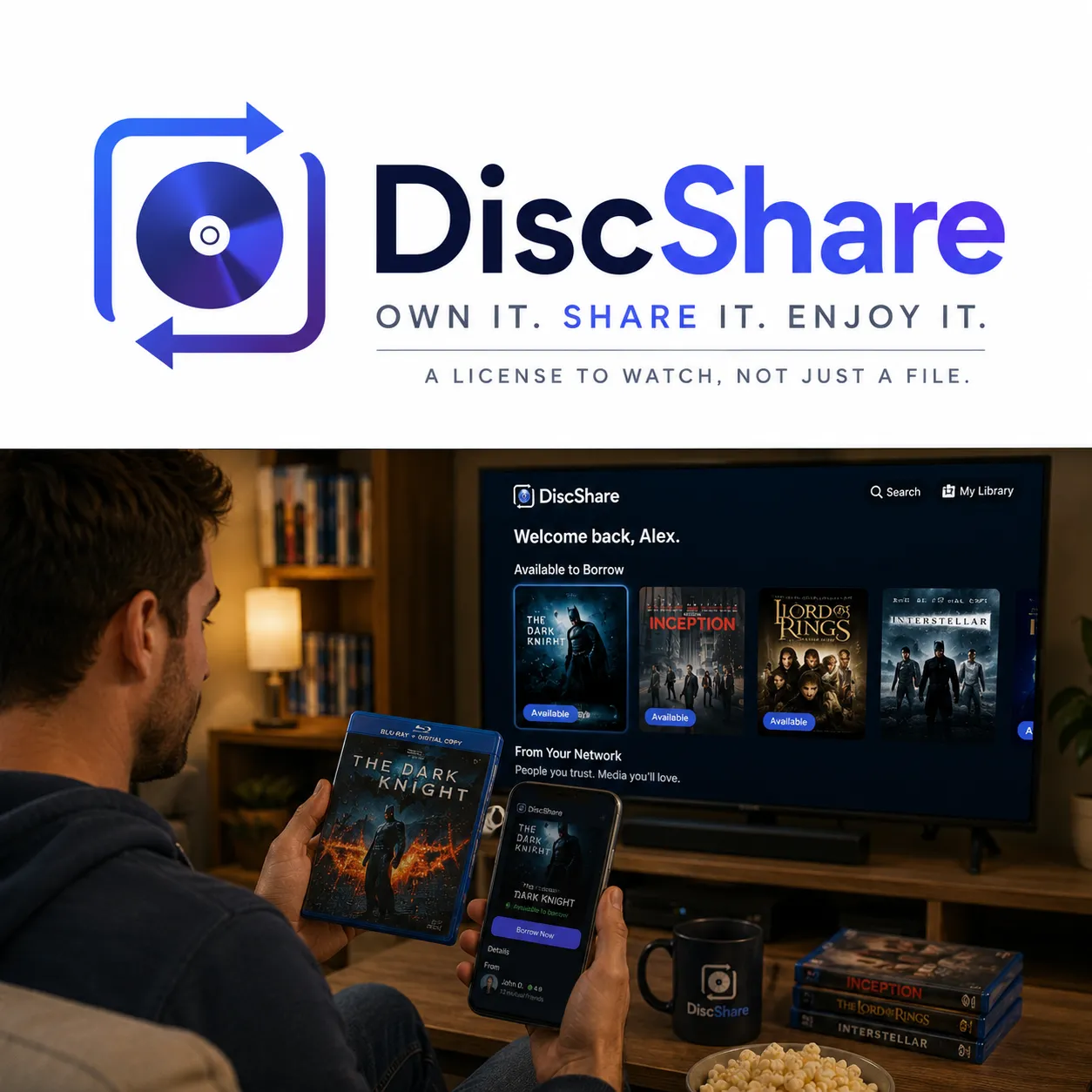
Millions of DVDs and Blu-rays sit unused on shelves while consumers continue paying for multiple streaming subscriptions or resort to piracy because there is no simple way to digitally lend physical media they already own. A Shared Physical Media License Network gives those collections new life by allowing users to register their physical copies and temporarily share those licenses with others in the network. Each registered copy can only be used by one person at a time, creating an experience that mirrors borrowing a physical disc rather than distributing unlimited digital copies. Members gain access by contributing their own collections, turning millions of idle movies into a community-powered library. As streaming services become increasingly fragmented, subscription costs continue rising, and interest in physical media ownership has begun to rebound, consumers are looking for legitimate alternatives that maximize the value of the content they've already purchased. Someone with hundreds of Blu-rays could unlock thousands of additional titles from other collectors while their own collection remains available to the community whenever it isn't being used.
Description
No additional description provided.
The Pitch
Expose an inefficiency streaming created: the world already bought an enormous long-tail catalog, then rebuilt access to that catalog through rented, fragmented subscriptions. The strange opportunity is that ownership did not disappear; it just became socially useless. A service that makes private collections temporarily liquid turns a dusty household asset into shared cultural infrastructure.
The most interesting insight is that scarcity is not a weakness here. Most digital media businesses try to eliminate scarcity, which is exactly what makes rights holders defensive and piracy attractive. Tying access to one registered physical copy used by one person at a time gives the system a familiar moral shape: it feels like lending, not copying. That constraint may make the product less convenient than piracy, but more legitimate than most attempts to “unlock” owned media.
The business also benefits from the fact that movie availability has become emotionally unreliable. Consumers are learning that streaming catalogs are not libraries; they are rotating storefronts. A film can vanish because of a licensing window, a tax write-off, a corporate merger, or simple neglect. Physical collectors increasingly look less like nostalgic hobbyists and more like people preserving access to culture that platforms treat as inventory. A network built on their collections could become valuable precisely because it is anchored in objects that cannot be silently delisted.
Contribution-based access is powerful because it changes the psychology from consumption to membership. A person with a modest shelf of discs is not just paying to enter a catalog; they are bringing something the catalog needs. That creates a different kind of supply engine than a traditional licensing business, because every new participant can improve the library for everyone else. The service becomes more useful as it attracts the kind of people who already care enough about films to own them.
The deeper business case is that there is a large gap between “I own this” and “this is useful to me.” Most households have media whose value is trapped by format, hardware, and inconvenience. If that value can be reactivated without pretending ownership is the same as unlimited digital distribution, the company would sit in a rare position: cheaper than endless subscriptions, cleaner than piracy, and more durable than any single streaming catalog.