Shared Entity Mapping Knowledge Network
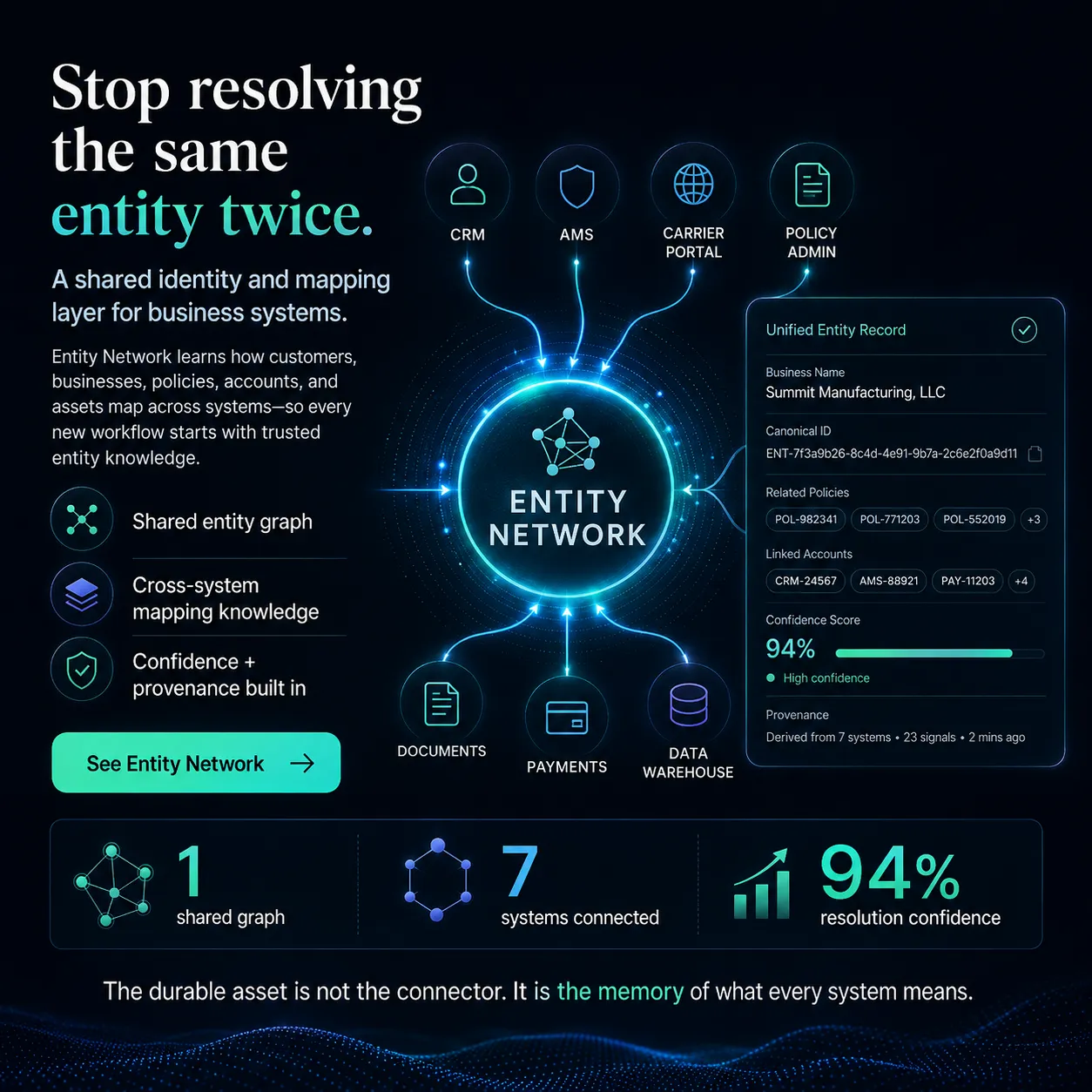
Make entity and mapping knowledge shared infrastructure rather than something every company reconstructs privately. Entity Network would maintain a continuously improving graph of how real-world businesses, people, policies, accounts and assets are represented across thousands of software systems, with provenance and confidence attached to every relationship. Why now: connectors are becoming commoditized, while the hard part increasingly is knowing whether two records actually describe the same thing and how their structures correspond. Example: a carrier receives a submission from an unfamiliar agency system and the network already understands how that system represents insureds, locations and coverages because those mappings have been resolved elsewhere.
Description
No additional description provided.
The Pitch
Entity resolution is one of the few software problems where everyone pays the cost, but almost nobody gains strategic advantage from solving it alone. A carrier, bank, hospital, or logistics company may spend years reconciling counterparties, subsidiaries, account hierarchies, products, addresses, contracts, and policies across systems, yet the result is usually trapped inside internal data plumbing. The work is expensive precisely because it is repetitive across institutions. The same mismatched names, legacy schemas, vendor fields, and ambiguous relationships are being rediscovered thousands of times in parallel.
The business becomes powerful if its knowledge improves with exposure. Unlike a static data vendor, the asset is not just a database of entities; it is a memory of how different systems describe reality. Each resolved ambiguity teaches the network something reusable: that one platform’s “primary insured” is another’s “named account,” that a particular identifier is unreliable after a merger, that a location record often represents a campus rather than a building. Over time, the hard-to-copy asset is not coverage of entities alone, but accumulated judgment about equivalence, hierarchy, and meaning across messy operational contexts.
This is especially interesting because the center of gravity in integration is shifting from moving data to interpreting data. APIs and connectors make it easier to access records, but they do not answer the more consequential question: what does this record correspond to in the world, and can it be trusted? As more workflows become automated, small mapping errors become operational risks rather than clerical annoyances. A shared entity layer would sit at the point where automation most often breaks: the gap between syntactic compatibility and semantic confidence.
The company would also benefit from a rare trust dynamic. Most firms are reluctant to share proprietary data, but they have a strong reason to share derived reconciliation knowledge if the underlying sensitive records can remain protected. A network that preserves provenance and confidence could let participants benefit from collective learning without exposing their customer files wholesale. That makes the idea less like a marketplace for data and more like a utility for reducing duplicated uncertainty.
If it worked, the business would become most valuable in domains where relationships matter more than individual records. Real-world commerce is full of entities that change names, split, merge, act through intermediaries, use inconsistent identifiers, and appear differently depending on the system observing them. Owning the connective tissue between those representations would make the company a quiet dependency beneath a large share of institutional software.