Shared Dataset of AI Reasoning Paths
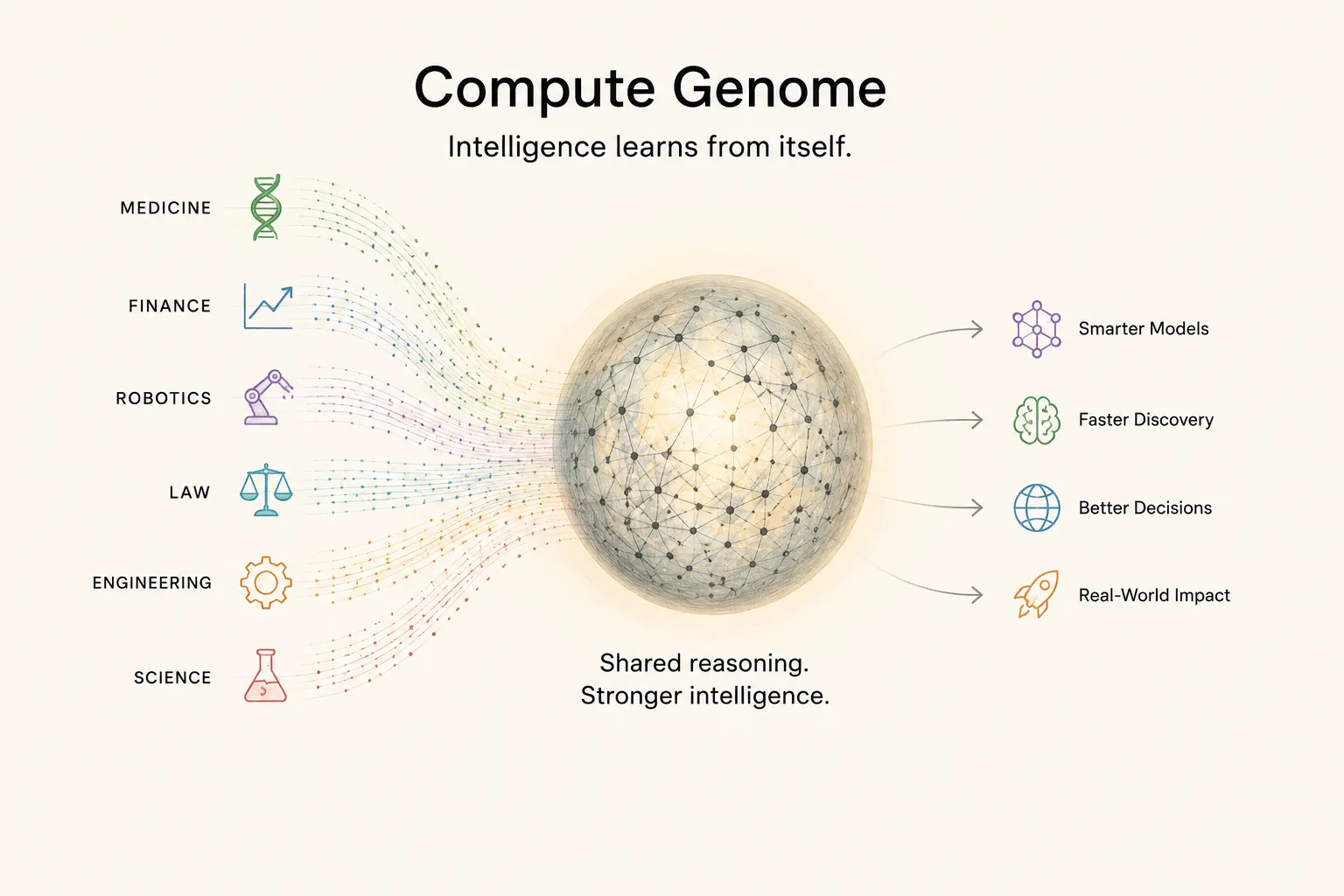
Today’s AI models learn from human-generated data, but in an inference-first world, the largest dataset on Earth may become AI’s own reasoning. Every inference contains valuable information about how intelligence solves problems, yet those reasoning paths disappear the moment an answer is returned. This startup builds the Compute Genome: a shared intelligence layer that captures, anonymizes, and organizes billions of successful reasoning trajectories across industries. Instead of training future models on static internet content, they learn from how AI has actually solved real-world problems. A pharmaceutical model could reuse reasoning patterns first discovered in materials science, while a logistics AI benefits from planning strategies developed in robotics. If the internet became the training data for language models, the Compute Genome could become the training data for the next generation of intelligence.
Description
No additional description provided.
The Pitch
Inference may become more valuable than content. The internet was valuable training material because it recorded what humans had already expressed. But the more interesting artifact of AI use is not the final answer; it is the hidden search process behind the answer. A correct response is like a photograph of a solved problem. The reasoning path is closer to the experiment log: what was tried, rejected, combined, abstracted, and compressed. If intelligence work increasingly happens inside models, then the exhaust of that work becomes a new kind of raw material.
This business would sit at a strange but powerful choke point: between model makers, enterprises, and the growing universe of AI agents doing useful work. Individual companies will generate valuable reasoning data, but most of them will see only their own narrow slice of problems. The real compounding happens when patterns generalize across domains. A scheduling insight from hospitals, a constraint-solving pattern from chip design, and a decomposition strategy from legal research may rhyme more than their surface vocabulary suggests. A company that can recognize and package those transferable structures would not merely collect data; it would turn isolated problem-solving events into reusable cognitive infrastructure.
The non-obvious value is that successful reasoning trajectories may age better than facts. Facts decay, documents become outdated, and web data is polluted by duplication, spam, and synthetic filler. But a robust way to break down uncertainty, navigate tradeoffs, or search a solution space can remain useful across many contexts. That makes this less like building another data warehouse and more like building a library of reusable methods discovered in the wild. The asset is not “more text”; it is evidence of what kinds of thinking actually worked when exposed to reality.
There is also a structural reason this should exist outside any single model company. If one lab owns the feedback loop, the world gets narrower intelligence: optimized around one architecture, one customer base, and one set of incentives. A shared, privacy-preserving layer could make the market for reasoning more liquid, allowing progress in one corner of the economy to improve tools elsewhere without exposing the underlying secrets. The business works if it becomes trusted as a neutral memory layer for machine intelligence.
The deeper thesis is that AI creates a new resource: solved cognition. Today it is mostly discarded. A company that captures it safely could become important for the same reason search engines became important after the web appeared: not because they created the world’s information, but because they made its hidden structure usable.