Shared AI Threat Intelligence Network
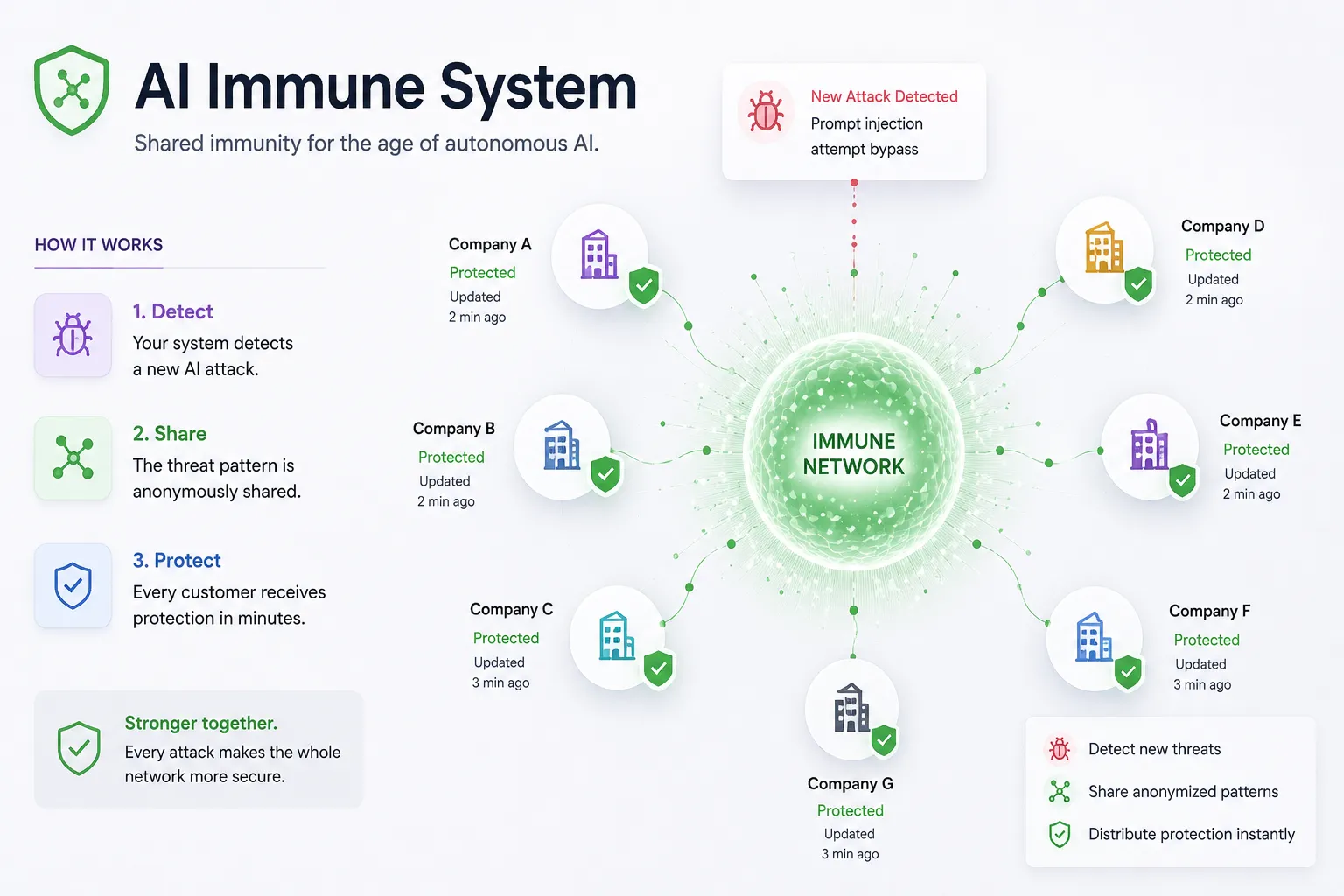
Every company is discovering AI vulnerabilities independently, even though the same attacks quickly spread across every model and enterprise. Security teams repeatedly solve identical problems because there is no shared defense layer for AI behavior. An AI Immune System would allow companies to anonymously contribute newly discovered jailbreaks, prompt exploits, deception strategies, and agent failures into a shared network that continuously updates protection for every participant. The platform becomes smarter with every incident rather than every customer learning the same lesson alone. As AI systems become increasingly autonomous, the speed of defense will matter more than the sophistication of individual security teams. A retailer discovering a prompt that tricks a customer service agent into exposing confidential pricing could protect thousands of other companies within minutes.
Description
Every company is discovering AI vulnerabilities independently, even though the same attacks quickly spread across every model and enterprise. Security teams repeatedly solve identical problems because there is no shared defense layer for AI behavior. An AI Immune System would allow companies to anonymously contribute newly discovered jailbreaks, prompt exploits, deception strategies, and agent failures into a shared network that continuously updates protection for every participant. The platform becomes smarter with every incident rather than every customer learning the same lesson alone. As AI systems become increasingly autonomous, the speed of defense will matter more than the sophistication of individual security teams. A retailer discovering a prompt that tricks a customer service agent into exposing confidential pricing could protect thousands of other companies within minutes.
The Pitch
AI risk does not behave like traditional software risk. A SQL injection flaw may live in one application; a successful prompt attack can become a reusable technique across thousands of deployments because the underlying models share behavioral similarities. The strange economic fact is that one company’s embarrassing failure is often another company’s early warning signal. Today that signal is trapped inside legal reviews, internal incident reports, and private Slack threads.
The business works if it becomes the place where AI incidents are converted into immunity rather than shame. Companies have strong reasons not to publicly disclose how their agents were manipulated, what data was exposed, or which workflows failed. But they have equally strong reasons to benefit from everyone else’s discoveries. An anonymized exchange solves a coordination problem: the value is collective, but the contribution has to feel safe. The company that can turn raw, sensitive failures into sanitized defensive patterns would sit in a privileged position between secrecy and shared survival.
The most interesting feature of this market is that the attackers already collaborate, even if informally. Jailbreaks, exploit prompts, and agent manipulation tricks spread through forums, social media, research papers, and screenshots faster than corporate controls can adapt. Defenders, by contrast, are organized around individual vendors and internal policies. That asymmetry creates a natural opening for a shared defensive network. The goal is not perfect security; it is making the half-life of an exploit dramatically shorter.
As AI agents gain permission to issue refunds, query databases, write code, negotiate with customers, and trigger business processes, the boundary between “bad answer” and “security incident” disappears. AI safety stops being a research concern and becomes an operational dependency, like fraud detection for payments or spam filtering for email. In those categories, the best systems improved because they saw more attacks than any single customer could see alone. AI defense is likely to follow the same pattern: breadth of exposure becomes a durable advantage.
The deeper thesis is that model providers alone cannot own this layer. Enterprises will use many models, wrap them in custom tools, and expose them to different incentives, data, and users. The dangerous behavior often emerges in the interaction between the model, the tool, the policy, and the business context. A neutral immune layer that learns across those environments could become valuable precisely because it is not tied to one model’s worldview. Its advantage would be accumulated memory of how AI systems fail in the wild.