Semantic Usage Billing for Software APIs
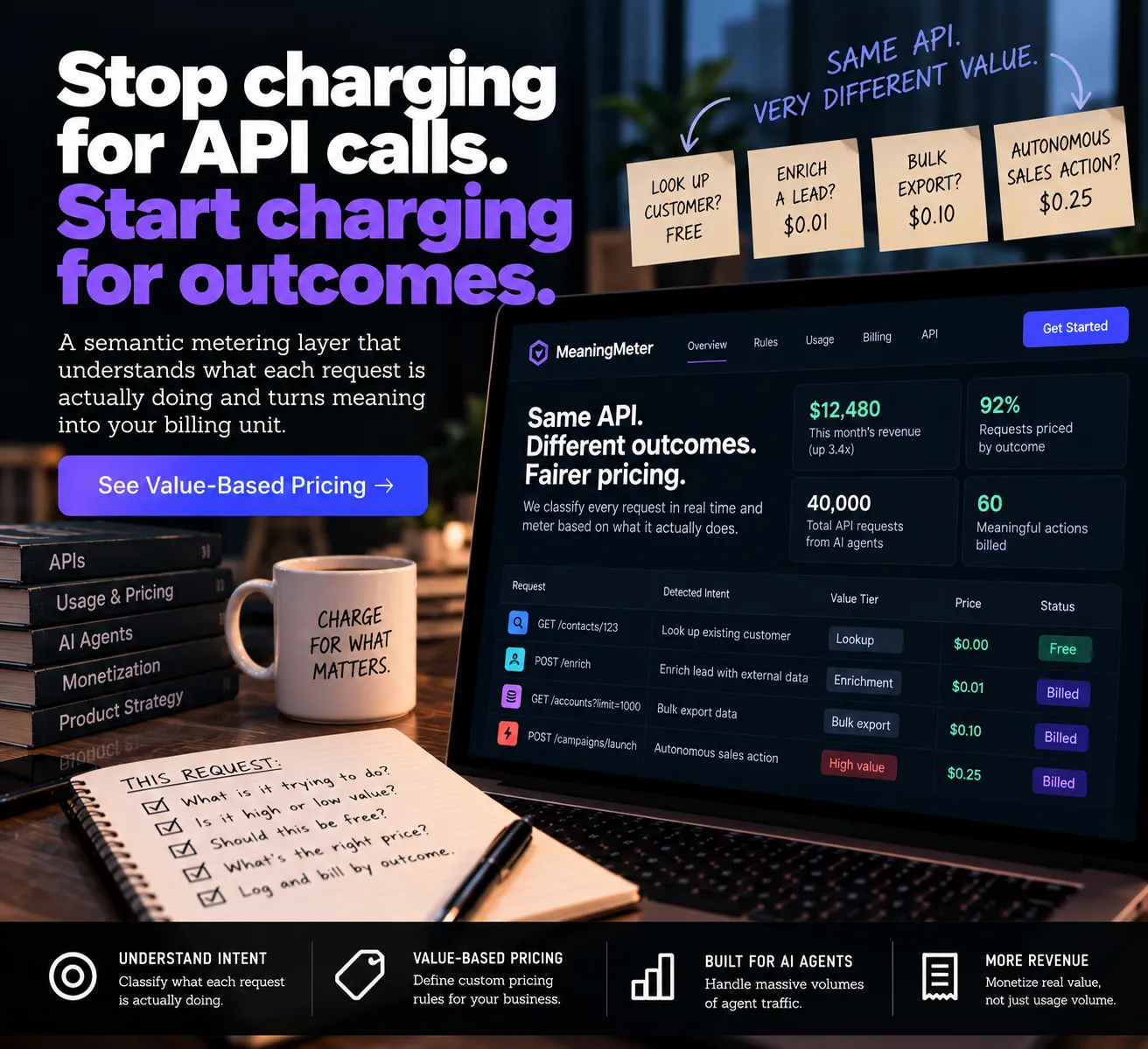
Software pricing still measures mechanical things like seats, API calls, tokens, and storage, even when two identical-looking actions create completely different amounts of value. Build a semantic metering layer that judges what each request is actually trying to accomplish and turns that meaning into the billing unit. A CRM lookup could be free, a prospect enrichment worth a penny, a bulk export worth ten cents, and an autonomous sales action worth twenty-five cents, even if they all touch the same API. This becomes possible now because models like Jev can classify intent, value, and risk cheaply enough to evaluate every request in real time. Imagine an AI agent making 40,000 API calls in a day but being billed for only the 60 meaningful business actions it actually completed. That's a product that needs to exist.
Description
No additional description provided.
The Pitch
Software is entering a period where usage is exploding while customer willingness to pay for raw usage is collapsing. AI agents can generate thousands of calls, reads, writes, and intermediate steps to complete one task, which makes infrastructure-based pricing feel arbitrary and punitive. The more capable the software becomes, the more absurd the old meters become: the customer does not care how many tokens were consumed to resolve a billing dispute, update an account, or qualify a lead. They care that the job happened.
The deeper opportunity is that billing has always been a crude proxy for trust. Seat pricing assumed humans were the scarce actors. API pricing assumed machine calls were scarce. Token pricing assumes computation is scarce. But in AI-mediated software, the scarce thing is neither labor nor calls nor compute; it is permission to take consequential action. A company that can reliably distinguish harmless retrieval from valuable completion from risky autonomy becomes a kind of economic control plane for software. It does not merely meter usage; it defines what the customer and vendor agree is worth paying for.
This also changes the psychology of adoption. Today, customers hesitate to unleash agents because every exploratory step can become a cost event, and vendors hesitate to offer generous access because heavy users can destroy margins. Semantic metering creates a more natural bargain: experimentation can be cheap or free, while completed outcomes and high-value actions carry the price. That removes one of the strangest frictions in modern software, where the path to value is billed almost as heavily as the value itself.
The business becomes especially interesting because the billing layer would sit at the boundary between product behavior and economic value. Once embedded, it would see the difference between lookup, enrichment, workflow execution, export, automation, and decisioning across many products. That is an unusually privileged position. Over time, it could become the shared vocabulary by which software companies describe what their products actually do, in economic rather than technical terms.
The most durable insight is that as software becomes more autonomous, pricing cannot remain syntactic. Charging for visible mechanics worked when humans clicked buttons and machines passively responded. When machines start deciding, chaining, and acting, the unit of commerce has to move up a level. The company that makes meaning billable would not just improve monetization; it would make the next generation of software feel fair enough to use.