Semantic Search Engine for Social Media Followers
Every day, valuable relationships slip through the cracks because social networks are built around usernames, not people. A founder might have top investors, potential customers, journalists, or future hires already following them without ever realizing it. The solution is a semantic search engine for your Instagram or X followers that lets you search in plain English: "Founders in NYC who follow me," "VCs interested in AI," or "Designers in San Francisco." It could also alert you whenever someone notable starts following you, ensuring important connections never go unnoticed. Large language models now make it possible to understand who people are from their bios and content, turning your follower list from a static directory into a searchable relationship graph. Your network is already your biggest asset—it just needs a better interface.
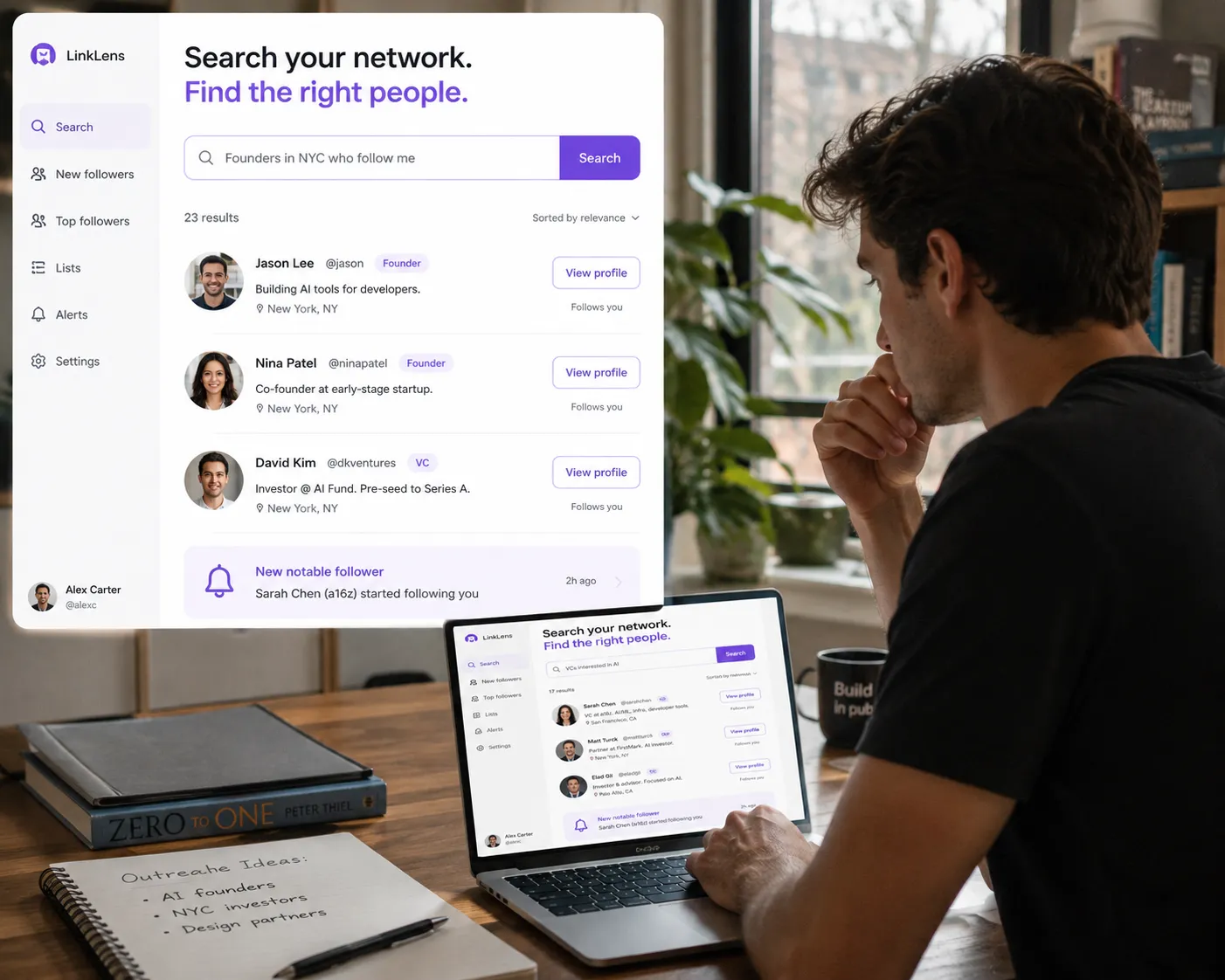
Description
No additional description provided.
The Pitch
Social platforms have trained people to accumulate followers, but they mostly expose that audience as a feed metric, not as a relationship database. A person with 20,000 followers may have less practical access to their network than someone with a well-kept spreadsheet of 200 contacts. The gap is strange: the platform knows who is connected to whom, the user has earned the attention, but the value remains locked behind a chronological interface.
The most interesting customers are people for whom a single overlooked relationship can materially change an outcome. A founder does not need to message every follower; they need to know that a partner at the right fund quietly followed six months ago. A journalist does not need a larger audience; they need to spot sources before a story breaks. A recruiter, creator, operator, or salesperson often has latent demand already circling them, but social products are optimized for broadcasting to strangers rather than recognizing warm paths to specific people.
This also benefits from a subtle behavioral truth: people are often more comfortable following than introducing themselves. A follow is a low-friction signal of curiosity, affinity, or status recognition. Most relationship tools start after contact has been made, but much of the opportunity lives one step earlier, in weak intent that has not yet turned into conversation. Reading that signal well could be more valuable than another cold outbound tool, because it begins with permission-light proximity rather than interruption.
The business works if it becomes the personal CRM that people actually keep updated, because the data updates itself. Traditional CRMs fail individuals because they require discipline: logging meetings, tagging contacts, remembering context. A social graph is different. It is alive by default. People change jobs, rewrite bios, start companies, move cities, gain credibility, and reveal interests publicly. The product’s job is not to make users maintain another database, but to notice when the database has changed in ways that matter.
The deeper thesis is that professional networks are becoming less explicit and more ambient. Influence, hiring, fundraising, sales, and collaboration increasingly begin as lightweight public signals scattered across social platforms. Whoever gives individuals a clear lens into those signals is not merely making search better; they are changing the moment at which a relationship becomes visible. In a world where opportunity often arrives disguised as a follower notification, recognizing it first is a real advantage.