Self-Updating Personal Knowledge OS
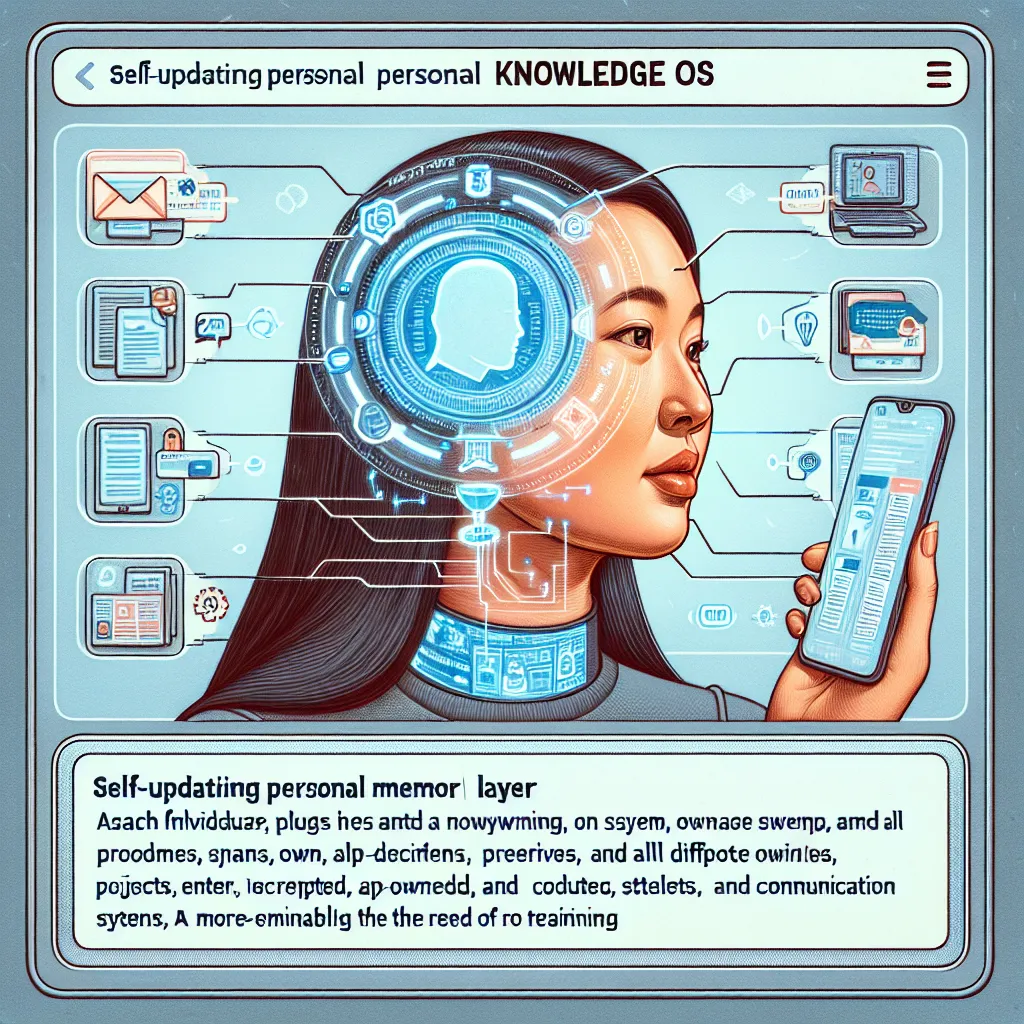
LLMs today act like goldfish — every session starts fresh. Users have scattered digital lives: emails, docs, apps. A Self-Updating Personal Knowledge OS would sync and organize this mess continuously, creating a persistent memory layer portable across LLMs. It’s not a chat history — it’s an evolving personal operating system. Why now? As AI agents get smarter, they need context to act truly personal. The OS would be encrypted, user-owned, and LLM-agnostic. Example: A freelancer plugs their Knowledge OS into a new AI agent and instantly gets project summaries, preferences, and communication styles from the past five years — no retraining.
Description
No additional description provided.
The Pitch
In today's fast-paced digital landscape, individuals often juggle multiple platforms and services, leading to fragmented personal data scattered across various devices and applications. This scenario presents a significant challenge: the lack of a cohesive, continuous memory layer that seamlessly integrates with evolving AI technologies. As a result, users frequently experience the frustration of starting anew with each interaction, unable to capitalize on past interactions and accumulated knowledge.
The core problem lies in the ephemeral nature of current AI interactions. Large Language Models (LLMs), despite their advancements, effectively have amnesia at the start of every session. This lack of continuity limits the ability of AI agents to provide truly personalized experiences. In an increasingly digital world, individuals need a system that intelligently syncs, organizes, and recalls their personal data across various platforms.
Enter the Self-Updating Personal Knowledge Operating System — a transformative solution designed to address this gap. Instead of merely retaining chat histories, this evolving OS creates a persistently updated layer of personal memory. By continuously syncing with emails, documents, and applications, it serves as a dynamic repository of user information that can be instantly accessed and utilized by any LLM or AI agent.
The timing for such a solution is ideal. AI technologies are advancing rapidly and are poised to become more deeply integrated into everyday life. For AI agents to become genuinely personal and context-aware, they require a robust framework that provides a nuanced understanding of the user's history, preferences, and communication styles. This Personal Knowledge OS offers precisely that by being encrypted, user-owned, and LLM-agnostic.
To illustrate the potential of this system, consider a freelancer. By plugging their Knowledge OS into a new AI agent, they can instantly access project summaries, preferences, and unique communication nuances from the past five years. This capability eliminates the need for retraining the AI and allows for immediate, tailored interactions.
Launching such a solution as a Minimum Viable Product (MVP) would involve the strategic use of several tools and technologies. A combination of cloud storage solutions like AWS or Google Cloud, alongside integration platforms such as Zapier for connecting various apps and services, would form the backbone of the OS. Security is paramount, so implementing strong encryption protocols and ensuring data ownership remains with the user are critical during the development phase.
The Go-To-Market (GTM) strategy would focus on showcasing the distinct advantages of the Personal Knowledge OS to potential users. Initial outreach could target early adopters such as tech-savvy professionals and freelancers who would benefit immediately from streamlined workflows. A robust online presence, informative webinars, and partnerships with AI developers would facilitate market entry and awareness.
In terms of business model, a subscription-based approach provides a balance between accessibility and sustainability. Offering tiered plans based on storage needs and advanced features could cater to diverse user segments. Additionally, a freemium model could entice users to sample the product's capabilities before committing financially.
Ultimately, the Self-Updating Personal Knowledge Operating System stands to reshape interactions with AI, enabling a more personalized, efficient, and integrated digital experience. As society continues to embrace artificial intelligence, the opportunity to unify and harness personal data across platforms will become increasingly invaluable.