Self-Doubt Sandbox: Improving AI Answer Robustness
LLMs are brittle because they never “test” their answers before shipping them. The solution: a Self-Doubt Sandbox, a background simulation where AI agents stress-test their own outputs against counterfactuals before responding. It’s like a wind tunnel for ideas: the answer must survive multiple simulations before being shown to the user. Why now? GPT-5’s incremental improvements highlight that raw scale isn’t enough — robustness requires structural upgrades. Example: a financial AI recommends an investment strategy, but before surfacing it, it runs 50 alternative scenarios and tells the user: “This works in 48/50 simulations, but breaks in cases of prolonged inflation.”
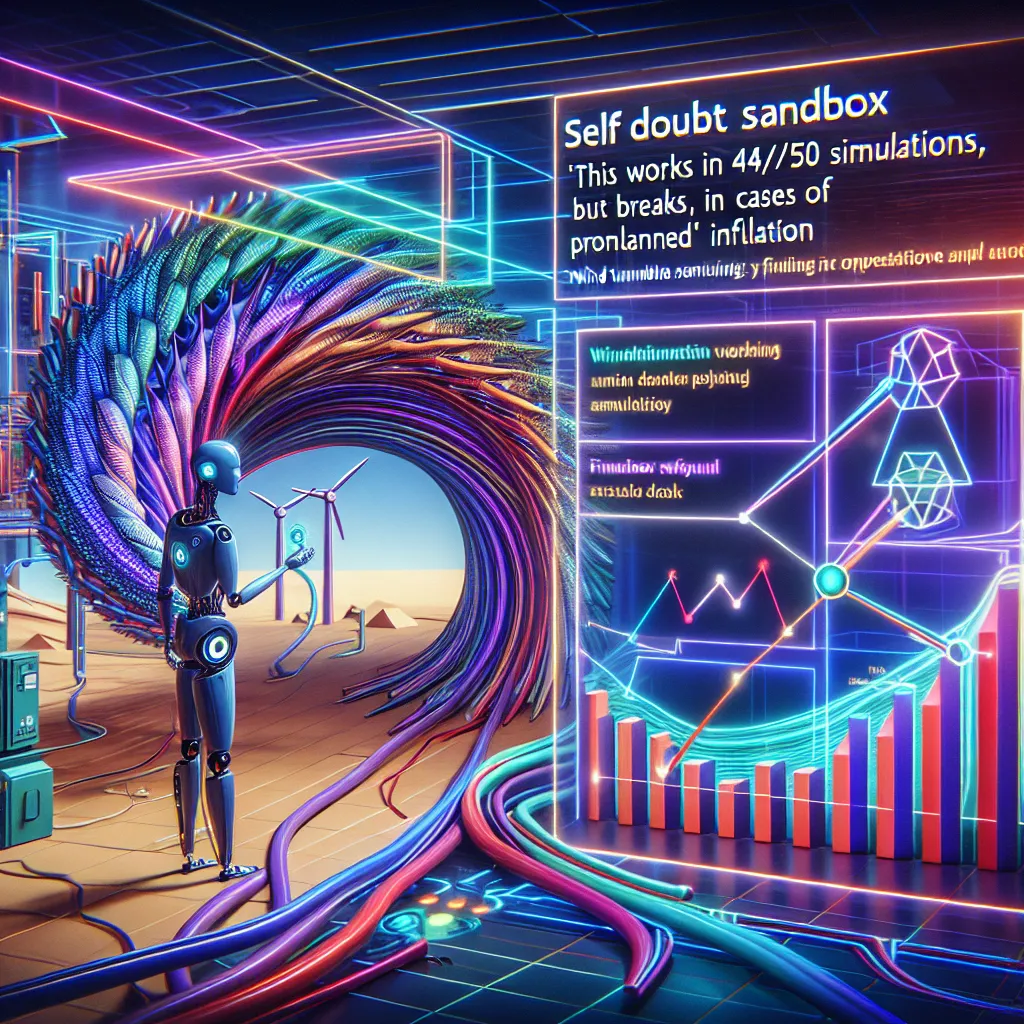
Description
No additional description provided.
The Pitch
As AI technologies continue to evolve, their integration into various industries, especially finance, healthcare, and autonomous systems, necessitates a higher standard of reliability. Despite advancements in language models, such as GPT-5, users often encounter the brittleness of AI responses that lack contextual robustness. This challenge arises because these models generate outputs based on trained data but rarely test their conclusions before presenting them.
**Problem:**
Current language models generate responses based on probabilities, without verifying their correctness in different scenarios. This results in outputs that may be convincing but not reliable, particularly in critical applications like financial advice. Users require assurances that AI recommendations will hold under varying conditions and stress.
**Solution:**
The Self-Doubt Sandbox is a novel approach to fortifying AI systems by embedding a layer of simulation that tests AI outputs against multiple counterfactual scenarios before presenting a final response. By stress-testing responses, this system aims to provide users with greater confidence in the AI's recommendations.
**Product Details:**
1. **Simulation Environment:** Before delivering an output, the AI runs numerous simulations with varying parameters, simulating different real-world conditions.
2. **Output Analysis:** The AI assesses the outcome of these simulations. For example, a financial strategy suggested by the AI is analyzed under scenarios like market volatility or prolonged inflation.
3. **Feedback Mechanism:** The AI generates a report detailing how the suggested output performed across various simulations. Users receive information like This strategy is effective in 48 out of 50 scenarios but may falter in the event of prolonged inflation.
4. **User Customization:** Users can tailor simulation parameters to align with their specific concerns, enhancing relevance and trust.
**Tools for Easy MVP Launch:**
1. **AI Model Integration:** Leverage existing language models such as GPT-5, incorporating an additional simulation layer. 2. **Scenario Builder:** Develop a customizable interface for defining parameters and alternate scenarios. 3. **Simulation Algorithms:** Create algorithms that can efficiently run simulations and analyze outcomes. 4. **API Development:** Offer an API for businesses to integrate the Self-Doubt Sandbox with their existing systems.
**Go-to-Market Strategy:**
1. **Targeted Industries:** Focus on industries where reliability is paramount, starting with finance, healthcare, and legal sectors. 2. **Partnerships:** Collaborate with financial institutes, hospitals, and law firms to pilot the technology. 3. **Educational Campaigns:** Conduct workshops and seminars showcasing the value and functionality of the Self-Doubt Sandbox. 4. **Case Studies:** Develop case studies demonstrating how the simulation layer improved AI reliability in real-world applications.
**Business Model:**
1. **Subscription Service:** Offer a tiered subscription model for access to the simulation environment and API based on usage needs. 2. **Enterprise Licensing:** Provide bespoke solutions for large enterprises requiring tailored simulation capabilities. 3. **Consulting Services:** Offer consulting to help companies integrate and maximize the Self-Doubt Sandbox in their AI solutions. 4. **Data Insights:** Generate additional revenue through data insights and analysis services.
By implementing a Self-Doubt Sandbox, the reliability of AI systems can be significantly improved, building user trust and expanding the horizons of AI applications in critical sectors.