Secure AI Vendor Evaluation Escrow
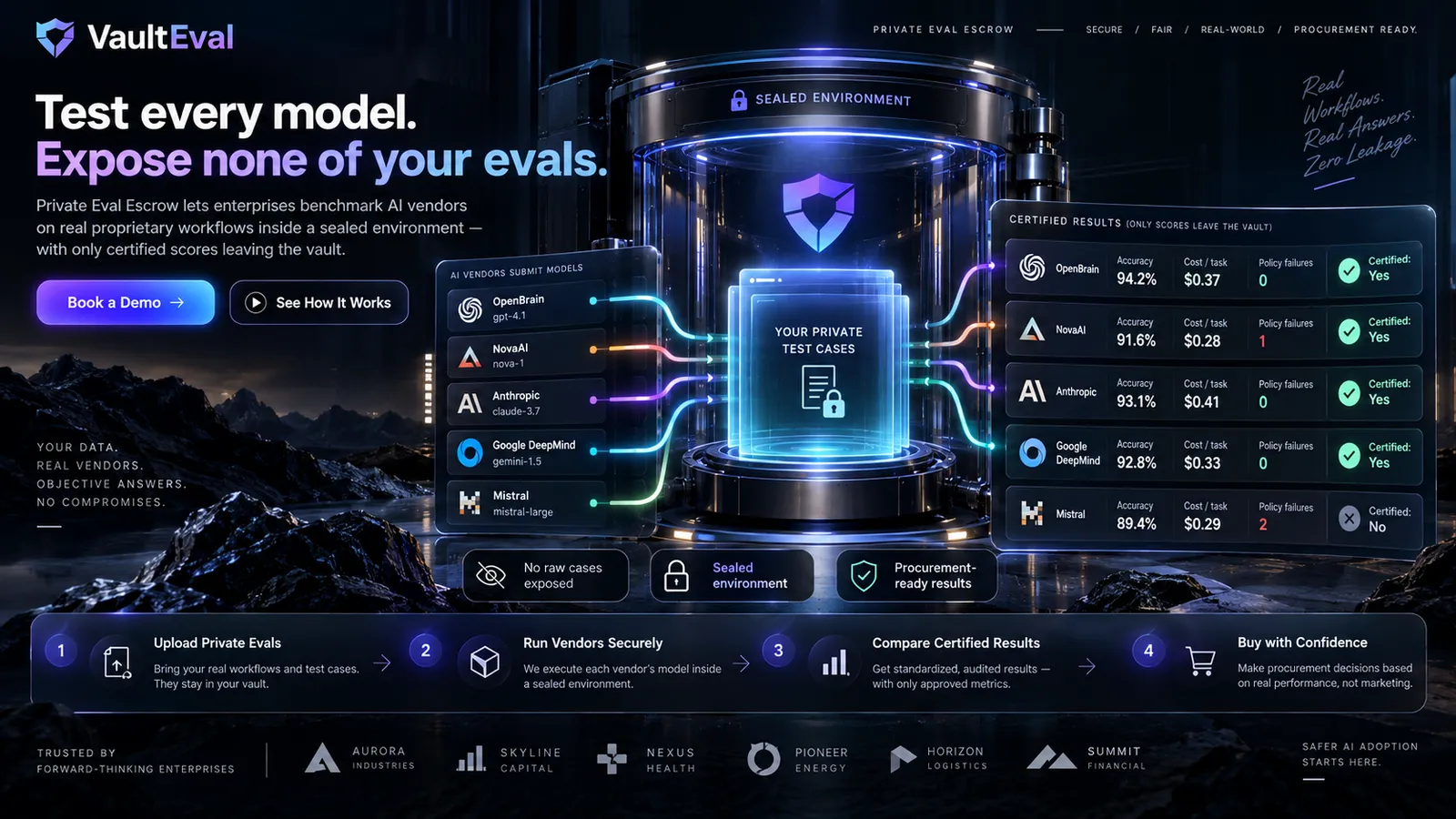
Enterprise eval suites are becoming valuable intellectual property because they encode real workflows, edge cases, risk tolerances, and exactly what a company considers a correct outcome, but companies still need outside AI vendors to prove they can pass those tests without exposing the tests themselves. Build a secure eval escrow where a company uploads its private benchmark once and vendors run their agents against it inside a sealed environment, receiving only approved scores and certification results. This matters now because enterprises are evaluating more models and agent vendors while becoming increasingly reluctant to hand proprietary workflows and sensitive examples to every provider they test. Imagine a bank letting five AI vendors compete on 10,000 private compliance scenarios while none of them ever sees the underlying cases, and procurement receiving a simple certified comparison of accuracy, cost, and failure rates.
Description
No additional description provided.
The Pitch
Evals are quietly becoming the new procurement interface for AI. In older software markets, buyers compared feature lists, security questionnaires, and reference calls. With AI agents, none of that is enough, because the real question is not what the system claims to do but how it behaves on a company’s messy, specific, politically sensitive work. Whoever controls the trusted testing layer sits at the point where marketing language is converted into measurable performance.
The strange inversion is that the buyer’s benchmark may become more valuable than the vendor’s demo. A generic model benchmark decays quickly because everyone trains toward it, but an enterprise’s private eval improves as it absorbs incidents, exceptions, policy changes, and institutional memory. It becomes a living map of what the organization actually cares about. That makes it too valuable to distribute, yet too useful to keep locked away. A neutral escrow resolves that tension by letting the benchmark be used without being revealed.
This business would also benefit from a structural asymmetry: vendors need access to serious buyers more than buyers need another unverified vendor claim. If a credible enterprise says, “Passing our sealed eval is the condition for consideration,” vendors will tolerate restrictions they would reject in other contexts. Over time, the escrow could become a kind of common courtroom for AI performance disputes: not deciding which system is best in the abstract, but establishing what happened under rules both sides accepted.
The deeper reason this could matter is that AI purchasing will likely fragment into thousands of domain-specific judgments. There may be no universal “best” agent for insurance claims, legal review, customer support, or financial analysis, because correctness depends on each institution’s rules, history, and appetite for error. A secure evaluation intermediary makes that fragmentation manageable. It allows each company to preserve its own definition of quality while still creating a repeatable market mechanism for comparing suppliers.
If it worked, the company would not merely sell testing infrastructure. It would hold the place where enterprise trust is operationalized. In markets where the cost of a wrong answer is high, the winner is not always the most capable system; it is the system that can prove its capability under conditions the buyer believes are real.