Seasonal Attraction Conversion for Local Businesses
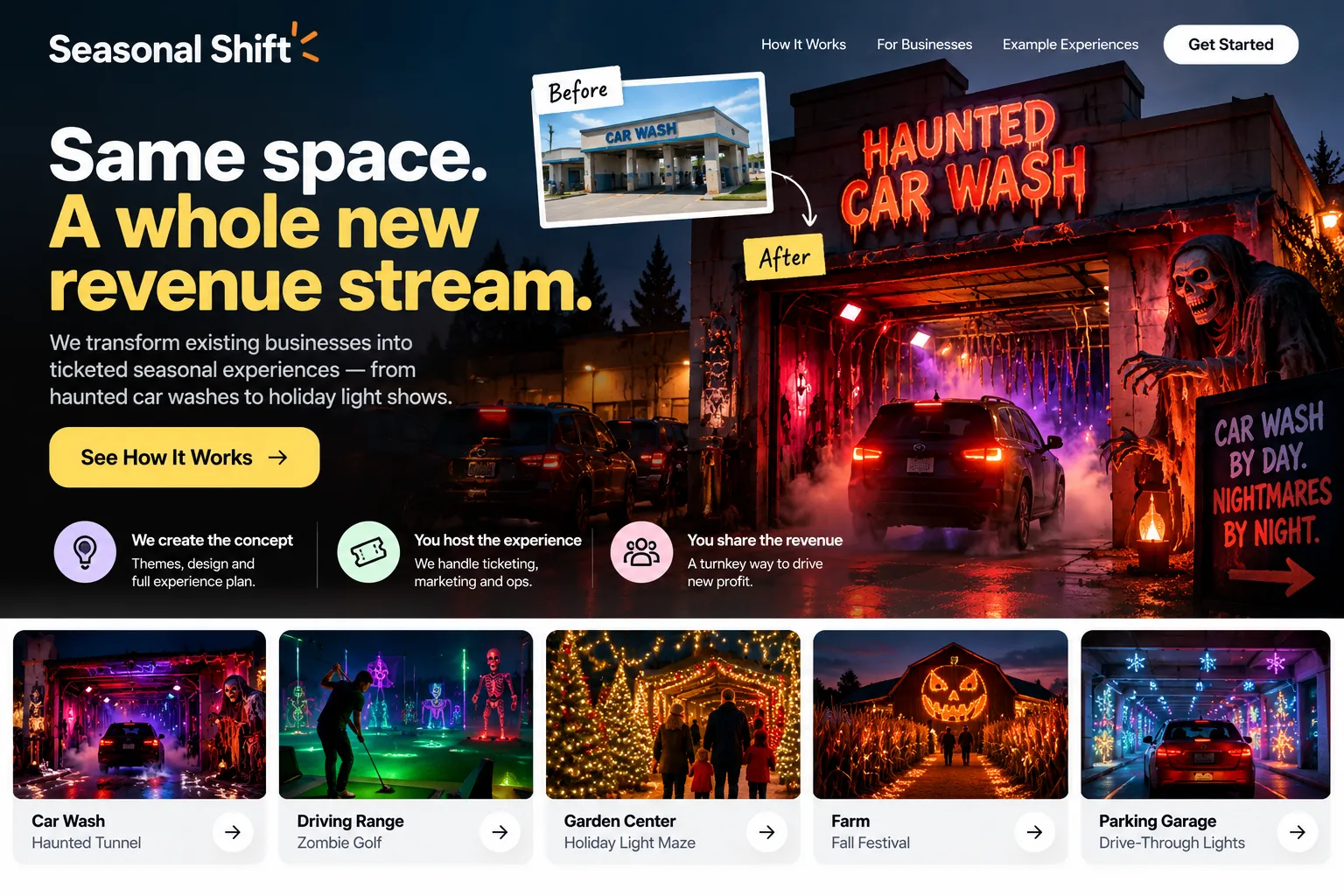
Thousands of local businesses own expensive physical spaces that generate revenue in only one predictable way, even though the same property could become something completely different for a few weeks each year. Build a company that temporarily transforms ordinary businesses into ticketed seasonal attractions by providing the concept, set design, equipment, staffing playbook, ticketing, marketing, and revenue-sharing model. A car wash could become a haunted tunnel, a driving range a zombie golf course, a garden center a Christmas light maze, or a parking garage a drive-through holiday show. This becomes more compelling as consumers spend more on experiences while local businesses look for new ways to monetize existing real estate without permanently changing their core operation. Imagine a suburban car wash turning four October weekends into a sold-out haunted attraction that generates more profit than an ordinary month of washes.
Description
No additional description provided.
The Pitch
This business starts with a strange asymmetry: local real estate is valued as if it has one identity, but customers are perfectly willing to experience it as another. A car wash is infrastructure most days, but in October its tunnels, darkness, water, machinery, and waiting lanes already resemble a theatrical set. The hidden asset is not just unused capacity; it is the accidental drama inside ordinary places. This company would make money by recognizing that many boring properties are one temporary story away from becoming destinations.
The most interesting part is that the host business does not need to become an entertainment company. Seasonal attractions are operationally awkward: they require taste, props, safety judgment, labor coordination, ticketing, insurance thinking, crowd control, and local promotion. Most owners will never attempt them because the distance between “good idea” and “professionally executed attraction” is too wide. A specialized operator can collapse that distance, making transformation feel closer to renting a food truck than producing a live event.
The economics are appealing because the calendar does a lot of the marketing. Halloween, Christmas, Valentine’s Day, summer nights, and local school breaks already create consumer permission to seek novelty. People do not need to be convinced that a haunted car wash or light maze is useful; they need to see that it exists nearby and looks fun enough to share. The scarcity of a short run also turns an otherwise modest local activity into something with urgency, which is rare for small businesses that usually depend on routine traffic.
This model also fits the way local entertainment spreads. A temporary attraction is inherently visual, geographically specific, and conversation-worthy. It gives families, teenagers, and friend groups a reason to visit a business they might otherwise ignore, while giving the business a story more memorable than a discount. The host is not merely renting out space; it is borrowing cultural relevance for a few weeks.
What makes the idea durable is that the company could develop a library of repeatable transformations while each installation still feels local and novel. The same underlying playbook can move from market to market, but the customer experiences it as a one-of-one event tied to a familiar place. That combination—standardized behind the scenes, surprising from the street—is often where strong physical businesses are born.