Safety Certification Platform for Physical AI
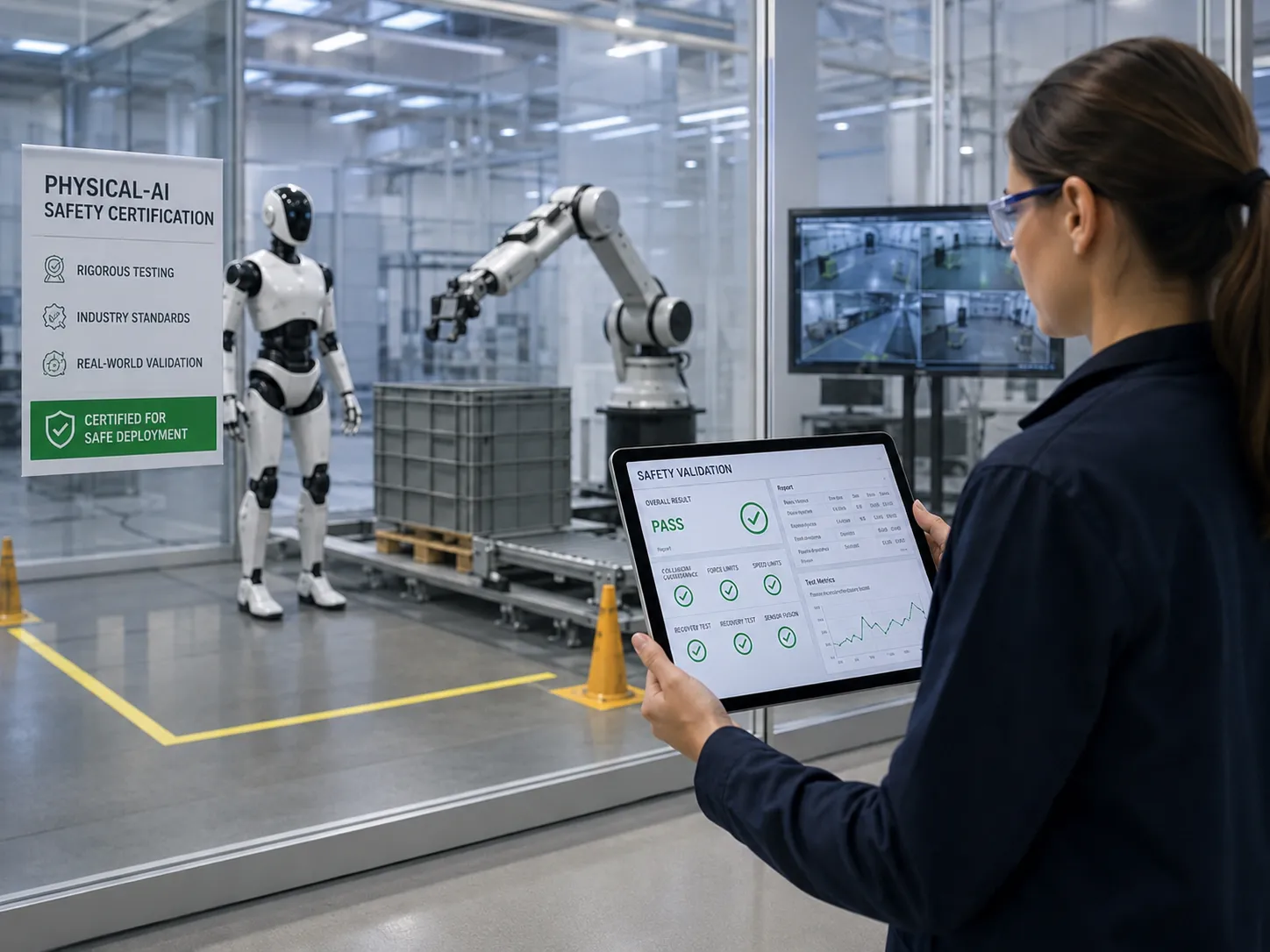
As NVIDIA expands into robotics, autonomous vehicles and industrial systems, companies need to establish not merely that a model is accurate, but that the full hardware-and-software system behaves safely in the physical world. Build a continuous testing and certification platform for physical-AI systems. It would run simulated edge cases, inspect software and hardware changes, track regulatory requirements and issue a continuously updated safety score or deployment certificate. A warehouse robotics company could test every software release against thousands of simulated human-interaction scenarios before deploying it to customer facilities. Insurers, regulators and enterprise buyers could require the certificate. The business could become a form of Underwriters Laboratories for physical AI.
Description
No additional description provided.
The Pitch
Physical AI turns software risk into bodily risk. A bad recommendation engine annoys users; a bad warehouse robot injures someone, damages inventory, shuts down a site, and creates a liability trail. As robots and autonomous systems become cheaper to build, the scarce thing will not be another model or sensor stack. It will be trust that the whole machine behaves acceptably when the world gets weird.
The old software testing model breaks down here because the important failures live in combinations: a firmware update, a worn sensor, a lighting change, a child-sized obstacle, a wet floor, a slightly different pallet, a model retrained on new data. No buyer or regulator can manually reason through those interactions release by release. A company that accumulates the best library of physical edge cases would become more valuable over time, because its advantage would be the map of how real machines fail, not just the tooling used to test them.
This could also sit in a powerful position between manufacturers and the institutions that bear the consequences. Enterprise buyers do not want to become robotics safety experts just to purchase automation. Insurers do not want to underwrite black boxes. Regulators do not want to approve static systems that change every week. A continuously updated certificate gives each party a shared reference point: not a guarantee of perfection, but a way to convert a vague technical risk into something comparable, auditable, and contractible.
The most interesting business dynamic is that certification can become part of distribution. If large customers, insurers, or facility operators begin to require proof of testing, vendors will not treat it as optional compliance work; they will need it to sell. That makes the platform less like a testing utility and more like a market passport. The certificate’s value grows as more buyers recognize it, and the underlying test corpus improves as more systems pass through it.
There is also a timing asymmetry. The companies building physical AI want to move at software speed, while the world they are entering still thinks in industrial safety cycles. The winning intermediary will translate between those tempos. It will let builders ship frequently without asking customers to accept blind trust, and it will let conservative industries adopt intelligent machines without pretending that one-time approval is enough for systems that never stop changing.