Royalties for Employee AI Corrections
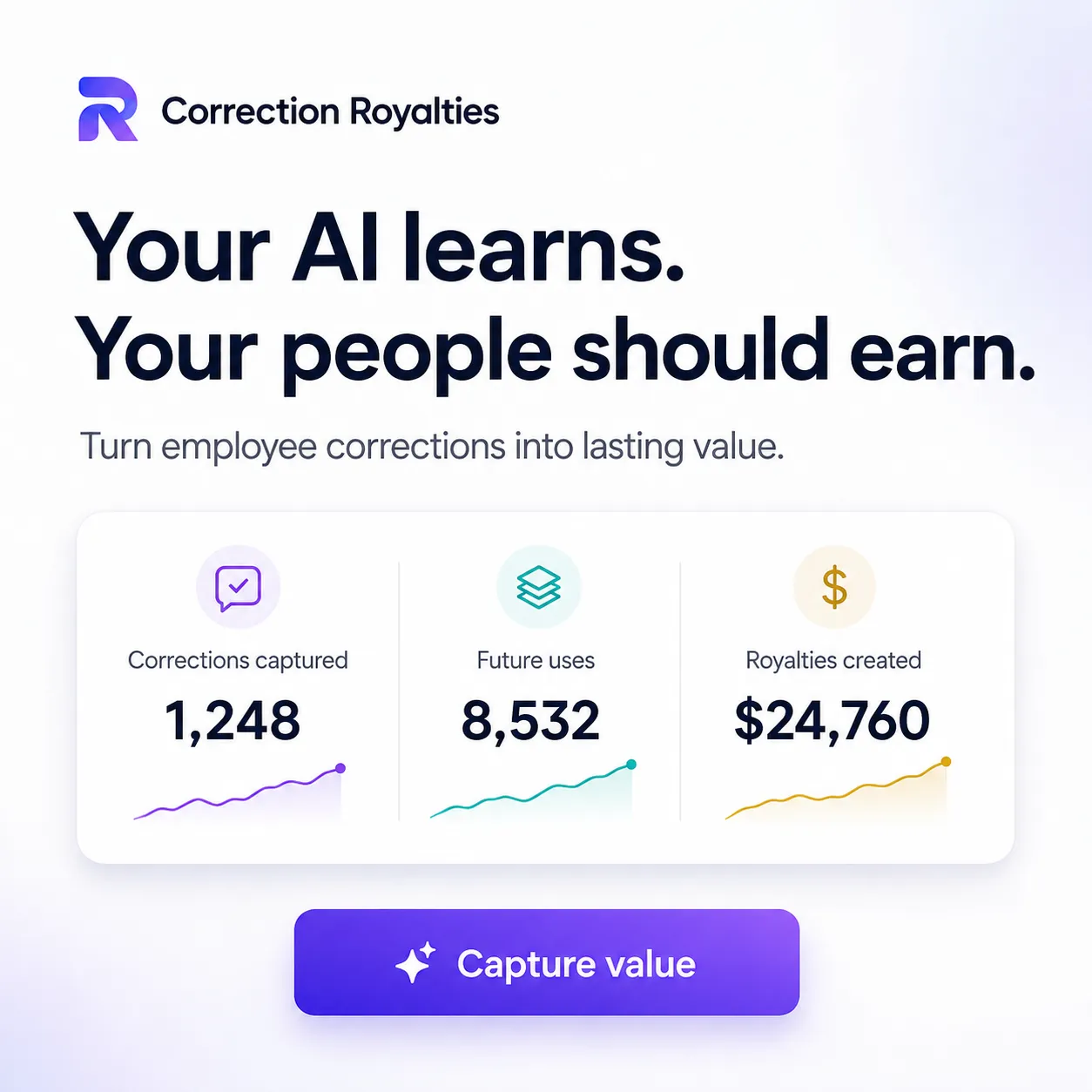
Every time an employee fixes an AI output, they’re creating something potentially more valuable than the work itself: a lesson that can improve every future output. Today that knowledge disappears into a thumbs-down button or model feedback log. Correction Royalties would track which human corrections become durable rules and measure how often those rules create value later. If one lawyer’s correction prevents 20,000 future contract errors, or one salesperson teaches an agent an objection response used for years, that contribution could earn ongoing compensation. Once employee judgment becomes reusable machine capital, companies may need a way to pay the people who created it.
Description
No additional description provided.
The Pitch
A business like this would matter because it recognizes a new kind of labor that companies are currently treating as exhaust. The valuable moment is not when an employee uses an AI system successfully; it is when the system fails and the employee knows exactly why. That correction captures context, taste, risk tolerance, domain judgment, and institutional memory in a compressed form. In many knowledge businesses, those qualities are more defensible than the underlying model.
The most interesting shift is that AI turns individual judgment into infrastructure. A lawyer’s redline, a support agent’s rewritten answer, or an engineer’s rejected code suggestion may stop being a one-time act of expertise and become part of the operating system for everyone else. That creates an attribution problem companies have mostly avoided until now: if human judgment is being absorbed into a machine that produces future economic output, who gets credit when that judgment keeps paying off?
This could become especially compelling inside large organizations because the best corrections often come from the people closest to edge cases, not from the people officially responsible for training systems. The employee who sees the weird exception, the subtle customer objection, or the risky clause may be creating the data that makes the whole system commercially useful. Without a mechanism to recognize that, companies risk teaching employees to treat AI errors as annoyances to work around rather than assets to refine.
The business also sits at the intersection of incentive design and trust. Employees are more likely to improve AI systems if they believe their contributions will not simply be extracted and used to make them replaceable. Compensation is not only a reward mechanism; it is a signal that the company distinguishes between routine usage and durable expertise. That distinction could become important in retaining high-skill workers in environments where AI is steadily absorbing their visible output.
The larger insight is that AI adoption will not only require better models; it will require economic systems for human-machine collaboration. Companies already understand royalties for music, patents, sales commissions, and content licensing because they accept that some contributions keep generating value after the original act. Correction royalties apply that same logic to judgment. If AI makes expertise scalable, then the businesses that know how to measure and reward the sources of that expertise may build better systems and healthier organizations at the same time.