Risk Control Layer for Autonomous AI Agents
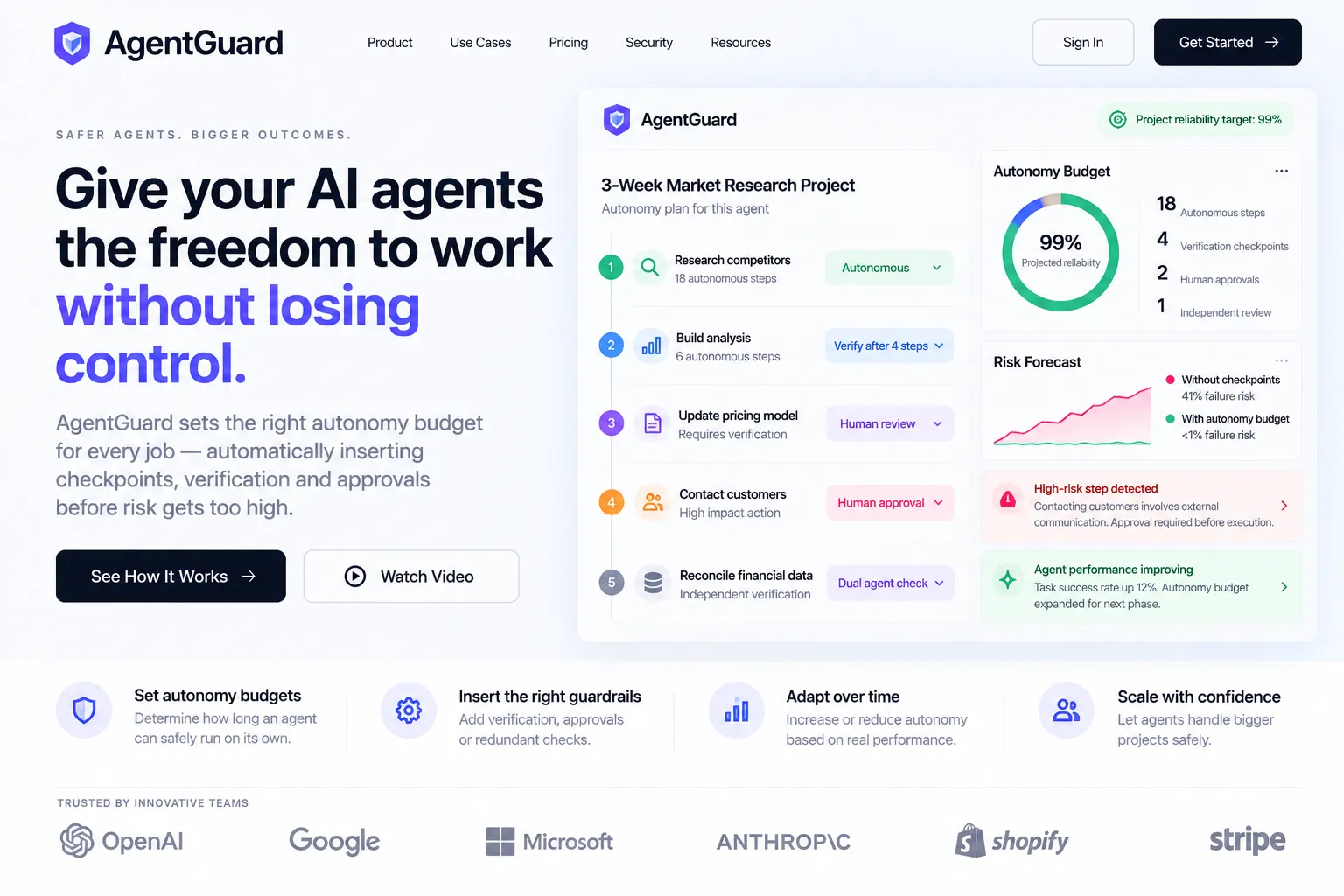
AI agents are starting to take on projects that run for days or weeks, but even a highly reliable agent can become dangerous when small errors compound across dozens of dependent steps. Build an autonomy-control layer that measures how reliably an agent performs each type of work, calculates how long it can safely operate without intervention, and automatically inserts checkpoints, independent verification, or human approval before accumulated risk gets too high. This matters now because agents are moving from short tasks into long-running business workflows where one unnoticed mistake can contaminate everything that follows. Imagine an agent running a three-week research project autonomously for 18 low-risk steps, requiring verification before changing a pricing model, and stopping for approval before contacting customers or moving money.
Description
No additional description provided.
The Pitch
"Better agents,” but a control system for deciding how much independence any agent deserves in a specific situation. That distinction matters because autonomy will not be granted all at once. It will be rationed, expanded, and revoked based on evidence. The company that becomes the meter for that trust could sit above every model, tool, and workflow, because the question is not which agent is smartest; it is how far this agent should be allowed to go before someone checks its work.
The non-obvious insight is that reliability is not a single score. An agent may be excellent at summarizing documents, mediocre at reconciling conflicting data, and unacceptable at making external commitments. Businesses do not need a philosophical answer to whether AI is “safe.” They need a practical boundary: this kind of agent, doing this kind of work, with these consequences, can operate for roughly this long before risk becomes too concentrated. Turning judgment into an operational limit is what makes autonomy usable inside real organizations.
This becomes more valuable as workflows become longer, because risk in agentic work is path-dependent. A small mistake early in a chain can quietly become the premise for twenty later decisions, making the final output look polished while being fundamentally corrupted. Traditional software monitoring catches system failures; it is poorly suited to catching reasoning drift, bad assumptions, or misplaced confidence. A business that understands accumulated cognitive risk would provide a new form of infrastructure: not uptime monitoring, but judgment monitoring.
The business also benefits from being model-agnostic in a world where model leadership will keep changing. If companies are constantly swapping models, chaining tools, and mixing internal and external agents, the stable layer is the one that records performance by task, consequence, and context. Over time, that layer becomes a memory of what different agents can be trusted to do. It turns every completed workflow into evidence that improves future control.
The deepest reason this should exist is that businesses do not actually want full automation; they want calibrated absence. They want people removed from the boring parts without being absent at the consequential moments. A company that can place human attention exactly where it has the highest marginal value would not merely reduce labor. It would make AI feel less like a reckless substitute for people and more like an organization with a nervous system.