Revolutionary Smart Screens Powered by Light
Most displays — even advanced ones like VR or holograms — rely on power-hungry graphics chips to work. They process data in one place and send it to the screen. But what if the screen was the processor? With the recent 2025 discovery of tunable light and magnetism in 2D materials, it’s now possible to build displays that do real-time logic using light alone. This means a screen could respond, compute, and update visuals instantly — without needing a chip or heavy hardware. Why now? Before this discovery, displays couldn’t process data — they only showed it. Now they can think. Imagine an AR headset that updates visuals based on your movement without any GPU, battery pack, or wires. Or a thin holographic poster that responds to your gestures in real time. This is the future of screens — lightweight, low-power, and smart by design.
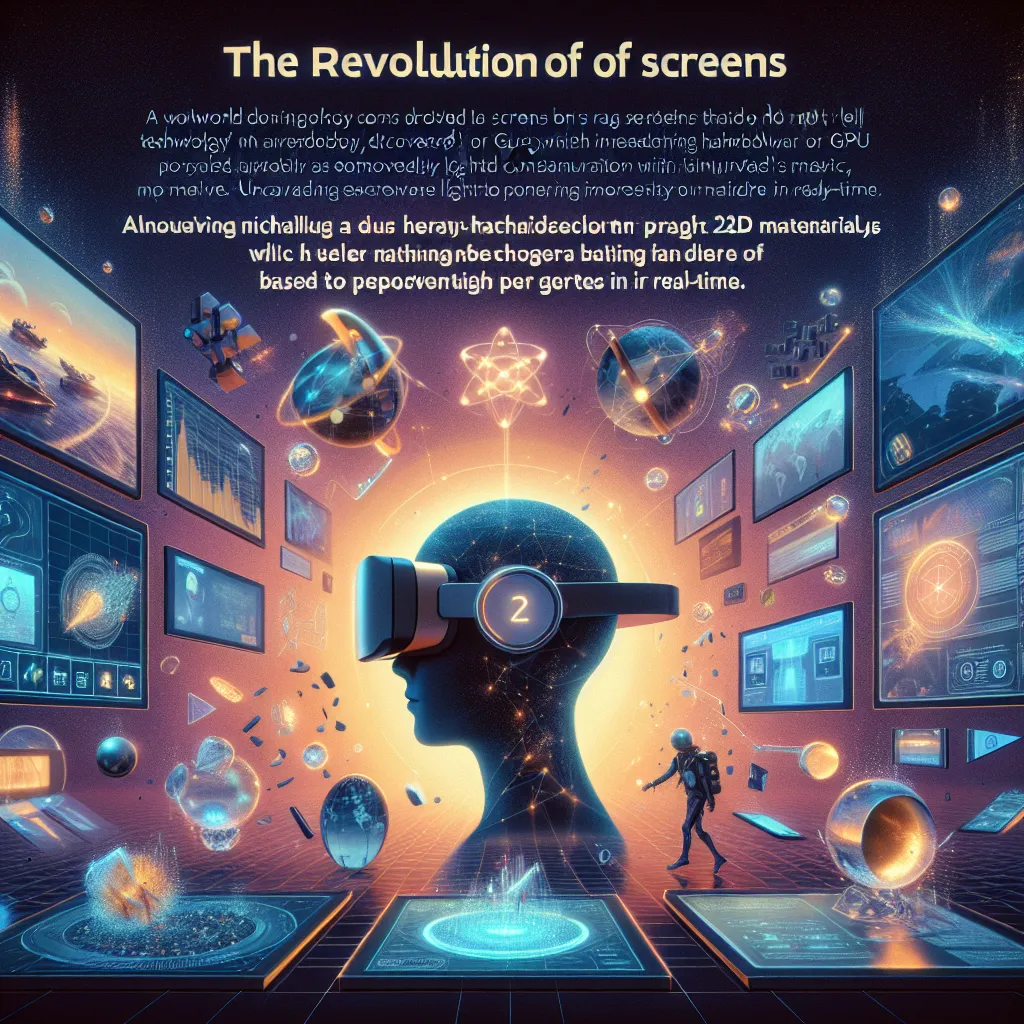
Description
No additional description provided.
The Pitch
As technology enthusiasts, innovators, and entrepreneurs, you're on the lookout for groundbreaking advancements that can redefine the way we interact with the digital world. The recent 2025 discovery of tunable light and magnetism in 2D materials is one such game-changer. This breakthrough paves the way for displays to not only show data but also process it in real-time, all without the need for traditional power-hungry graphics chips. It unlocks possibilities for completely new kinds of experiences with display technology that is lightweight, energy-efficient, and intelligent.
**Backstory**
Displays have long depended on external graphics processing units (GPUs) to operate, consuming significant power and often requiring additional heavy hardware supports, such as battery packs and wired connections. Despite improvements over the years in display resolutions and refresh rates, the fundamental method of operation has remained largely unchanged. Displays received data and simply rendered it, without the capability to process or react to information autonomously.
The discovery of tunable light and magnetism in 2D materials fundamentally changes this paradigm. By integrating these properties into display technology, screens can now be both display and processor, allowing them to perform computations using light alone. This means the potential for instant responses and visual updates, opening several areas for innovative applications.
**Problem**
Existing display technologies are limited by their dependence on external processing power, leading to several challenges:
1. Power Consumption: Traditional displays, especially those used in VR and AR, are power-intensive, often requiring sizable battery packs. 2. Hardware Bulk: The need for additional chips and hardware results in bulky designs, limiting portability and ease of use. 3. Lag and Response Time: Dependence on external processing can introduce delays in visual updates, impacting the user experience. 4. Limited Interactivity: Current displays cannot respond or adapt to gestures or environmental changes instantly.
**Solution**
The integration of 2D materials with tunable light and magnetism into displays offers a solution that addresses these challenges directly by enabling the display unit to act as its own processor:
1. Low Power: These displays require minimal energy, significantly reducing or potentially eliminating the need for large battery packs. 2. Compact Design: By removing the need for auxiliary processing units, designs can be sleek and lightweight. 3. Real-Time Responsiveness: Displays can update visuals and react to stimuli almost instantaneously without the lag caused by data transmission. 4. Enhanced Interactivity: With the ability to process input reactions directly, displays can offer a higher level of interaction, such as responding to gestures or environmental changes in real time.
**Product Details**
Imagine a next-generation AR headset with the following features:
- Integrated processing within the display unit using 2D material technology. - Ultra-lightweight design, eliminating need for traditional power sources. - Instantaneous visual update capabilities reflective of real-world interactions. - Wireless, seamless integration into everyday technology with minimal setup. - Adaptive brightness and contrast, responsive to ambient light conditions.
**Tools for MVP Development**
To develop a Minimum Viable Product (MVP), several steps and tools can be utilized:
1. **2D Material Integration**: Collaborate with research institutions or companies specializing in 2D materials for initial prototypes. 2. **Rapid Prototyping**: Use 3D printing and design tools like CAD software to create initial designs for the device casing and display. 3. **Software Development**: Develop a lightweight operating system using languages like Python or C++ for efficient processing on the new display tech. 4. **User Testing**: Employ UX design tools such as Sketch or Figma to plan intuitive user interfaces and rapidly adapt based on feedback.
**Go-to-Market (GTM) Strategy**
1. **Early Adopters**: Target tech enthusiasts and developers through platforms such as Kickstarter or Indiegogo to gather initial feedback and funding. 2. **Partnerships**: Partner with tech companies, universities, and research labs to develop and test prototypes. 3. **Expos and Conferences**: Showcase the technology at major tech expos and conferences to generate buzz and attract potential investors. 4. **Social Media & Online Campaigns**: Leverage platforms like YouTube, Instagram, and Tech blogs for video demonstrations and educational content about the technology. 5. **Pilot Programs**: Launch pilot programs with select enterprises in sectors like gaming, interactive advertising, or educational tools to demonstrate real-world applications.
**Business Model**
1. **Direct Sales**: Sell devices directly through e-commerce platforms and specialty tech stores. 2. **Licensing**: License the technology to other companies looking to innovate in the display sector. 3. **Subscription Models**: Offer software and content updates through subscription services to ensure users always have access to the latest features. 4. **Customization Services**: Provide bespoke display solutions tailored to specific industries such as retail, education, and healthcare.
This new era in display technology not only solves longstanding challenges but also opens the door to incredible innovation opportunities. As an entrepreneur or investor interested in cutting-edge technology, the potential for disruptive digital experiences is boundless.