Revolutionary Neural Dust Enables Real-Time Brain Monitoring
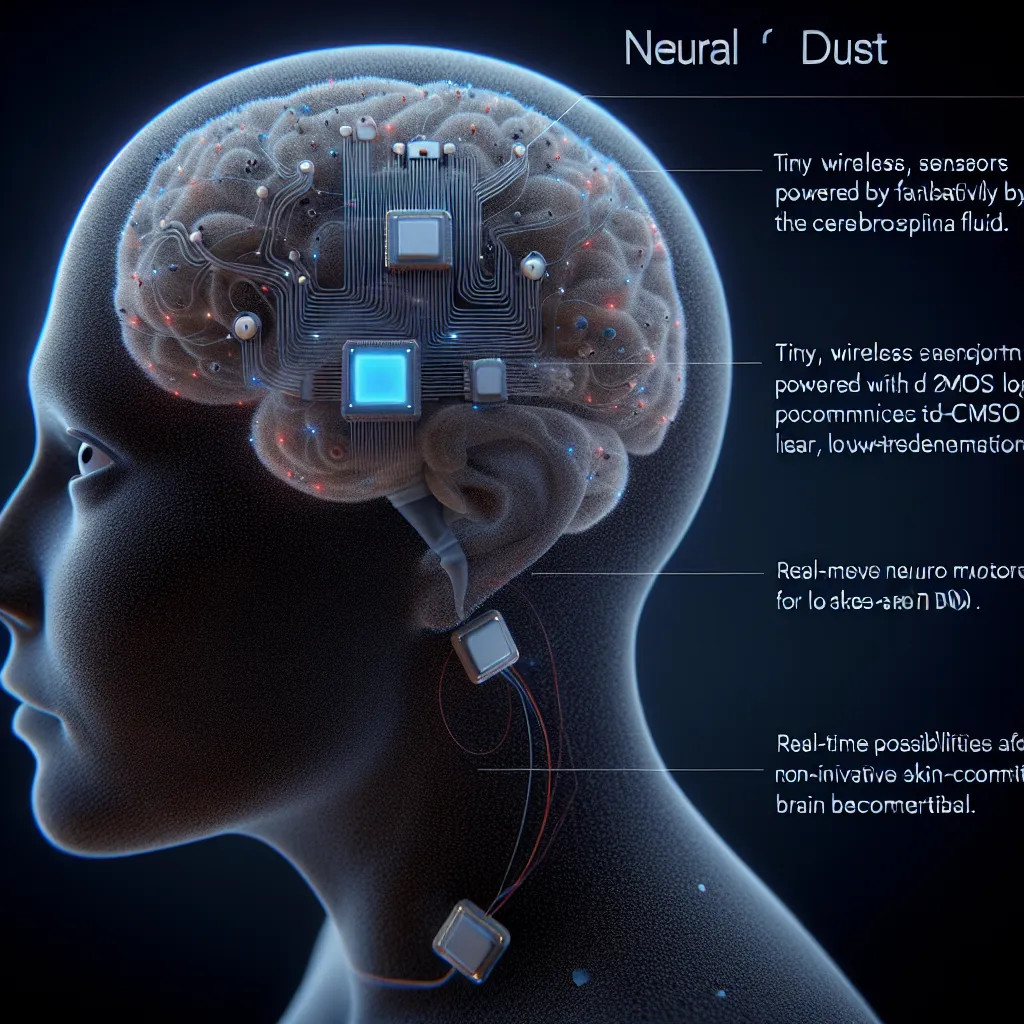
Understanding the human brain still requires invasive implants or bulky headsets with limited resolution. There’s no way to non-invasively monitor brain activity at high fidelity and resolution in real time. Now imagine neural “dust” — microscopic, wireless, flexible sensors powered by 2D-CMOS logic that float in the cerebrospinal fluid or rest harmlessly on the skull’s surface. These devices could passively track local neural activity and communicate with a patch on the skin via ultrasound or low-frequency RF. Until now, power and compute requirements made this unthinkable. But with atom-thin processors and near-zero power draw, real-time, large-scale brain monitoring becomes viable. In practice, this could enable new treatments for epilepsy, mood disorders, or neurodegeneration — and even lay groundwork for full-scale non-invasive BCIs (brain-computer interfaces).
Description
No additional description provided.
The Pitch
The intricacies of the human brain remain largely elusive, with contemporary scientific methods hampered by the necessity for either invasive procedures or cumbersome devices that provide limited resolution. Current technologies do not allow for high-fidelity, non-invasive monitoring of brain activity in real time. This is a significant barrier to developing advanced treatments for neurological conditions and exploring the potential of brain-computer interfaces. We propose a groundbreaking innovation: neural dust — tiny, wireless sensors with 2D-CMOS logic, engineered to float in cerebrospinal fluid or reside unobtrusively on the skull's surface. These sensors would possess the capability to track local neural signals and communicate via a wearable patch using ultrasound or low-frequency RF, shifting the paradigm of brain monitoring.
Background and Problem
Existing methods for monitoring brain activity are constrained by size, invasiveness, and lack of real-time fidelity. This limits research capabilities, clinical diagnostics, and treatment potential for a variety of neurological disorders. The need for accurate, high-resolution, and non-invasive monitoring solutions is paramount to advance our understanding of the brain and develop more effective therapies.
Proposed Solution
The innovation leverages recent advancements in nanotechnology and semiconductor engineering to create atomically thin sensors with minimal power consumption. These sensors effortlessly surpass previous technological barriers by enabling real-time, large-scale brain activity monitoring in a truly non-invasive manner. This advancement could revolutionize the treatment of conditions such as epilepsy, mood disorders, and neurodegeneration, and opens the door to the development of non-invasive brain-computer interfaces.
Product Details
The core of this solution is the neural dust itself — microscopic, flexible sensors that operate wirelessly, powered by 2D-CMOS logic. These sensors track neural activity at a localized level and communicate with an external patch that rests on the skin. The communication occurs through ultrasound or low-frequency RF technologies, providing a stable, non-intrusive connection for data collection and transmission.
Tools for MVP Launch
- Ultra-thin semiconductor materials - 2D-CMOS fabrication technology - Low-frequency RF and ultrasound communication components - Wearable patch development toolkit - Software for data analysis and visualization
Go-To-Market Strategy (GTM)
1. Regulatory Approval: Begin with medical compliance testing and acquire the necessary regulatory approvals for clinical trials in specific neurological disorder treatments.
2. Strategic Partnerships: Collaborate with neuroscience research institutions and medical device companies to aid in development, testing, and scaling.
3. Pilot Testing: Conduct pilot studies in partnership with hospitals and research labs to demonstrate efficacy and safety.
4. Marketing and Education: Employ targeted marketing campaigns aimed at neurologists, researchers, and healthcare providers to inform them of the product’s benefits and potential applications.
5. Incremental Rollout: Initially target niche neurological treatment areas with plans to expand to broader markets as the technology matures.
Business Model
- Direct Sales: Sell the neural dust sensors and accompanying technology directly to medical facilities and research institutions.
- Subscription Model: Offer a subscription-based model for data analytics software and continuous updates, providing ongoing value and support to users.
- Licensing: License the technology to other medical device manufacturers and research labs, creating additional revenue streams.
This approach focuses on leveraging cutting-edge technology to solve a critical problem in neuroscience, positioning the innovation at the forefront of brain monitoring solutions while paving the way for future development of brain-computer interface technologies.