Revolutionary BCI Enables Effortless ALS Communication
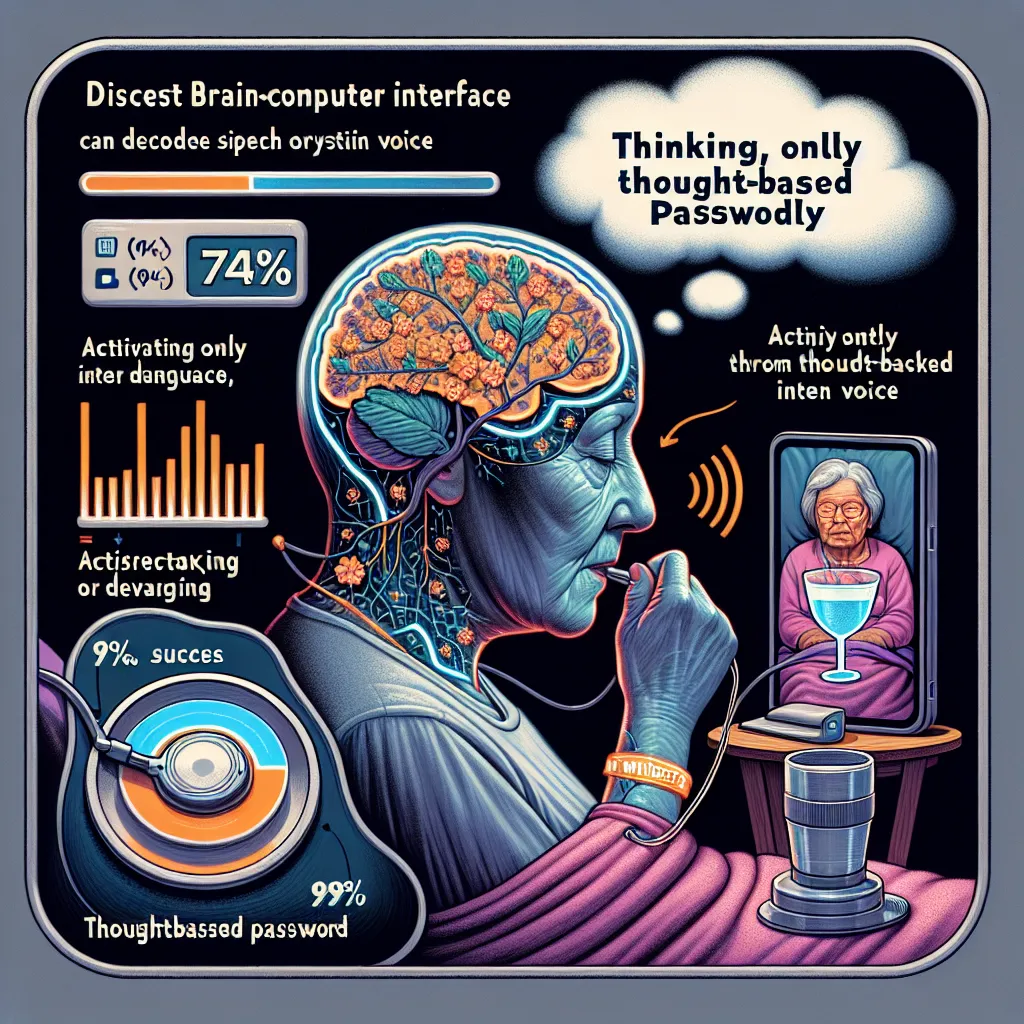
Millions with ALS, stroke damage, or vocal impairments struggle to communicate without bulky, slow devices. Traditional AAC (augmentative and alternative communication) tools require eye tracking or typing, which is exhausting. Solution: A discreet brain-computer interface (BCI) that decodes inner speech and transmits it as text or synthetic voice, activated only by a thought-based password to ensure privacy. Why Now: Researchers just achieved 74% accuracy in decoding inner speech and 98%+ success in thought-password recognition, meaning a limited-vocabulary communication tool is now feasible for real-world use. Example: A patient with late-stage ALS thinks “I’m thirsty,” which is instantly spoken aloud by their tablet in natural voice—no eye tracking, no delay.
Description
No additional description provided.
The Pitch
Millions of individuals living with conditions such as ALS, stroke-induced damage, or various vocal impairments face significant challenges in communicating effectively. Current technologies, like augmentative and alternative communication (AAC) devices, rely heavily on eye-tracking or typing mechanisms. These methods often prove to be cumbersome and exhausting for users, leading to a demand for more efficient solutions.
Recently, a groundbreaking solution has emerged: a discreet brain-computer interface (BCI) capable of decoding inner speech and converting it into text or synthetic speech. This innovative approach offers seamless communication by being activated through a unique thought-based password, ensuring user privacy and security.
This solution is particularly timely due to recent breakthroughs in research. Scientists have achieved impressive advancements, reaching a 74% accuracy rate in decoding inner speech, and over 98% success in recognizing thought-based passwords. These advancements validate the feasibility of creating a limited-vocabulary communication tool that can be operated efficiently in real-world scenarios.
Imagine a scenario where a patient with advanced ALS simply thinks I’m thirsty, and the phrase is immediately spoken by their tablet in a natural-sounding voice. This technology eliminates the need for eye tracking or other cumbersome input methods and drastically reduces communication delays.
To build a minimum viable product (MVP) for this BCI communication system, several key components and considerations are necessary:
- Development Tools: The initial development can leverage platforms and tools that facilitate BCI technology integration, such as OpenBCI or NeuroSky, which provide the necessary hardware and software frameworks.
- Signal Processing: Employ advanced algorithms for accurate signal decoding. Machine learning models, particularly those based on neural networks, can enhance the precision of inner speech recognition.
- User Interface: Design a user-friendly interface that presents decoded speech in both text and synthetic voice options. This interface should be intuitive for seamless interaction.
- Privacy and Security: Implement robust security measures, such as encrypted data transmission and storage, to protect sensitive neural data. The thought-password feature must remain reliably secure.
In terms of a go-to-market (GTM) strategy:
- Partnerships: Collaborate with healthcare facilities and rehabilitation centers to pilot the technology, gathering feedback and building credibility.
- Awareness Campaigns: Launch awareness initiatives targeting both medical professionals and potential users to highlight the benefits and capabilities of the technology.
- Accessibility: Ensure the product is accessible financially, potentially working with insurance companies or healthcare providers to cover costs.
The business model can be structured around:
- Subscription Service: Offer a subscription model for continuous support and software updates.
- Licensing: License the technology to other AAC device manufacturers, extending reach and impact.
- Direct Sales: Sell directly to consumers and healthcare institutions, accompanied by personalized setup and training services.
With these strategies, the BCI communication system promises to revolutionize the lives of those impacted by communication barriers, offering a new level of independence and connectivity.