Revenue Throughput Capacity Planning Software
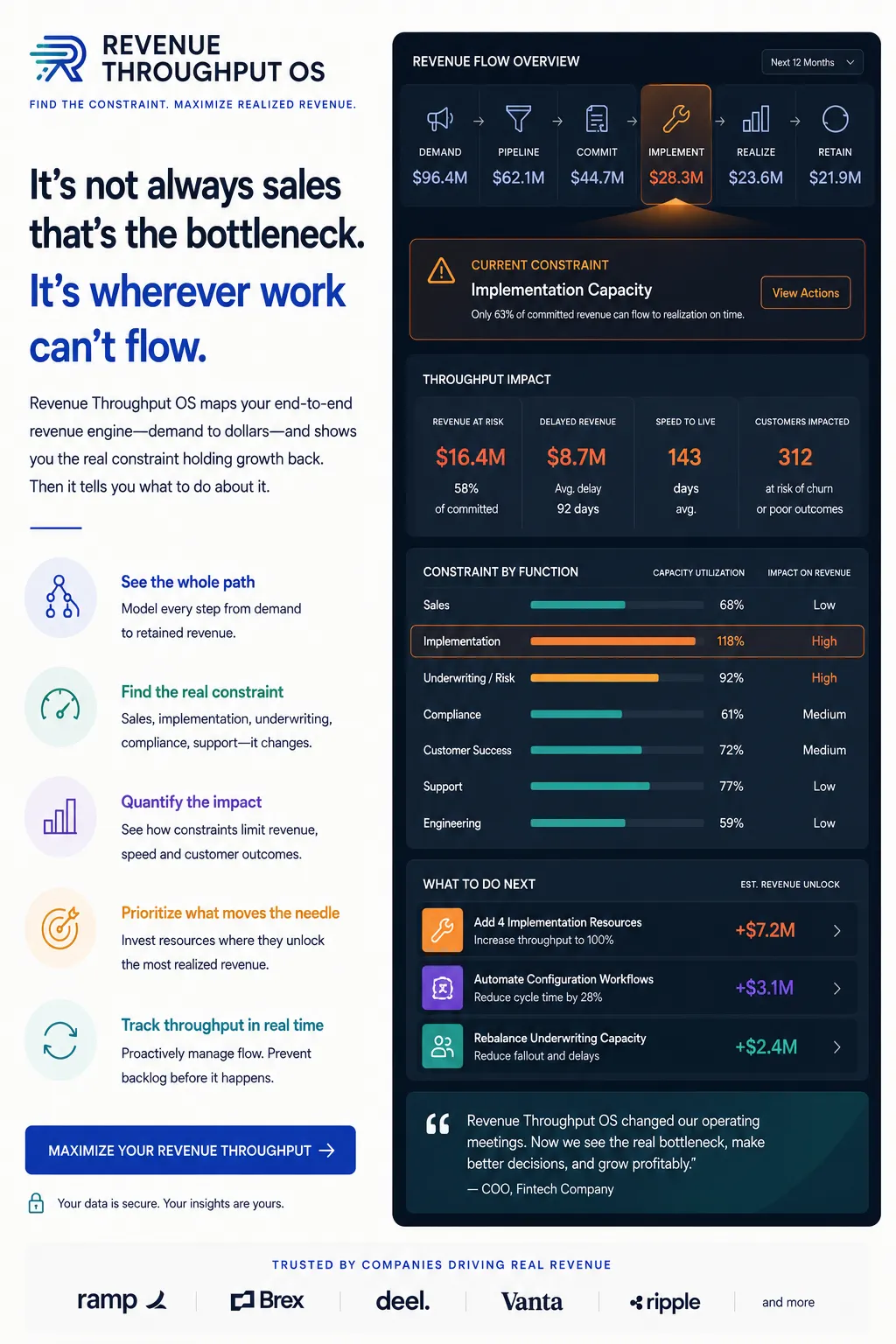
model the entire path from demand to recognized, retained revenue and identify the real constraint at any moment. Sometimes it is sales. Sometimes implementation. Sometimes underwriting, compliance, onboarding, support or engineering. Revenue Throughput OS would continuously model capacity across those functions and tell leadership where adding another dollar of demand actually creates revenue versus backlog. Example: a company thinks it needs ten more reps. The system shows sales already produces 30% more demand than implementation can absorb, and that three deployment hires would create more realized revenue than ten sales hires.
Description
No additional description provided.
The Pitch
Revenue Throughput OS is that it treats revenue as a production system rather than a scoreboard. Most companies manage pipeline, bookings, headcount, and churn as separate facts, then argue about them in meetings after the constraint has already moved. But revenue is not created when a deal is signed; it is created when demand survives every internal handoff and becomes something a customer adopts, pays for, and keeps. The company that can see that full path clearly has a different kind of operating advantage: it stops optimizing the loudest function and starts optimizing the binding constraint.
This matters because modern companies have made go-to-market systems far more complex than their management tools admit. A dollar of new demand can be cheap or expensive depending not only on CAC, but on whether security review is overloaded, customer success is understaffed, integrations are fragile, legal approvals are slow, or product gaps create silent implementation debt. The non-obvious insight is that many “growth problems” are actually translation problems: the organization cannot translate sold intent into durable revenue fast enough. A system that reveals this would often make the best next investment look embarrassingly unglamorous, which is precisely why it would be valuable.
The business would also be compelling because the buyer already feels the pain, but usually lacks a neutral instrument to resolve it. Sales claims there is not enough pipeline quality, implementation claims sales oversells, finance sees missed forecasts, product sees edge-case requests, and leadership sees a revenue plan drifting out of reach. Today these debates are settled through politics, anecdotes, or whoever owns the most persuasive dashboard. A shared model of throughput would become a management reference point because it changes the argument from “which team is underperforming?” to “where is the system saturated?”
Its strongest wedge is that it connects planning decisions to realized revenue, not departmental efficiency. Companies routinely hire in the place where performance is easiest to measure, not where the next unit of capacity has the highest economic return. That creates a durable opening for software that can say, with evidence, that one compliance analyst, two onboarding specialists, or a reduction in engineering escalations may outperform a larger sales push. In a world where capital, headcount, and patience are all less abundant, the ability to know where growth is actually constrained becomes more than analytical hygiene; it becomes a way to make the company less wasteful and more truthful.