Revenue Bonds for Creator Businesses
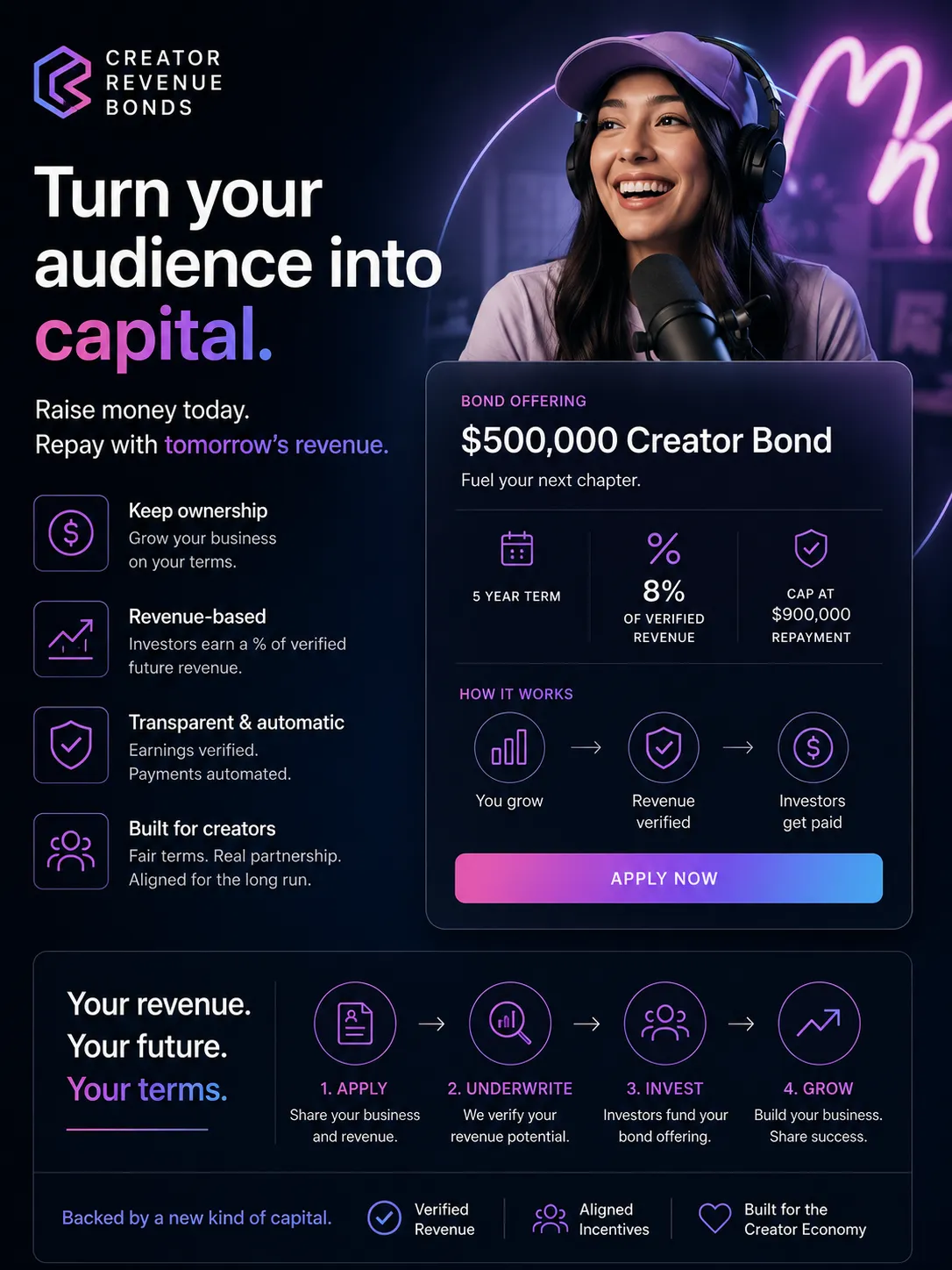
Creators have become businesses, but they still finance themselves like individuals or startups: savings, brand advances, bank loans or equity. Creator Revenue Bonds would let creators raise capital directly against independently verified future earnings. A creator generating $1 million annually could raise $500,000 to launch a product by issuing a five-year bond paying investors 8% of verified creator revenue until $900,000 has been returned, with the platform verifying income and automatically distributing payments. Creator businesses now generate recurring revenue across sponsorships, subscriptions, commerce and licensing, making their cash flows increasingly underwritable. Venture capital financed companies; the creator economy may need a capital market of its own.
Description
No additional description provided.
The Pitch
The creator economy has quietly crossed the line from personality-driven work into cash-flowing media infrastructure, but the financial system still treats it as unstable self-employment. The interesting gap is not that creators need money; it is that many now have revenue profiles more legible than small businesses that routinely get financed. A newsletter, podcast, YouTube channel, or paid community can have years of platform-level earnings data, audience retention, conversion history, and diversified income, yet the owner is still judged through a personal credit score or forced into sponsorship dependency.
The most important insight is that creator income is volatile at the level of any single post, but often patterned at the level of an audience. A creator with a durable niche, repeat sponsors, paid subscribers, and commerce conversions is not selling random content; they are monetizing trust over time. That trust behaves like an asset, even if it does not sit neatly on a balance sheet. A market that can price that asset without requiring the creator to sell ownership would unlock a form of financing better matched to the underlying business.
It also changes the power dynamic between creators and the companies around them. Today, the cheapest capital often comes disguised as distribution, exclusivity, or brand partnership. Creators accept bad economics because cash arrives bundled with access. A transparent revenue-backed instrument separates financing from control. That matters because the most valuable creator businesses are often valuable precisely because they are independent; the audience relationship deteriorates when every decision looks like it was made to satisfy a sponsor, platform, or acquirer.
The business works if verification becomes the trust layer. Investors do not need to understand internet culture in all its nuance if they can rely on clean data, automatic repayment, and standardized terms. Creators do not need to become financial engineers if the platform turns messy multi-source income into something underwritable. The defensible position is less about matching money with creators and more about becoming the ledger where creator earnings are authenticated, normalized, and converted into investable cash flows.
The larger opportunity is that this could create a new category of capital for people whose businesses are too small, personal, or unconventional for traditional finance but too profitable to justify selling equity. The best creators do not necessarily want to become venture-scale companies. Many want to stay independent, build assets, and compound audience trust. A financial product that respects that ambition would not just fund creators; it would acknowledge that a modern media business can be built around a person without being limited to personal finance.