Reusable Data Mapping Knowledge Platform
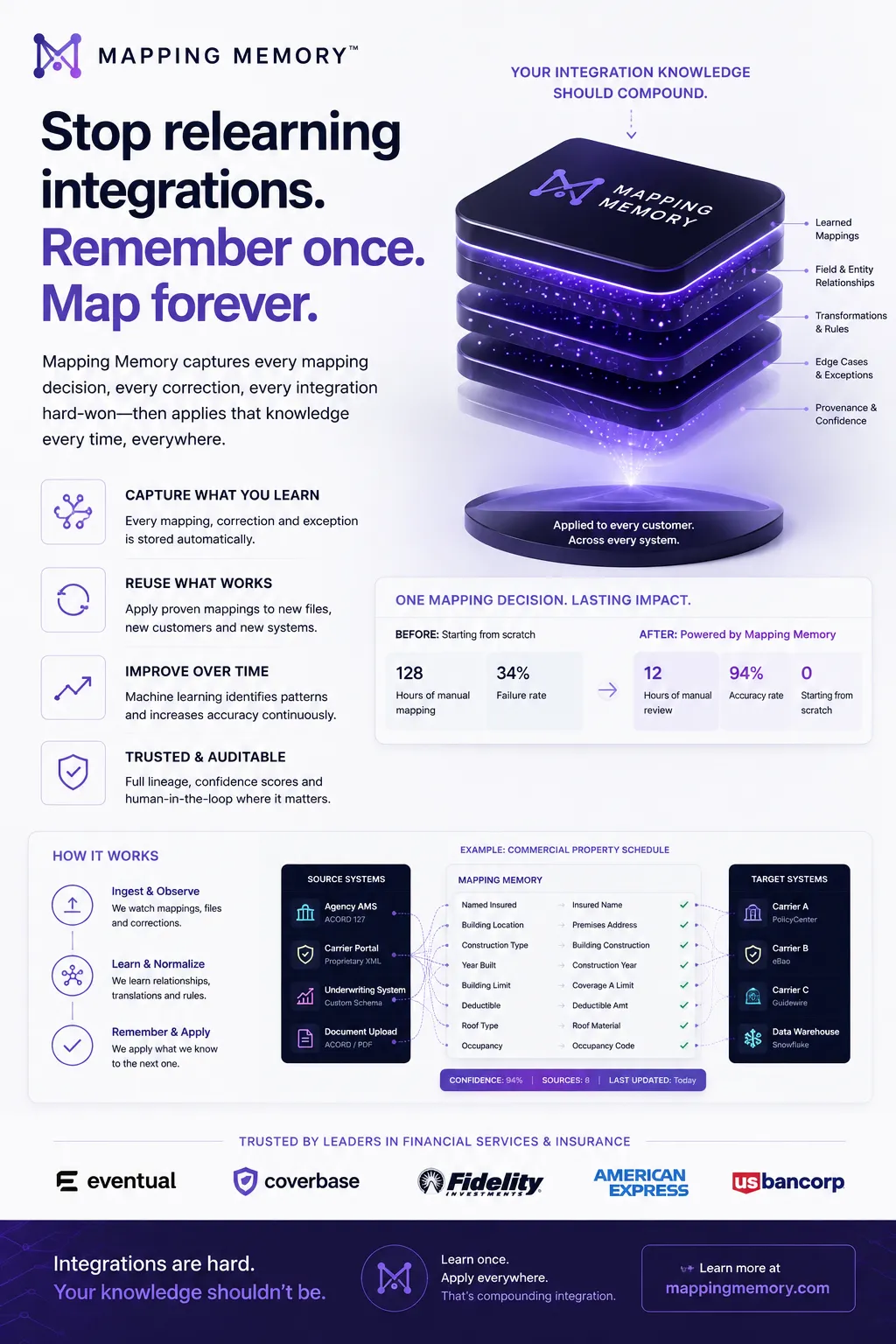
Every integration team keeps relearning the same translation problem: what this field, document, relationship or entity means in System A versus System B. Mapping Memory captures those corrections once and turns them into reusable mapping knowledge that improves across customers and systems. Why now: decades of industry standardization have not eliminated custom schemas and edge cases, while AI can finally learn from historical mapping decisions instead of forcing teams to encode every rule manually. Example: after learning how one AMS maps commercial-property schedules into several carrier formats, the next customer using that AMS inherits the mappings rather than rebuilding them from scratch.
Description
No additional description provided.
The Pitch
Integrations are full of knowledge that is valuable but currently evaporates. The hard part of connecting systems is rarely the pipe; it is the accumulated judgment about what two organizations meant when they named, nested, split, merged, or repurposed data. Today that judgment lives in tickets, spreadsheets, consultants’ heads, and one-off scripts. The moment the project ends, the most reusable part of the work becomes the least reusable asset.
The unusually attractive feature is that mapping knowledge has network effects without needing all customers to use the same software. Most data-network businesses depend on standardization; this one benefits from the failure of standardization. Every weird legacy field, every carrier-specific requirement, every local exception becomes training material. The mess is not a temporary obstacle to be cleaned up before the business works. The mess is the raw material.
There is also a strong asymmetry in the value of a correction. A single resolved ambiguity may take a human hours to understand the first time, but can be applied instantly the next hundred times a similar pattern appears. That creates a business where small units of expert labor can compound. Unlike generic automation, which often struggles when the edge cases matter, this becomes more useful precisely where the work is most tedious, specialized, and expensive.
The best customers would not just be buying speed; they would be buying continuity across an industry that constantly changes vendors, systems, and formats. When a company switches platforms or adds a new partner, it usually loses the institutional memory embedded in its prior integrations. Mapping Memory would make that memory portable. Over time, the defensible asset is not a connector library, but a living semantic layer for how an industry’s systems actually interpret the world.
What makes the idea especially interesting is that it turns a service-heavy category into an accumulating knowledge business. Traditional integration firms get paid because the same confusion keeps recurring. This company would get stronger because the same confusion keeps recurring. That inversion matters: the more fragmented and idiosyncratic the market remains, the more valuable the memory becomes.