Repurposing Ideas App for Household Items
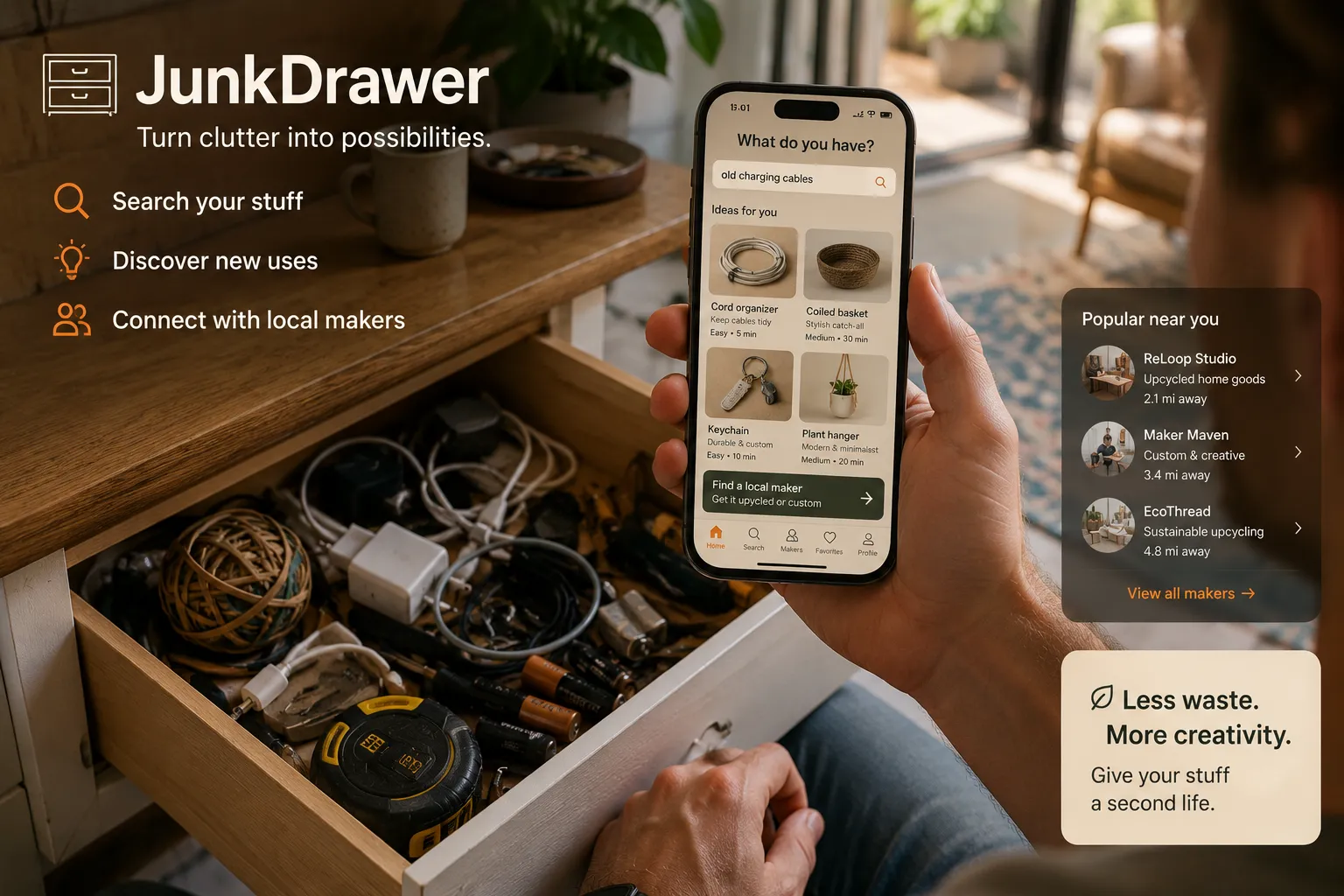
Almost everyone owns boxes of cables, old electronics, tools, leftover materials, and random household items they can't bring themselves to throw away because they feel like they might be useful someday. Unfortunately, discovering practical ways to repurpose them usually requires hours of searching through blogs and YouTube videos. Junk Drawer is a searchable database that recommends practical alternative uses for everyday objects while also connecting users with local makers who can transform those materials into finished products. Every suggestion is categorized by difficulty, required time, additional supplies, and whether you can do it yourself or hire someone nearby. As sustainability becomes more important and maker communities continue growing, consumers are increasingly interested in extending the life of products instead of discarding them. Instead of throwing away a box of old charging cables, the app suggests five practical projects, identifies the easiest one that takes under ten minutes, or introduces you to someone nearby who can repurpose them for you.
Description
No additional description provided.
The Pitch
This would be compelling because it turns a strangely universal form of household guilt into a usable asset. Most people do not see their clutter as trash; they see it as unresolved potential. That emotional distinction matters. The object is not being kept because it has value today, but because discarding it feels like closing off a future use that might have existed. A company that can reliably surface that future use is not merely organizing information; it is converting latent value into action.
The more interesting insight is that reuse usually fails at the moment of imagination, not execution. People are often willing to spend ten minutes fixing, adapting, or donating something, but they are rarely willing to do the research required to find the right idea. The internet contains endless reuse content, yet it is organized around creators, not objects. Someone with an old router, a bent baking sheet, or half a bag of grout does not want inspiration in general; they want to know what this specific thing can become. Object-first search is a more natural interface for household decision-making.
It also benefits from the fact that usefulness is highly local. A spare cabinet door may be worthless to one person and exactly what a nearby hobbyist, repair person, teacher, artist, or landlord needs. Marketplaces usually ask users to know what they are selling; this starts with what they have and helps discover who might value it. That shifts the experience from “list my junk” to “find the hidden demand for this object,” which is a much lower-friction behavior for ordinary households.
The business could become stronger over time because the knowledge base would compound in a way generic search does not. Every object, project, successful handoff, failed attempt, and local maker interaction teaches the system what is actually practical, not just what is theoretically possible. The rare and valuable dataset is not a catalog of DIY ideas; it is a map of which neglected household objects can be turned into outcomes people genuinely want.
At its best, the company would make sustainability feel less like sacrifice and more like cleverness. People love the feeling of getting one more use out of something they nearly threw away. If that feeling can be made repeatable, convenient, and social, the junk drawer stops being a symbol of procrastination and becomes a small inventory of possibilities.