Regulatory Risk Insurance for Emerging Industries
Prediction markets can tell you whether people think a regulation will happen. They don't compensate the company that loses $40 million if it does. Regulatory Exposure Contracts would let businesses insure specific operational consequences of rules that don't exist yet. A drone company could purchase a contract paying if regulators require human operators; an AI company could hedge against mandatory inference logging; a pharmaceutical platform could hedge against a new approval requirement. As companies increasingly build businesses before governments decide the rules governing them, regulatory uncertainty becomes something businesses can transfer rather than simply endure.
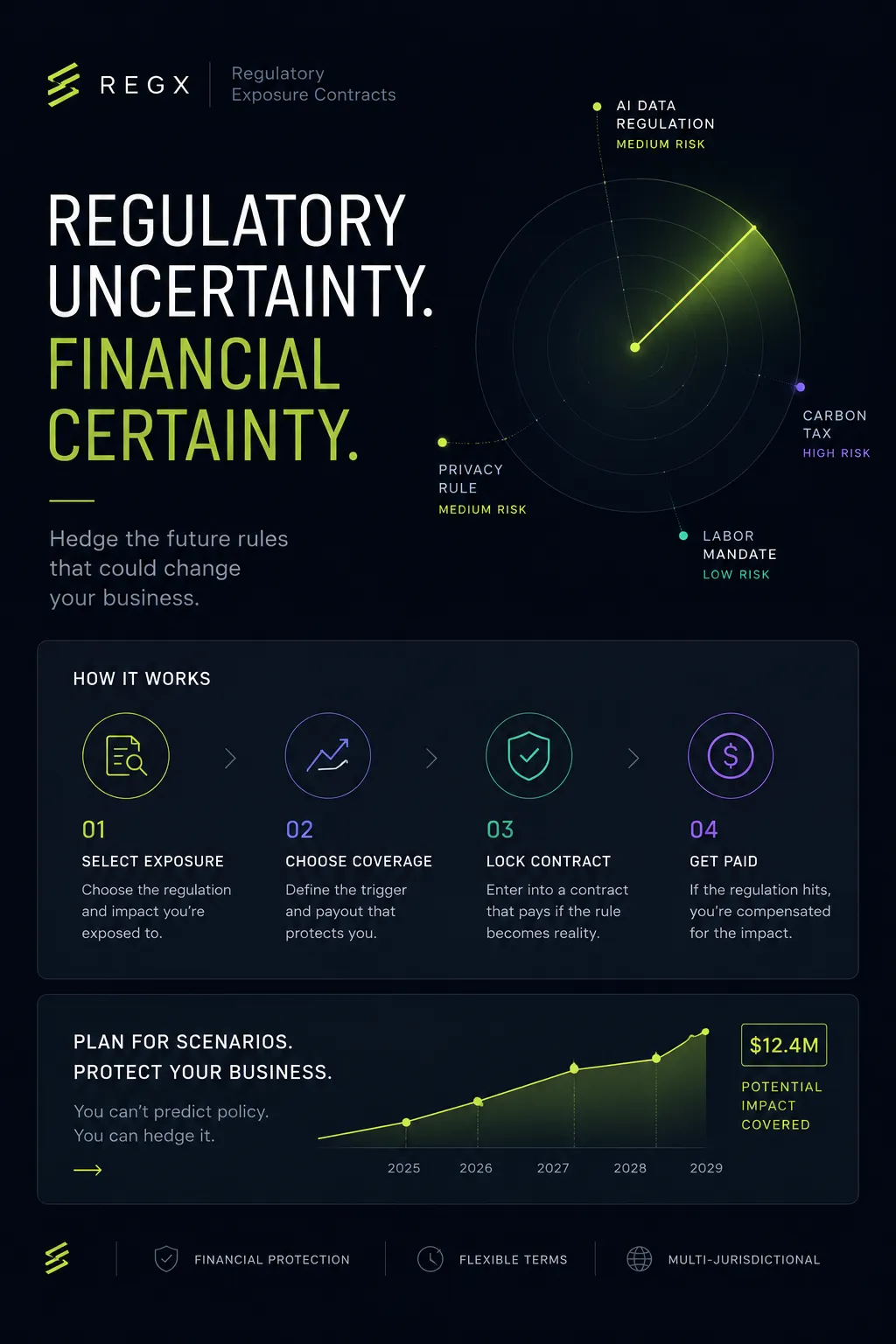
Description
No additional description provided.
The Pitch
A business built around regulatory exposure works because regulation is no longer a slow externality that arrives after markets mature. In many frontier sectors, the business is being built at the same time as the law is being invented. That creates a peculiar kind of risk: not that demand disappears, or a factory burns down, but that a single sentence in a rulemaking converts a profitable operating model into a structurally worse one. Traditional insurance is comfortable with accidents; it is much less comfortable with policy choices that have measurable commercial consequences.
The compelling insight is that many regulatory risks are not vague political anxieties. They can be expressed as very specific operational triggers. “If autonomous drones must maintain one remote pilot per aircraft” is not a philosophical question about aviation policy; it is a labor-cost shock. “If model providers must retain inference logs for seven years” is not merely an AI governance debate; it is an infrastructure, privacy, and liability burden. Once a rule can be translated into an observable business consequence, it starts to look less like unknowable uncertainty and more like a contractable event.
This would also create a new kind of market signal. Prediction markets reveal what outsiders think will happen, but regulatory exposure contracts would reveal what the affected companies are willing to pay to survive the outcome. That distinction matters. A low-probability rule can still command a high hedge price if it destroys margin or invalidates a strategy. Over time, the market would not just price the chance of regulation; it would price the fragility of different business models under regulation.
The strongest version of the business would become valuable because it sits between industries that understand their own operational exposure and capital markets that are good at absorbing priced risk. Today, companies often respond to regulatory uncertainty by lobbying harder, slowing expansion, or carrying hidden contingency costs. A contract that pays when a specific rule lands changes the managerial posture: a company can keep building while knowing which version of the future it has offloaded.
The deeper reason this should exist is that modern companies are increasingly making irreversible bets inside unfinished legal systems. When law lags technology, the gap becomes a balance-sheet problem. A market that converts that gap into a tradable exposure would not eliminate regulatory risk, but it would make it legible, comparable, and survivable.